


AI workloads are accelerating data center growth, increasing the number of vendors, contractors, and third parties requiring controlled facility access. As facilities scale, the risk is no longer limited to an unknown person attempting to enter a building.
Modern data centers regularly manage access for:
- Third-party maintenance technicians working on critical equipment
- Contractors supporting upgrades, installations, and repairs
- Colocation customers accessing dedicated infrastructure
- Auditors reviewing compliance controls
- Delivery teams handling hardware and supplies
- Visitors joining facility tours or business meetings
The real enterprise security management question is not just “Who entered the facility?”
It is: Was the visitor verified, approved for the specific task, restricted to the right area, monitored during the visit, and automatically removed from access once the visit ended?
In 2027, the visitor management system is becoming a core layer of data center security, integrating identity verification, access control, real-time monitoring, and audit records rather than serving as a simple visitor sign-in process.
What Are the Essential Visitor Management Security Requirements for Data Centers?
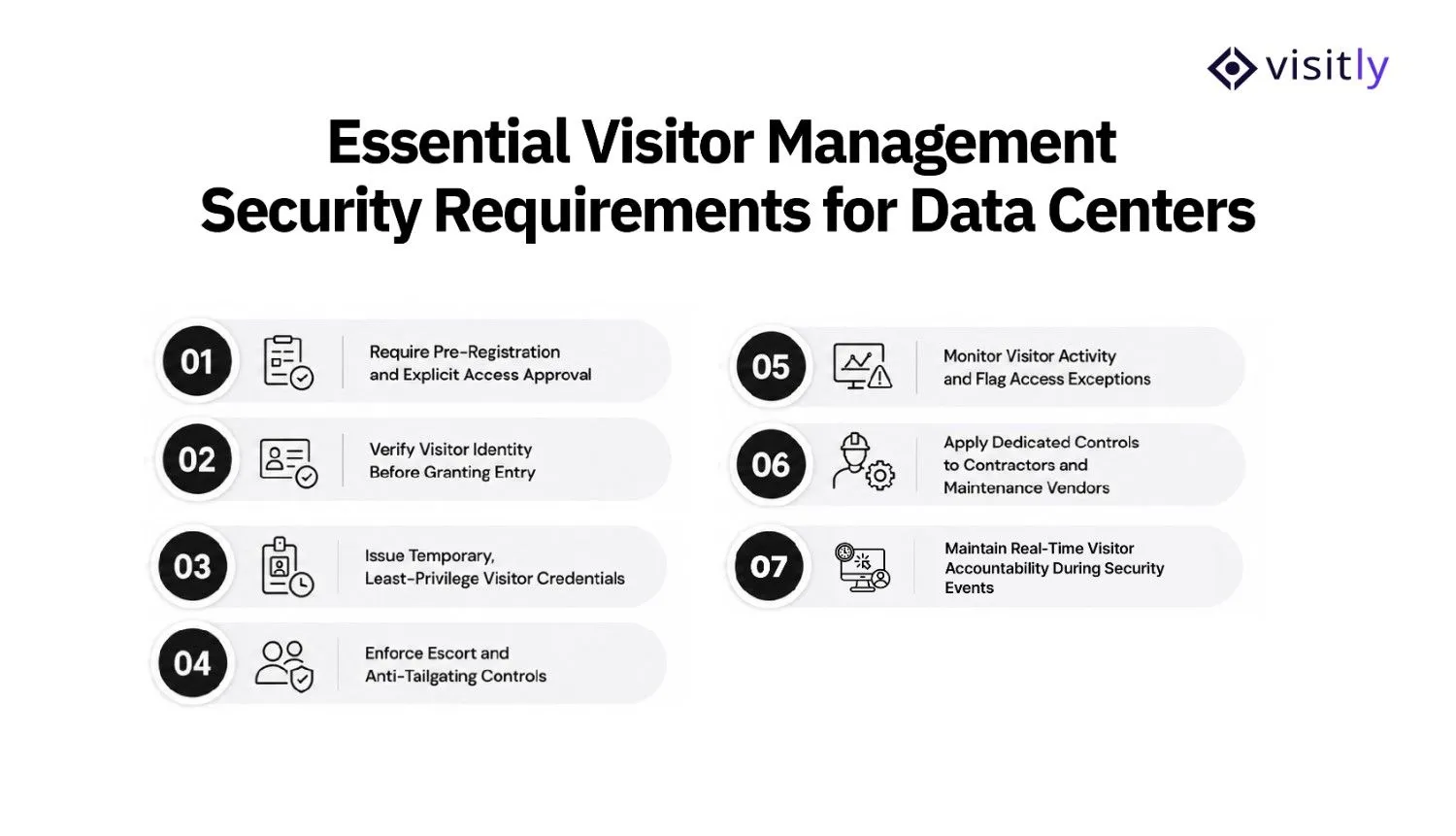
The essential visitor management security requirements for data centers are:
1. Require Pre-Registration and Explicit Access Approval
2. Verify Visitor Identity Before Granting Entry
3. Issue Temporary, Least-Privilege Visitor Credentials
4. Enforce Escort and Anti-Tailgating Controls
5. Monitor Visitor Activity and Flag Access Exceptions
6. Apply Dedicated Controls to Contractors and Maintenance Vendors
7. Maintain Real-Time Visitor Accountability During Security Events
With more third-party access, remote hands support, maintenance activities, and compliance requirements, organizations need a visitor management process that controls who enters, why they enter, where they can go, and when their access ends.
A secure data center visitor management approach should combine identity verification, approval workflows, access restrictions, monitoring, and audit-ready records.
The following requirements help security teams reduce unauthorized access risks while maintaining operational efficiency.
1. Require Pre-Registration and Explicit Access Approval Before Arrival
A secure visitor process starts before the person reaches the facility. Allowing visitors to arrive first and verify details later creates unnecessary security gaps, especially when dealing with contractors, vendors, and external technicians who require access to critical infrastructure.
Before granting access, data centers should capture and verify:
- Visitor name and organization
- Host or internal sponsor responsible for the visit
- Business purpose or reason for access
- Requested visit date and time
- Facility, building, or security zone being accessed
- Contractor work order, maintenance request, or service purpose where applicable
- Required approvals based on visitor type and access level
For sensitive areas such as server rooms, cages, or restricted data halls, approval should happen before any visitor credential is activated. Organizations should also require acceptance of security standards, confidentiality agreements, or NDAs before granting physical access.
Microsoft’s data center security approach follows a similar model, requiring identity verification, approved access requests, management authorization, and temporary access credentials before visitors can enter controlled areas.
2. Verify Visitor Identity Before Granting Entry
Knowing who is entering a data center is the foundation of physical security. A visitor badge alone does not confirm identity. Security teams need confidence that the person arriving matches the approved visitor record.
Modern data center visitor verification should include:
- Government-issued ID verification
- ID scanning and validation
- Visitor photo capture or identity matching
- Screening against internal watchlists or denied-entry records where applicable
- Risk-based verification requirements depending on visitor type
- Additional verification for contractors or recurring vendors
Not every visitor carries the same level of risk. A scheduled customer tour, a third-party technician working near critical systems, and an emergency maintenance vendor may require different verification workflows.
For high-security environments, organizations should avoid assuming that previous access automatically equals trusted access. Contractor identities, permissions, and approvals should be reviewed regularly.
3. Issue Temporary, Least-Privilege Visitor Credentials
A visitor should never receive more access than required for the approved task. Data centers should follow the principle of least privilege by issuing temporary credentials that are limited by location, purpose, and duration.
Visitor credentials should be:
- Unique to each visitor
- Clearly distinguishable from employee badges
- Restricted based on:
- Facility location
- Floor or building
- Data hall
- Cage or approved work area
- Approved access timeframe
- Automatically expire after the visit window ends
- Immediately revoked after checkout, cancellation, or security concerns
Shared visitor badges or reusable credentials create accountability gaps because security teams cannot accurately determine who accessed a restricted area.
4. Enforce Escort Rules and Prevent Tailgating Risks
Even after approval and identity verification, some visitors should not move freely throughout a data center. Escort requirements help maintain accountability, especially for sensitive areas containing critical infrastructure.
Data centers should define clear escort policies based on visitor risk, including:
- Which visitor categories require continuous escort
- Which areas allow independent movement
- Who is responsible for escorting the visitor
- When escort verification is required
- How security teams handle unauthorized movement
Additional controls should include:
- Mantraps or access-control vestibules for restricted entrances
- Anti-tailgating measures to prevent unauthorized individuals from following authorized users
- Clear visual distinction between visitor and employee credentials
- Monitoring of visitor movement through controlled zones
NIST physical access control guidance highlights visitor escorting and controlled entry mechanisms as important measures for preventing unauthorized access through secure entry points.
5. Monitor Visitor Activity and Identify Access Exceptions in Real Time
Visitor management should not end after check-in. Security teams need visibility throughout the entire visit lifecycle.
A modern data center visitor security platform should help teams:
- Track who is currently on-site
- Monitor check-in and checkout activity
- Identify attempted access to unauthorized areas
- Detect unusual visitor behavior
- Generate alerts when:
- A visitor repeatedly attempts restricted access
- A visitor enters the wrong zone
- A visitor remains on-site after the approved timeframe
- A visitor fails to complete checkout
Connecting a digital visitor management platform with physical access control systems (PACS), surveillance tools, and security alerts creates a more complete view of visitor activity.
NIST recommends monitoring physical access events and reviewing access records for unusual timing, abnormal duration, or unexpected activity patterns.
6. Apply Dedicated Controls for Contractors and Maintenance Vendors
Contractors represent one of the most common visitor categories in data centers because facilities require regular maintenance, hardware replacement, installations, and technical support.
However, recurring access should not become unrestricted access.
Data centers should control contractor access by:
- Linking access approval to a specific maintenance window
- Recording work orders or service requirements
- Limiting access to only the required equipment or location
- Capturing required safety and security acknowledgements
- Reviewing recurring contractor permissions regularly
- Automatically removing access when the approved work period ends
A technician replacing equipment in one data hall should not automatically have access to unrelated areas. Contractor permissions should always match the exact business need.
7. Maintain Real-Time Visitor Accountability During Security Events
During a security event, knowing exactly who is inside the facility can become critical. Visitor management software should provide an accurate, real-time view of all visitors, contractors, and external personnel currently on-site.
Security operations teams can identify:
- Current visitors inside the facility
- Their host or responsible employee
- Approved access locations
- Check-in time and expected departure time
- Whether they have completed checkout
This visibility is especially important during:
- Fire evacuations
- Power incidents
- Security lockdowns
- Emergency response situations
What Must a Data Center Visitor Log Capture?
A complete visitor log should provide enough detail to answer key security questions:
- Who accessed the facility?
- Why were they granted access?
- Who approved the visit?
- Which areas could they enter?
- When did they arrive and leave?
- Were there any access exceptions?
According to NIST PE-8 (Visitor Access Records), organizations should maintain and review visitor records containing details such as visitor identity, organization, purpose of visit, access dates, entry and departure times, and the person responsible for the visit.
A secure data center visitor log should capture:
Common Data Center Visitor Security Challenges
Data centers handle access from employees, contractors, vendors, customers, and maintenance teams. Without a structured visitor security process, managing these different access requirements can create visibility gaps and increase the risk of unauthorized entry.
Common challenges include:
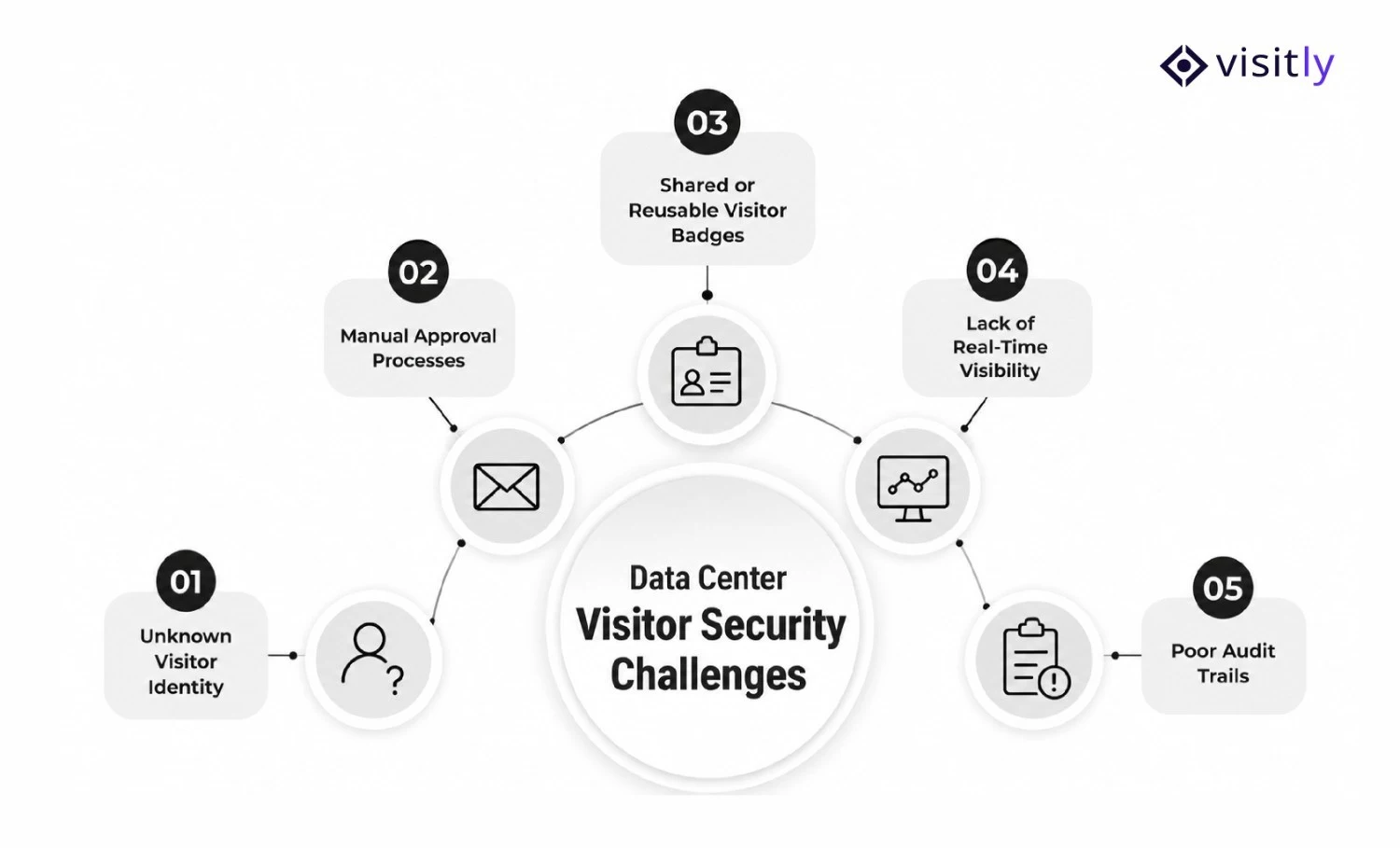
1. Unknown Visitor Identity
Allowing visitors to enter without proper identity verification creates uncertainty about who is accessing critical infrastructure. A name on a sign-in sheet or a manually issued badge does not provide enough confidence that the person entering matches the approved visitor record.
2. Manual Approval Processes
Traditional approval methods, such as emails or spreadsheets, can slow down access requests and make it difficult to track who approved a visit, why access was granted, and whether the request followed security policies.
3. Shared or Reusable Visitor Badges
Shared visitor credentials reduce accountability because security teams cannot accurately determine who used a badge or accessed a restricted area. Temporary, visitor-specific credentials help maintain a clear access history.
4. Lack of Real-Time Visibility
Security teams need to know who is currently inside the facility, where visitors are authorized to go, and whether anyone exceeds their approved access period. Without real-time visibility, responding to security incidents becomes more difficult.
5. Poor Audit Trails
Incomplete visitor records can create challenges during compliance reviews and security investigations. Data centers need searchable records that capture visitor details, approvals, access activity, and checkout information.
Is Your Current Data Center Visitor Security Process Strong Enough?
A data center visitor security process should be tested regularly to identify gaps before they become access risks. Use the following checklist to evaluate whether your current visitor management approach provides enough control, visibility, and accountability.
What Should You Require From a Data Center Visitor Management System?
A data center visitor management system should do more than replace a paper sign-in sheet. It should help security teams control every stage of visitor access, from approval before arrival to credential removal after departure.
Before selecting a solution, a secure visitor workflow should evaluate whether the system can handle real-world access scenarios:
- Before arrival: Can the system prevent visitor credentials from being issued until the required approvals are completed?
- At check-in: Can it verify visitor identity through ID scanning, verification workflows, or screening checks?
- For different visitor types: Can it apply separate workflows for contractors, vendors, auditors, customers, and temporary visitors?
- During access: Can it restrict entry based on approved locations, security zones, and time windows?
- During security events: Can it flag denied visitors, unusual access attempts, or restricted individuals?
- For compliance: Can it maintain searchable visitor histories and provide audit-ready access records?
- Across locations: Can it standardize visitor security policies across multiple data centers?
- After completion: Can it automatically revoke temporary access once the approved visit ends?
The right system should connect visitor identity, physical access control, contractor workflows, and audit records into one controlled visitor security workflow.
Platforms like Visitly support this approach through features such as ID verification, visitor screening, contractor management, watchlist checks, real-time visitor visibility, and digital visitor records, helping organizations maintain stronger control over facility access.
How Visitly Helps Strengthen Data Center Visitor Security
Visitly helps data center teams move from manual visitor handling to a structured security workflow that improves control, accountability, and compliance. By managing visitor access from pre-registration to checkout, Visitly helps organizations reduce security risks and maintain better visibility across facility access.
The platform helps data centers:
- Reduce unauthorized access risks through visitor pre-registration, approval workflows, ID verification, and security screening before granting facility access.
- Improve audit readiness with digital visitor records, access histories, and audit trails that provide clear visibility into who entered, why access was granted, and when visitors checked out.
- Simplify contractor and vendor oversight with dedicated workflows for managing third-party access, screening requirements, approvals, and temporary credentials.
- Increase visibility during security incidents by providing real-time visitor tracking, host notifications, and accurate records of everyone currently inside the facility.
- Strengthen access control processes by connecting visitor management workflows with existing workplace security systems and policies.
- Create a smoother visitor experience with secure digital check-in options that reduce manual processes without compromising security.
Closing Thoughts
Secure data center visitor management is not about simply recording who entered a facility. It is about proving who they were, why they were authorized, where they were allowed to go, what happened during their visit, and when their access was removed.
As data centers continue handling more critical infrastructure, third-party access, and compliance requirements, visitor security must become a controlled, traceable process rather than a manual check-in activity.
With identity verification, contractor workflows, real-time visitor visibility, and audit-ready records, Visitly helps organizations build a stronger physical security layer for their data centers.
Protect your critical infrastructure with smarter visitor management. Start securing every visitor entry, access decision, and audit record with Visitly today.
Schedule a Visitly demo today.
FAQs
1. What is data center visitor management security?
Data center visitor management security is the process of controlling, verifying, monitoring, and recording visitor access to protect critical infrastructure from unauthorized physical access.
2. Why is visitor management important for data center security?
Visitor management helps data centers verify identities, control access permissions, maintain audit trails, manage contractors, and ensure only authorized individuals enter sensitive areas.
3. What should a data center visitor log include?
A data center visitor log should include visitor identity, organization, approval details, visit purpose, check-in and checkout times, assigned credentials, access areas, and security exceptions.
4. How do data centers manage contractor access securely?
Data centers manage contractor access by using pre-approval workflows, identity verification, temporary credentials, restricted zone access, escort policies, and automatic access removal after completed work.
5. What features should a data center visitor management system have?
A data center visitor management system should include identity verification, visitor pre-registration, access control integration, contractor workflows, real-time visitor tracking, digital logs, and audit reporting.