


Visitor management is undergoing a transformation that few could have predicted a decade ago. Hence, an AI visitor management system is no longer just a futuristic concept but a core enabler of workplace security and efficiency.
Today’s front desk is becoming intelligent, powered by artificial intelligence, learning algorithms, and automation systems that operate in real time.
Here’s why this shift matters:
- Manual visitor check-ins take 3–5 minutes per person, adding up to hours of lost productivity weekly.
- 68% of organizations admit they struggle to track on-site visitors accurately for compliance.
Businesses today face a new set of challenges: hybrid workforces, stricter compliance regulations, elevated security concerns, and a growing demand for seamless experiences. This is why businesses are shifting toward an automated front desk powered by AI, reducing delays while enhancing both security and experience.
Let’s explore how AI is reshaping this space and what lies ahead.
Why Traditional Visitor Management No Longer Meets Modern Needs
The clipboard-and-pen model of visitor tracking is outdated, and even digital sign-in kiosks from a few years ago no longer cut it. Even traditional kiosks can’t keep up with evolving demands, making the shift to an automated front desk essential for scaling compliance and security.
Thus, organizations need more than a simple name log, they need a system that understands context, adapts to risk levels, and integrates seamlessly with broader workplace systems.
Here’s what’s broken:
- Security gaps: Anyone can write a false name and gain access without validation.
- Compliance blind spots: Regulatory bodies require detailed logs, NDAs, and safety protocols. Manual systems don’t offer audit-ready reports.
- Visitor experience: Long queues and repetitive forms frustrate guests and waste employee time.
- Remote oversight: Facilities teams need visibility across multiple locations, manual systems don’t scale.
The workplace is changing, and visitor management must evolve with it. This is where artificial intelligence comes in.
AI Visitor Management System: How It Works and What It Solves
Artificial Intelligence in visitor management does more than automate check-ins. It brings intelligence to every touchpoint, from recognizing a returning guest to detecting unusual behavior or issuing real-time alerts.
Key capabilities include:
- Facial recognition: Streamline visitor check-ins and boost workplace safety with AI-powered systems that use facial recognition for fast, secure identification.
- Natural language processing: Powers chatbots that assist guests in real time or guide them through processes.
- Machine learning: Learns patterns such as peak entry times and adjusts resource allocation or sends notifications accordingly.
- Predictive analytics: Helps facility managers forecast visitor volumes or anticipate compliance issues.
The real value lies in the system’s ability to adapt. AI enables dynamic decision-making, which makes visitor management proactive rather than reactive.
How Is AI Redefining the Future of Visitor Management?
AI is transforming visitor management by integrating smart, automated features that enhance security, efficiency, and the overall guest experience. From instant identity verification and facial recognition to real-time alerts and predictive analytics, these innovations streamline check-ins, reduce human error, and ensure compliance.
Together, they are shaping the future of workplaces where safety, convenience, and intelligence go hand in hand.
Let’s take a closer look at the specific innovations driving this transformation.
1. Facial Recognition and Biometric Authentication
AI-powered facial recognition allows instant check-ins without physical contact or even pulling out a phone. Cameras placed at entrances match faces with pre-registered profiles or previously captured data.
Benefits:
- Reduces check-in time to under 3 seconds.
- Prevents unauthorized access via badge misuse or impersonation.
- Adds a layer of two-factor security when paired with digital ID verification.
2. Smart Pre-Registration and Scheduling
AI tools can predict visitor trends based on past data and dynamically allocate time slots or entry windows. They can also personalize the visitor experience based on role (e.g., vendor, contractor, executive guest).
Use Cases:
- Auto-scheduling visits during low-traffic hours.
- Pre-filled digital forms and fast-track access for known visitors.
- Smart routing: directing guests to specific doors or lobbies based on department visits.
3. Automated Compliance & Health Screening
Since the pandemic, health screenings and regulatory compliance have become standard. AI handles these steps intelligently.
Capabilities:
- Dynamic questionnaires based on visitor type or risk factors.
- Thermal cameras connected to AI flag individuals with elevated temperatures.
- Auto-flagging of incomplete forms or failed health screenings before entry.
It reduces human error and creates a secure audit trail.
4. Risk Detection and Real-Time Security Alerts
AI continuously monitors behavior through the access control system and connected cameras, triggering alerts if someone attempts unauthorized entry or tailgating. If someone bypasses a checkpoint or lingers too long in a restricted zone, the system can raise an alert and notify security in real time.
Example:
- If a guest signs in but doesn’t show up on connected camera feeds, the system can trigger an anomaly alert.
- AI can identify suspicious repeat visitors or flag tailgating events.
This kind of situational awareness strengthens workplace safety.
5. Voice and Chatbot Interfaces
Touchless visitor check-ins are gaining traction. Visitors can speak commands or chat with an AI assistant to register, sign documents, or request directions.
Why It Matters:
- Reduces friction for first-time guests.
- Ideal for multi-language or accessibility-focused environments.
- Works well in high-traffic environments where speed is essential.
This is a perfect example of how an AI front desk can handle guest interactions more efficiently than traditional reception models.
6. Predictive Dashboards and Smart Analytics
Data from AI-powered dashboards provides insights that strengthen security and compliance across all visitor interactions. This aligns with broader AI trends in visitor management systems, where data-driven intelligence replaces guesswork and enables proactive facility planning.
Features:
- Identify peak traffic hours and adjust staffing accordingly.
- Monitor which departments receive the most visitors.
- Forecast upcoming compliance renewals or policy expirations.
It turns raw data into strategic insight, empowering facility managers to make better decisions.
AI Trends in Visitor Management Systems: What’s Coming Next
As AI technologies evolve, visitor management systems are set to become even more advanced, personalized, and autonomous.
Here’s what’s on the horizon:
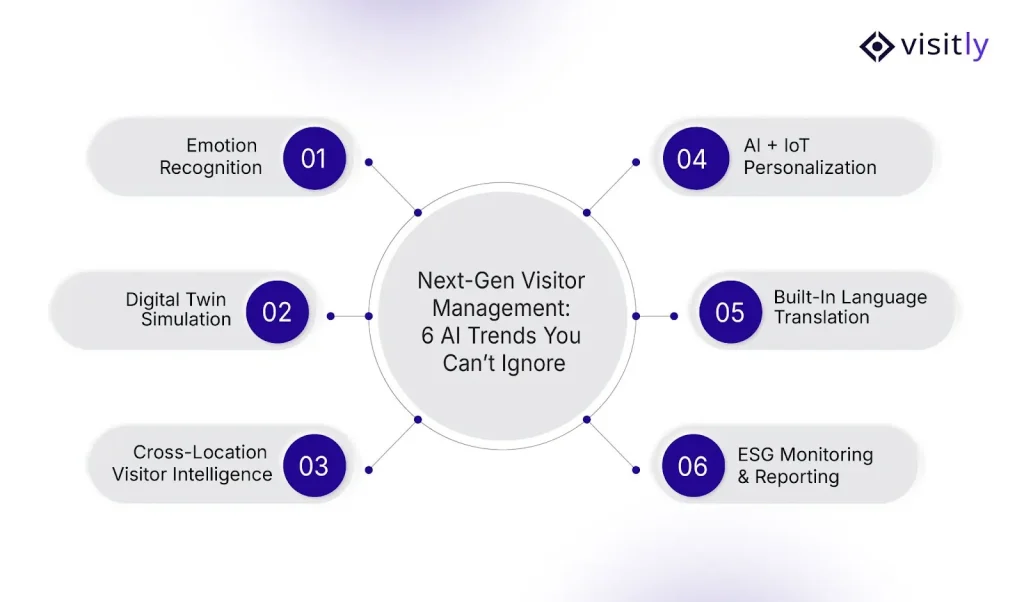
1. Emotion Recognition
AI will soon detect visitor sentiment through facial cues or tone of voice. This can enhance security (by identifying agitation or distress) or improve customer service.
Example:
- Calm demeanor = standard check-in.
- Nervous behavior = triggers secondary screening or human intervention.
2. Digital Twin Simulation
Digital twin technology will allow organizations to simulate entire visitor journeys and identify inefficiencies or risks before they occur.
It can test what happens if a lobby gets overcrowded or a new policy delays entry.
3. Cross-Location Visitor Intelligence
A visitor who checks into one office can be recognized at another without starting from scratch. AI syncs profiles, permissions, and compliance across locations.
Ideal for:
- Enterprises with multiple campuses.
- Contractors or vendors with rotating schedules.
4. AI + IoT: Environment-Based Personalization
Imagine a visitor steps inside, and the room adjusts lighting, elevator access, and air temperature based on their profile.
AI can connect with IoT systems to create contextual, personalized experiences.
5. Built-In Language Translation
AI will soon enable dynamic translation of visitor messages, instructions, and check-in flows. It eliminates confusion for international guests and improves accessibility.
6. ESG Monitoring and Reporting
Visitor data contributes to an organization’s carbon footprint. AI can help measure and optimize environmental impact such as emissions from deliveries or transport.
Sustainability will be a key pillar of AI-powered visitor platforms.
Challenges Ahead: Bias, Privacy, and Dependence
Despite the advantages, AI in visitor management isn’t without concerns. These challenges highlight the need for careful implementation, strong ethical standards, and continuous monitoring to avoid unintended harm. Without proactive measures, organizations risk eroding trust among employees and visitors.
The following are some of the key challenges:
1. Facial Recognition Bias
Facial recognition tools have historically shown inconsistencies across races and genders. Organizations must ensure systems are trained on diverse datasets to minimize risk.
2. Data Privacy and Consent
AI systems store biometric and behavioral data, which must be protected. Visitors should have the ability to opt out or use alternate check-in methods.
Vendors need to meet global privacy standards like GDPR, HIPAA, and SOC 2.
3. Over-Reliance on Automation
Fully automated systems must include human oversight. There should always be an option to escalate to a human receptionist or facility manager.
AI should enhance, not replace human judgment.
Visitly: The Best Visitor Management System
Visitly is a cloud-based visitor management system that automates check-ins and enhances workplace safety. It streamlines registration, notifications, and compliance for offices and facilities.
Key Features:
- Digital Check-In and Pre-Registration
Visitors can check in quickly using an iPad or QR code, reducing manual paperwork. Hosts can pre-register guests to speed up entry and improve front-desk efficiency.
- Instant Host Notifications
When a visitor arrives, the host is notified instantly via email, SMS, Slack, or Microsoft Teams. This ensures no visitor is left waiting and improves overall communication.
- Customizable Workflows
Organizations can tailor check-in processes with NDA signing, photo capture, badge printing, or ID scanning. This flexibility allows businesses to meet unique security and compliance needs.
- Emergency Evacuation Management
Visitly provides real-time visitor and employee logs for quick roll calls during emergencies. This enhances workplace safety by ensuring everyone is accounted for.
- Regulatory Compliance & Security
The system helps organizations stay compliant with standards like GDPR, HIPAA, and SOC 2. Features like watchlist screening and data security protect both businesses and their visitors.
Conclusion: The Future Is Already Here, Now It’s About Adoption
AI in visitor management is transforming workplaces today for many reasons. From tech offices and corporate campuses to hospitals and manufacturing sites, AI-driven platforms are delivering measurable improvements in security, compliance, and efficiency. Organizations that don’t modernize risk falling behind, not just operationally, but in the visitor experience itself. The best part? With AI-powered solutions, you’re not just upgrading your front desk,you’re redefining how people enter and interact with your workplace.
Book a demo with Visitly now to experience the future of visitor management.
FAQ
1. What is AI-based visitor management?
An AI visitor management system uses artificial intelligence to automate and secure check-ins. It removes paperwork, speeds up entry, and creates a smarter visitor experience.
2. Is AI visitor software safe to use in offices?
Yes, reputable platforms follow strict compliance standards and use encryption. This keeps sensitive data safe while meeting workplace security policies.
3. Can AI recognize repeat visitors?
Yes, AI identifies returning visitors through facial recognition or QR profiles. This cuts check-in time and makes guests feel valued.
4. How does an AI visitor management system help with workplace security?
It spots unusual behavior, sends instant alerts, and blocks unauthorized entry. An AI visitor management system integrates with access control systems to strengthen overall protection.
5. Is AI visitor management suitable for small businesses?
Yes, many solutions are scalable and budget-friendly. Small companies can start with basic features and expand as needed.
6. What about people who don’t want their face scanned?
Most systems provide options like QR codes, PINs, or manual sign-ins. Visitors can choose whichever method they prefer.
7. Can AI help with visitor compliance?
Yes, it automates tasks like NDA signing, safety training, and policy acknowledgment. This ensures every visitor follows legal and internal requirements.
8. Is an automated front desk suitable for small businesses?
Yes, an automated front desk is scalable and budget-friendly. Small businesses can start with basic features like digital check-ins and notifications, and expand into advanced AI-driven tools as needed.
9. What are the top AI trends in visitor management systems?
Some of the biggest AI trends in visitor management systems include facial recognition, automated compliance checks, real-time risk detection, emotion recognition, and AI-IoT integration. These innovations make workplaces smarter, safer, and more efficient.
10. What are the benefits of automated management systems?
They reduce manual work, minimize errors, cut costs, and provide real-time insights. In visitor management, automated management systems create faster, safer, and more reliable check-in experiences.