



The Gap Between Administration and Security
Picture this: a vendor walks into the lobby of a global bank’s trading floor.
The front desk checks them in on a system that has not changed in years. No watchlist check runs. No location-specific NDA appears. No alert goes to the security team. A visitor badge prints in seconds, and it opens the entire floor.
That floor holds live trading systems, proprietary data, and sensitive client records.
This happens every day at financial institutions around the world. It looks like a front-desk problem. It is not. It is the gap between the visitor management system and visitor security. Legacy platforms were never built to close that gap, and regulators and threat actors are paying closer attention.
Why Financial Services Is a Different Threat Surface
Financial institutions do not run a single physical environment.
A trading floor has different access rules than a client suite. A data center needs tighter controls than a back-office space. Each area carries its own risk level, visitor population, and compliance requirements.
Security and compliance add more complexity. SOC 2 audits now extend to physical access controls.
FINRA examination teams request visitor logs, and those logs need to be accurate, fast, and formatted correctly. SEC physical security requirements mean firms must show that access to sensitive areas is managed and documented. The visitor log is no longer a hospitality record. It is a compliance artifact.
For banks with 50 to 200-plus global offices, the challenge grows. Each location may fall under different local regulations, carry different internal policies, and be managed by its own security team.
Yet the central risk function needs real-time visibility across all of them without manual aggregation. That is the operational reality that visitor management software must handle.
Where Legacy Systems Break Down
Legacy visitor management systems were built for a simpler era. They handle check-in speed and basic record storage. They do not handle the complexity of workplace security policies that enterprise financial institutions now require.
The failure modes are specific, and each one matters to a CISO.
- Location-specific policy enforcement: Rules for visiting a trading floor differ from those for a regional sales office. Legacy platforms apply the same logic everywhere or rely on manual workarounds that introduce human error. When a high-risk visitor arrives at a sensitive facility, the appropriate policy should be triggered automatically.
- Watchlist screening: OFAC sanctions lists, internal do-not-admit registries, and counterparty risk databases must be checked before a visitor is admitted, not after. A system that screens only at badge printing or skips it entirely creates a gap that auditors will find.
- PACS Isolation: When visitor check-in is disconnected from physical access control systems such as Lenel or Genetec, a printed badge carries no intelligence. It does not expire. It cannot be zone-restricted. It cannot be revoked remotely. The badge becomes a liability.
- Audit trail quality: Records from legacy systems rarely meet the standard required in a regulatory examination. Timestamps may be imprecise. Formats may be unusable. When an examiner requests visitor logs across multiple locations, the response should not be a manual compilation.
- No centralized control: A CISO overseeing dozens of offices cannot manage a physical security check-in system through a set of disconnected local systems. Without a unified dashboard, blind spots are not a risk, but they are a guarantee.
What Integration-First Visitor Security Looks Like
A modern enterprise visitor management platform does not start when a visitor walks through the door. It starts well before arrival.
Before Arrival
When a host registers a visitor, a digital NDA specific to that location and access type is automatically triggered. The visitor’s details are cross-referenced against OFAC sanctions lists, internal watchlists, and any other risk registries used by the institution. If there is a match, the security team receives an alert before the visit is confirmed.
No one reaches the lobby without first passing a baseline screening. This is where risk is most efficiently managed.
At the Lobby
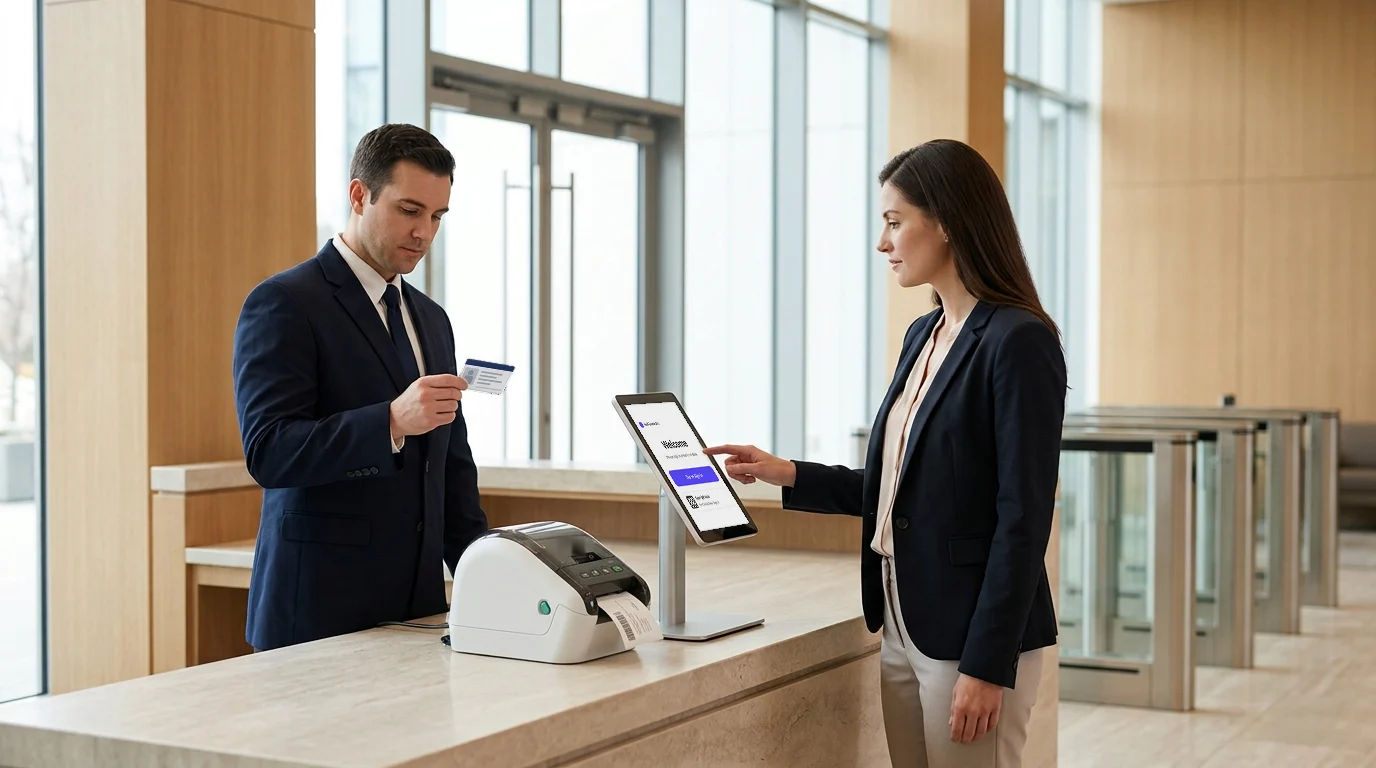
Government ID scanning and photo capture verify identity beyond what a visitor self-reports. A real-time OFAC cross-reference runs again at check-in, catching any watchlist updates that occurred since the visitor registration. The badge reflects location-specific zone restrictions. A vendor with conference-room access cannot access the trading floor.
Connected to Physical Access Control
When the platform connects to Lenel or Genetec, the digital check-in event triggers a temporary, time-bound credential pushed directly to the PACS. The door does not open until check-in is complete. The credential expires at the end of the visit window. Early sign-outs or no-shows are handled automatically.
After the Visit
Automatic sign-out closes the loop. Access is revoked. An audit log is generated that covers pre-registration, screening results, check-in time, badge issuance, zones accessed, and sign-out, in a format designed for regulatory examination.
Visitly’s SOC 2 Type II certification and API-first architecture mean that visitor data is handled in accordance with enterprise-grade security standards and integrates cleanly with SIEM, identity, and compliance systems.
The visitor badge is an access credential. The visitor log is a compliance record. The platform behind them should be built to that standard.
Centralized Control Across a Decentralized Footprint
The Singapore office operates under MAS guidelines with specific rules for third-party access to technology infrastructure. The New York trading floor is subject to SEC and FINRA oversight. The London back office handles GDPR-regulated data. Each location has its own rules and its own visitor population.
A CISO does not need a platform that treats all locations the same. They need one that allows per-location policy configuration managed centrally and enforced locally.
Regional security leads should be able to configure policies for their facilities without IT involvement or custom development. Role-based access controls keep regional administrators within parameters set by the central security function without allowing overrides of enterprise-wide standards.
Across all locations, the platform delivers real-time occupancy data, alert feeds, and audit reporting in a single consolidated view. When an examiner asks how many third-party visitors accessed the London trading floor in a specific quarter, the answer is retrievable in seconds.
The Questions That Surface the Gaps Fast
When evaluating platforms, the right questions surface the gaps fast. These five should anchor any vendor conversation for a financial institution with serious physical security requirements.
Q: Can your platform enforce location-specific visitor policies such as different NDAs, zone restrictions, and screening protocols per facility without custom development on our side?
A: The answer tells you whether the platform was designed for enterprise complexity or retrofitted to approximate it.
Q: At what point in the visitor journey does watchlist screening occur, and which registries does it check?
A: A platform that screens only at badge printing, or supports only OFAC, does not meet the requirements of a regulated financial institution.
Q: Which physical access control systems do you have certified integrations with and can a door open before digital check-in is complete?
A: Ask specifically about Lenel and Genetec. The answer to that last question tells you everything about how the integration actually works.
Q: What does the audit log format look like, and has it been used in a regulatory examination?
A: Request a sample. If the vendor cannot produce one, or if significant reformatting is required before submission, factor that operational cost into the evaluation.
Q: Is your SOC 2 Type II certification scoped to include visitor data and the systems that process it?
A: Scope matters. A platform handling visitor identity data must show that those systems fall within the certification boundary, not just adjacent infrastructure.
How Visitly Helps
Visitly is an enterprise visitor management platform built for the security and compliance requirements of regulated industries. Here is what it delivers in practice:
Before a visitor arrives: Visitly pre-screens every visitor against OFAC sanctions lists and internal watchlists, triggers location-specific NDAs automatically, and alerts your security team to any flag before the visit is confirmed.
At the lobby: Government ID scanning, photo capture, and real-time identity verification run at check-in. Badges are zone-restricted to the areas the visitor is authorized to access, nothing more.
Connected to your access control infrastructure: Visitly integrates natively with Lenel and Genetec. The door does not open until digital check-in is complete. Credentials are time-bound and revoked automatically at sign-out.
Across all your locations: Every office runs its own location-specific policies. Your central security team sees all of them: occupancy, alerts, and audit logs in a single real-time dashboard.
Built for audit readiness: Every visitor event generates a complete, exportable audit log formatted for regulatory examination. No manual compilation. No gaps.
Ready to see it in your environment? Book a security-focused demo

Conclusion
Visitor access has quietly become one of the most overlooked entry points in enterprise physical security. For global banks, the stakes are too high to leave it unmanaged.
The convergence of compliance pressure, multi-site complexity, and increasingly sophisticated physical threats means that who walks into your building, and how that event is recorded, controlled, and audited, is now a board-level concern, not a front-desk one.
Institutions that treat visitor management as a security layer will move faster through audit cycles, respond more decisively to incidents, and demonstrate to regulators that their physical security posture is as mature as their digital one.
The lobby is the perimeter. Treat it accordingly.
Connect with us for more information on visitor management.
FAQs
Why are banks treating visitor access as a security layer?
Banks treat visitor access as a security layer because a visitor badge is an access credential and the visitor log is evidence in an audit. Trading floors, data centers and client suites carry different risk, so one sign-in rule for every visitor leaves gaps. Screening, zone limits and a complete record close them.
Does Visitly integrate with Lenel and Genetec?
Yes. Visitly integrates with Genetec Security Center and LenelS2 Netbox, and also with Brivo, Kisi and C CURE 9000. Our team can show you how they work with your access control system. Visitly handles visitor identity, screening and the visit record, and your access control system keeps control of the doors. Confirm the credential behavior for your Lenel or Genetec version with sales during scoping.
What watchlists does Visitly screen visitors against?
Visitly screens visitors against the watchlists your security team configures, per location or across every site, and can block the check-in or alert security on a match. It also screens against sanctions and restricted-party lists such as OFAC, directly or through an integration with the screening platform you choose. Your compliance lead decides which lists apply.
How should a bank enforce visitor policy across many offices?
Set the standard centrally and let each office configure within it. The central security team defines required screening, NDAs and escort rules. Regional administrators adjust visitor types and host notifications for local regulation. Every location reports into one view, so the central team can answer an examiner's question about any office without asking that office.
Is Visitly certified for financial services regulatory requirements?
Compliance with financial regulation belongs to the bank, not to its visitor platform. Visitly holds SOC 2 Type II and ISO 27001 certifications and is GDPR, CCPA and HIPAA compliant. It supplies the visitor records, signed acknowledgments and audit log export your program needs as evidence. Your compliance lead or counsel decides what your examiners require.
What should a bank's visitor audit log capture?
The log should capture who the visitor was, who approved and hosted them, the screening result, signed documents, the badge issued, and check-in and sign-out times. It should be searchable by location and date and exportable without manual compilation. If an examiner asks who entered a trading floor last quarter, the answer should take minutes.