



Most companies still think contractor management is about check-ins. It isn’t.
In a typical enterprise today, contractors, vendors, and temporary workers often outnumber employees on-site. Yet, many organizations still rely on fragmented systems, spreadsheets, emails, and badge logs to manage them.
The result is a blind spot: no real-time visibility, weak compliance tracking, and delayed response when something goes wrong.
This is where the risk sits. Not in your employees, but in the external workforce moving through your facilities without a unified control system.
The shift is already underway. Contractor management software is no longer a front desk function. It is becoming a core operational layer that connects identity, access, workplace compliance, and real-time visibility.
The question is not whether to adopt new contractor management tools.
The question is whether your current system can actually handle the scale, speed, and risk of a digital workplace.
This blog breaks down what is changing, what most contractor management tools still get wrong, and how to evaluate contractor management platforms that are built for what comes next.
So, let us start!
Why Are Current Contractor Management Tools Failing Modern Digital Workplaces?
Most contractor management tools were built for a different reality: single locations, predictable workflows, and limited external workforce movement. That’s not how workplaces operate anymore. Today, contractors move across sites, access sensitive areas, and interact with critical systems often without a unified layer of control.
The problem isn’t just outdated tools. It’s that most systems were never designed to handle scale, speed, and risk simultaneously.
Where Traditional Systems Break
Traditional contractor management setups rely on disconnected processes that create blind spots instead of clarity.
- Manual logs, spreadsheets, and fragmented tools
Data sits in multiple places: front desk logs, HR systems, and email approvals. No single source of truth exists, which means decisions are based on incomplete information.
- No real-time visibility across locations
Most systems report check-ins but not who is on-site, their location, or purpose—creating operational ambiguity at scale.
- Reactive instead of proactive management
Issues are identified after they happen: unauthorized access, expired certifications, and missed approvals. There’s no mechanism to prevent them in real time.
The Hidden Business Risk
These gaps don’t just slow operations; they also undermine them. They expose the business to risks that compound quietly until something breaks.
- Unauthorized access risks
Without strict validation and tracking, contractors can enter restricted areas or continue accessing facilities beyond approved timelines.
- Failed audits due to missing records
Compliance depends on complete, traceable logs. Fragmented systems make it difficult to prove who was on-site, what they signed, and whether protocols were followed.
- Delayed emergency response
In critical situations, knowing exactly who is inside the facility is non-negotiable. Without real-time data, response teams are forced to rely on outdated or inaccurate information.
What Is The Real Role Of Contractor Management Tools Today?
Modern contractor management tools go beyond logging entries and act as real-time control layers, managing site presence, purpose, permitted access, and compliance at all times.
From “record keeping” to “real-time control layer.”
This shift is fundamental. Earlier systems captured events; modern systems control outcomes.
- Track presence, purpose, permissions
Not just “who checked in,” but whether the contractor is authorized, scheduled, and compliant for that specific visit.
- Connect identity → access → activity
A contractor’s identity is verified, access is granted in accordance with rules, and their activity is monitored within defined boundaries. Everything is linked and traceable.
Why this shift matters
This transition is not a feature upgrade. It’s a response to how workplaces have changed.
- Contractors now outnumber employees in many operations.
In industries such as manufacturing, logistics, and facilities management, the presence of an external workforce is constant. Managing them manually or loosely is no longer viable.
- Risk surface is external, not internal
Most operational, security, and compliance risks now originate from outside the organization, including vendors, service providers, and temporary staff.
How Is Contractor Management Software Evolving Into A Workplace Infrastructure Layer?
Contractor management software is evolving into a workplace infrastructure layer in the following ways:
- Shift 1: Static data → real-time visibility
- Shift 2: Manual onboarding → automated workflows
- Shift 3: Isolated tools → integrated ecosystems
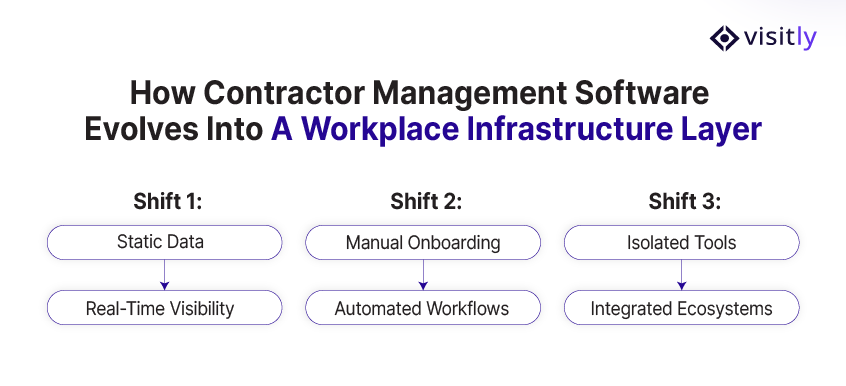
Shift 1: Static data → real-time visibility
Earlier systems were built to store records. Modern contractor management software is built to show what is happening right now.
- Live dashboards of contractor movement
Teams can see who is on-site, their purpose, and their status at any given moment, not after the fact.
- Multi-site monitoring
For enterprises operating across locations, visibility is no longer limited to a single office or facility. Everything is centralized and accessible in real time.
Shift 2: Manual onboarding → automated workflows
The biggest inefficiency in contractor safety software has always been onboarding. That’s where modern systems are driving the most change.
- Pre-registration
Contractors are verified before they arrive, reducing delays and eliminating manual entry at the front desk.
- Auto approvals
Access and permissions are granted based on predefined rules, not back-and-forth communication.
- Document validation
Certifications, NDAs, and compliance documents are automatically checked, ensuring no one enters without meeting the requirements.
Shift 3: Isolated tools → integrated ecosystems
The most important shift is not within the tool itself but how it connects with everything else.
- Access control integration
Contractor permissions are directly linked to physical access control systems, ensuring entry is aligned with approval status.
- HRMS + IAM integration
Identity and role data are synced across systems, creating consistency in how contractors are managed.
- Security systems sync
Surveillance, emergency notifications, and incident systems can reference contractor data in real time, improving response and accountability.

What Does A Future-Ready Contractor Management System Actually Look Like?
A future-ready contractor management system is not defined by how many features it has but by how much control it gives you in real time.
It should answer three questions instantly:
- Who is on-site right now?
- Are they authorized and compliant?
- What are they allowed to do — and are they staying within that scope?
If a system cannot answer these in real time, it is not future-ready.
Core capabilities (non-negotiable)
These are baseline requirements. Without them, the system cannot support a modern workplace.
- Real-time contractor visibility
You need a live view of every contractor across locations, including their status, purpose of the visit, and on-site duration. Anything delayed or static creates operational blind spots.
- Compliance tracking (NDA, certifications)
The system must enforce compliance before granting access, not after. Expired documents, missing certifications, or unsigned agreements should automatically block entry.
- Digital audit trails
Every interaction, check-in, document submission, access granted, and check-out must be logged and retrievable. This is critical for audits, incident reviews, and regulatory requirements.
Advanced capabilities (where the market is going)
This stage is where contractor management systems begin to become intelligent and predictive.
- Risk scoring of contractors
Systems begin assigning risk levels based on factors such as past activity, compliance gaps, visit frequency, and role sensitivity. High-risk contractors can be automatically flagged or restricted.
- Behavior tracking
Instead of just tracking entry and exit, systems monitor patterns. unusual access requests, extended stays, or deviations from approved activity.
- Predictive alerts
The system identifies potential issues before they escalate, such as upcoming compliance expirations, unauthorized access attempts, or anomalies in contractor behavior.
What Role Does Construction Management Software For Small Businesses Play In This Ecosystem?
Construction management software for small businesses plays an important role, but it solves a different problem.
It is designed to manage projects, timelines, and tasks, not to provide real-time control of people in the workplace. That distinction matters, especially as contractor movement becomes a security and compliance concern rather than just an operational one.
Where construction tools overlap
There is some functional overlap between construction tools and contractor management systems.
- Task and project tracking
Construction platforms help assign work, track progress, manage schedules, and coordinate teams across projects.
- Workforce coordination
They provide visibility into who is assigned to which job, timelines, and deliverables.
These capabilities are valuable for planning and execution at the project level.
Where they fall short
However, construction management software is not built to handle on-site control and real-time risk management.
- No workplace security integration
These tools are not connected to access control systems, identity verification, or entry restrictions. They cannot enforce who should or should not enter a facility.
- No real-time access or visibility
They do not track whether a contractor is physically present on-site, where they are, or if they are operating within approved boundaries.
This creates a gap.
You may know:
- Who is assigned to a project?
- What work are they supposed to do?
But you do not know:
- Whether they are actually on-site
- Whether they are authorized at that moment
- Whether they are compliant and restricted appropriately
Where Is The Future Heading?
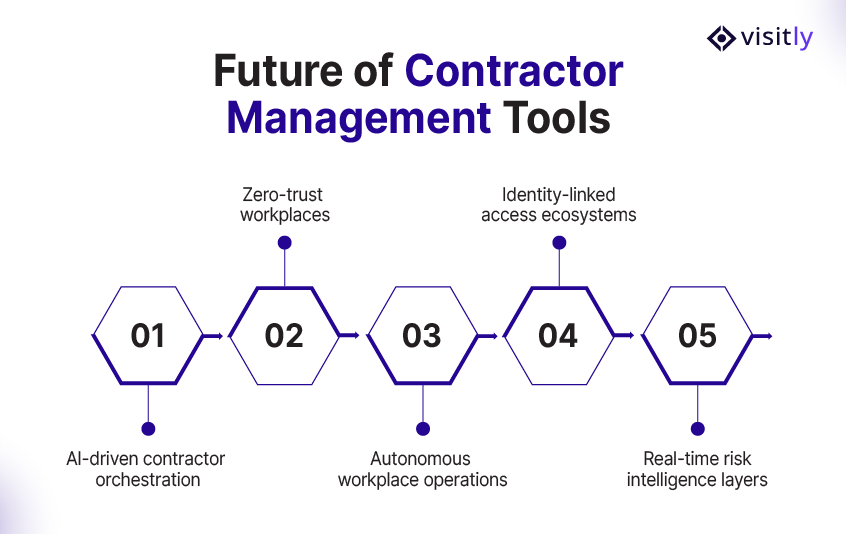
The future of contractor management tools in digital workplaces are:
1. AI-driven contractor orchestration
2. Zero-trust workplaces
3. Autonomous workplace operations
4. Identity-linked access ecosystems
5. Real-time risk intelligence layers
The next phase of contractor tracking software is not about adding more features. It is about reducing human dependency in decision-making while increasing control and accuracy.
What’s emerging is a shift from systems that assist teams to systems that orchestrate contractor operations in real time.
1. AI-driven contractor orchestration
The role of AI is moving beyond recommendations into execution.
- Automated approvals: Instead of managers reviewing every request, systems approve or reject access based on predefined rules, past behavior, and compliance status.
- Smart scheduling: Contractor visits are aligned with site capacity, resource availability, and risk levels, reducing overlap, congestion, and operational friction.
2. Zero-trust workplaces
Workplace security is shifting toward a zero-trust model, where access is never assumed.
- No access without validation: Every contractor must be verified at every stage: identity, purpose, compliance, and timing. Access is granted only when all conditions are met and revoked immediately when they are not.
3. Autonomous workplace operations
The end state is a system that manages contractor flow with minimal human intervention.
- Systems managing contractors without manual input: From pre-registration to check-in, access control, monitoring, and exit, the entire lifecycle is handled automatically based on rules and real-time data.
- Continuous enforcement without oversight gaps: The system does not forget, delay, or overlook exceptions. It enforces policies consistently across locations and timeframes.
4. Identity-linked access ecosystems
Contractor identity will become the central control point across all systems.
- Unified identity across systems: One verified identity connects contractor data across access control, HR systems, and security platforms.
- Dynamic access based on context: Access is not static; it changes in real time based on time, location, role, and compliance status.
5. Real-time risk intelligence layers
Future systems will not just track contractors; they will continuously assess risk.
- Continuous risk monitoring: Systems evaluate contractor behavior, access patterns, and compliance status in real time to detect anomalies.
- Instant escalation and intervention: When risk thresholds are crossed, alerts are triggered automatically, and access can be restricted without human delay.
Why Platforms Like Visitly Are Becoming Essential In Digital Workplaces
Most organizations don’t lack tools—they lack control over those tools.
As contractor volume increases and workplaces become more distributed, the need is no longer for isolated systems but for a platform that brings visibility, compliance, and access control into a single operational layer.
This is where platforms like Visitly are becoming critical, not as add-ons, but as infrastructure.
What Visitly solves directly
Visitly addresses the core gaps left by traditional contractor management setups.
- Real-time visibility: Know exactly who is on-site at any given moment, across locations, including purpose, host, and status. No delays, no guesswork.
- Automated check-ins: Contractors can be pre-registered, verified, and checked in without manual intervention, reducing front desk dependency and entry friction.
- Compliance tracking: NDAs, certifications, and required documents are enforced before access is granted, ensuring that every contractor meets compliance requirements upfront.
Business outcomes
The impact is not just operational; it directly affects risk, efficiency, and audit readiness.
- Reduced risk: Unauthorized access, compliance gaps, and untracked contractor movement are minimized through enforced workflows and real-time monitoring.
- Faster operations: Automated processes eliminate delays at entry points and reduce manual coordination across teams.
- Audit readiness: Every contractor interaction is logged and retrievable, enabling faster, cleaner, and more defensible audits.
Closing Thoughts
Contractor management is no longer a front desk task or an admin workflow. In digital workplaces, it has become a core operational system, directly tied to security, compliance, and workplace control.
That is why businesses need more than a basic check-in tool. They need a platform that provides real-time visibility, automates contractor entry and approvals, enforces compliance before granting access, and maintains a clear audit trail across all locations.
This is where Visitly stands out. It helps teams manage contractors with greater control, less manual work, and far better visibility into who is on-site, why they are there, and whether they meet all requirements.
The future of contractor management will belong to companies that treat it as infrastructure, not admin.
If your current process still depends on spreadsheets, emails, or fragmented tools, this is the right time to change that.
Book a demo with Visitly and see how smarter contractor management actually works.
Frequently Asked Questions
1. What is contractor management software?
Contractor management software helps businesses track, verify, and manage contractors by controlling access, ensuring compliance, and providing real-time visibility across locations.
2. Why is contractor management important in digital workplaces?
It reduces security risks, ensures compliance, and provides real-time visibility of external workforce activity, which is critical for multi-location and high-risk environments.
3. What features should a contractor management system have?
It should include real-time tracking, automated check-ins, compliance enforcement, audit logs, and integrations with access control and HR systems.
4. How does contractor management software improve compliance?
It enforces document validation, tracks certifications, logs every interaction, and ensures only compliant contractors are allowed access to the workplace.
5. Can contractor management tools integrate with other systems?
Yes, modern platforms integrate with access control, HRMS, and security systems to create a unified view of contractor activity and permissions.