


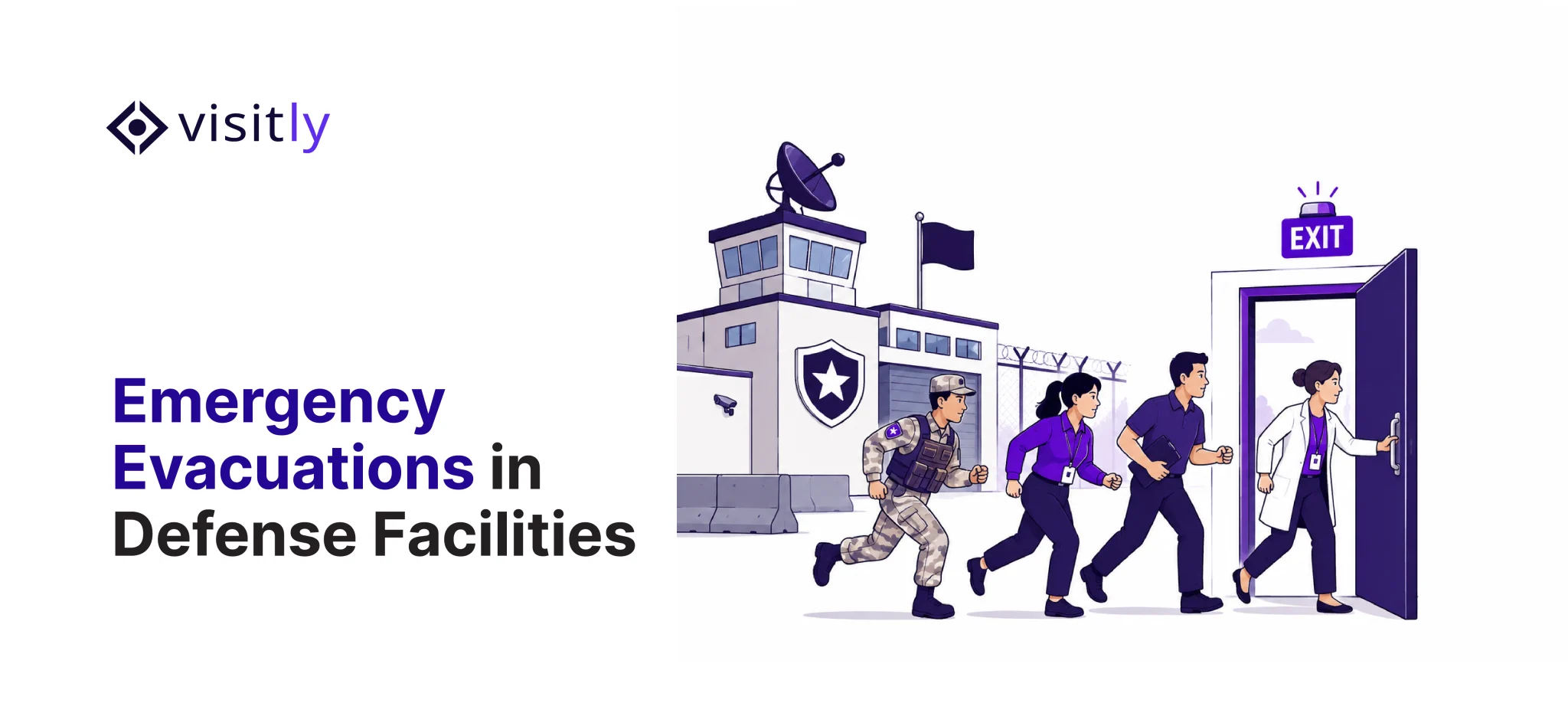
During a routine evacuation drill at a military research facility, everything went smoothly until one contractor, working in a restricted wing, failed to reach the muster point.
The paper sign-in log was hours old, leaving first responders guessing. This scenario highlights a critical gap in security and compliance protocols, and it occurs more often than managers would like to admit.
Emergency evacuations in high-security facilities differ greatly from standard workplace drills. Classified zones, restricted corridors, rotating contractor crews, and multi-agency coordination mean a single missed step can compromise workplace safety, endanger lives, trigger regulatory scrutiny, and halt operations.
The consequences extend beyond immediate danger: OSHA violations, failed audits, and, in the worst cases, irreversible harm to unaccounted personnel.
In this blog, you will explore the key challenges defense facilities face, best practices for protecting personnel, and how integrated solutions can streamline evacuations.
Why Are Emergency Evacuation Systems in Defense Facilities So Complex?
Emergency evacuation systems in defense facilities are uniquely challenging due to the combination of high-security protocols, sensitive areas, and restricted access. Every evacuation must balance personnel safety, operational continuity, and strict security and compliance requirements.
Key factors contributing to this complexity include:
- Coordination across multiple teams, including security, operations, and emergency responders
- Maintaining operational continuity during evacuations without disrupting critical activities
- Real-time communication challenges in fast-moving emergencies
- Ensuring compliance with regulations and workplace safety standards
- Access restrictions that delay headcount and mustering
- Classified zones create communication blackouts
- Multi-agency coordination adds layers of operational complexity
- 24/7 operations, leaving no safe window for drills or practice exercises
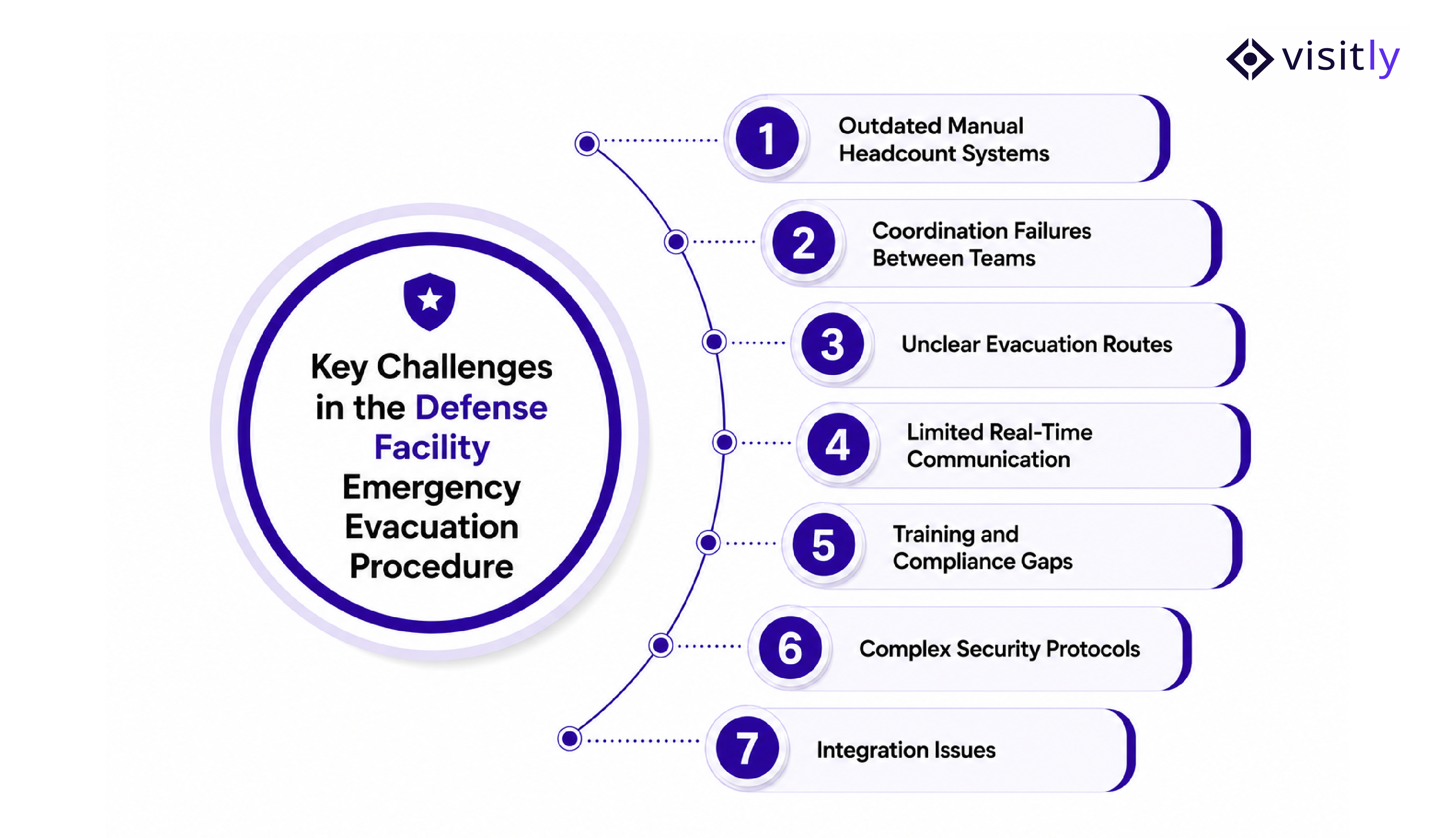
What are the Key Challenges in the Defense Facility Emergency Evacuation Procedure?
The key challenges in defense facility emergency evacuation procedures are:
- Outdated Manual Headcount Systems
- Coordination Failures Between Teams
- Unclear Evacuation Routes
- Limited Real-Time Communication
- Training and Compliance Gaps
- Complex Security Protocols
- Integration Issues
Even the most meticulously written emergency evacuation procedure can fall apart in the field. In defense facilities, the gap between a documented plan and real-world execution is often wider than safety officers realize, with serious consequences.
Here are the core challenges that consistently undermine evacuation effectiveness in high-security environments.
1. Outdated Manual Headcount Systems
Paper-based muster rolls and manual sign-in sheets were never designed for the speed and complexity of an emergency at a defense facility. When an alarm sounds, safety officers are left cross-referencing printed logs that may be hours out of date.
This creates critical blind spots:
- No real-time visibility into who is still inside the facility
- Contractor and visitor records that are incomplete or outdated
- Delayed accountability checks stall the entire emergency response
- No audit trail for post-incident compliance reporting
2. Coordination Failures Between Teams
Internal security teams and external emergency responders frequently operate on separate protocols, different communication systems, and misaligned command structures. During an active evacuation, this fragmentation creates dangerous delays.
First responders arriving on-site often lack:
- Current personnel data and real-time headcount status
- Access to floor plans of restricted or classified zones
- A unified command structure to coordinate with internal safety officers
- Clear protocols for handling unaccounted contractors or visitors
3. Unclear Evacuation Routes
Defense facilities are rarely simple, single-floor structures. Multi-level buildings, underground corridors, and clearance-based zone separations mean a single evacuation route map is never sufficient.
Common route-related problems include:
- Personnel with different clearance levels following conflicting exit paths
- Bottlenecks are forming at security checkpoints during high-traffic evacuations
- Lack of role-specific routing guidance for contractors unfamiliar with the facility
- Secondary and tertiary routes are left unmarked or poorly communicated
4. Limited Real-Time Communication
Signal-shielded rooms, restricted zones, and classified areas are standard in defense environments. They directly interfere with the alert systems that underpin emergency evacuations.
When communication breaks down, the consequences are immediate:
- Alarm signals fail to reach personnel in shielded or underground zones simultaneously
- Evacuation instructions arrive late or not at all in restricted wings
- Safety officers lose the ability to confirm personnel status in real time
- First responders receive fragmented updates, slowing their response
5. Training and Compliance Gaps
Infrequent drills, high staff turnover, and the routine exclusion of contractors from evacuation rehearsals leave most defense facilities with a largely unprepared workforce when a real emergency occurs.
The most common gaps include:
- Drills are conducted too infrequently to build genuine muscle memory
- New hires and rotating contractors who have never participated in a rehearsal
- Workplace safety training is treated as a compliance checkbox rather than genuine preparedness
- No post-drill review process to identify and close procedural gaps
6. Complex Security Protocols
The same access control systems that protect a defense facility during normal operations become friction points during an emergency. Personnel can find themselves trapped behind security barriers waiting for manual override, creating dangerous congestion throughout the facility.
Specific bottlenecks include:
- Biometric scanners and key card checkpoints that don’t auto-disengage during alarms
- Security clearance gates are creating choke points on primary evacuation routes
- Manual override procedures that are slow, inconsistent, or poorly understood
- Personnel hesitating at checkpoints, unsure whether security protocols still apply
7. Integration Failures
Many defense facilities operate with legacy safety infrastructure that was never designed to communicate with modern alarm and mass notification systems. When platforms don’t talk to each other, the entire response suffers.
Common integration failures include:
- Alarms that trigger in one zone but fail to notify the security operations center
- Visitor management system and access control entry systems are operating as isolated silos
- Mass emergency notification platforms that can’t push real-time updates to first responders
- No automated link between an alarm event and a live personnel accountability report
What are the Best Practices for the Defense Facility Emergency Evacuation Checklist?
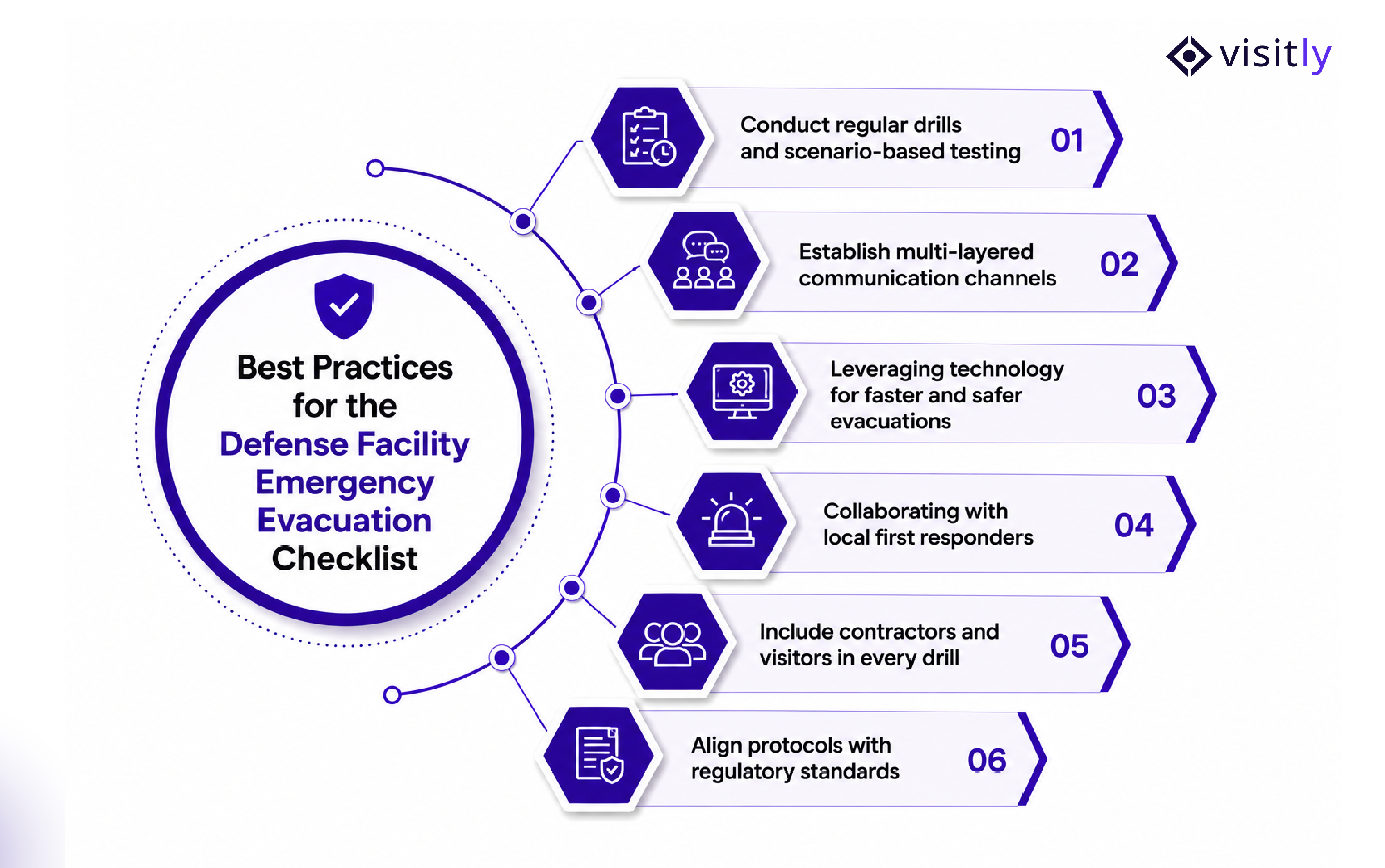
The best practices for a defense facility emergency evacuation checklist are:
- Conduct regular drills and scenario-based testing
- Establish multi-layered communication channels
- Leveraging technology for faster and safer evacuations
- Collaborating with local first responders
- Include contractors and visitors in every drill
- Align protocols with regulatory standards
A well-executed evacuation doesn’t happen by accident; it’s the result of deliberate evacuation planning, consistent training, and the right technology working in sync.
For defense facilities, best practices aren’t optional guidelines. They are operational necessities.
1. Conduct Regular Drills and Scenario-Based Testing
A drill that happens once a year is not a preparedness strategy; it’s a formality. Effective evacuation planning requires frequent, scenario-specific rehearsals that reflect real operating conditions:
- Run drills across different shifts, including night and weekend rotations
- Simulate zone-specific emergencies rather than generic facility-wide alarms
- Vary scenarios to include fire, chemical threats, and power failures
- Document every drill outcome and use it to close procedural gaps
2. Establish Multi-Layered Communication Channels
No single communication channel is reliable enough to carry the full weight of a defense facility evacuation. Your communication strategy must be redundant by design:
- Combine PA systems, digital signage, mobile alerts, and two-way radios into one unified framework
- Designate backup protocols for classified zones where standard wireless signals are blocked
- Assign dedicated communication leads per zone to confirm personnel status
- Test all channels during every scheduled drill — not just the primary system
3. Leverage Technology for Faster, Safer Evacuations
Modern evacuation planning cannot rely on clipboards and paper logs. Technology closes the accountability gaps that manual systems consistently leave open:
- Deploy a real-time digital check-in system tracking every visitor, contractor, and employee on-site
- Use emergency evacuation software that generates an instant personnel report when an alarm triggers
- Integrate access control, alarms, and mass notification platforms into one connected framework
- Maintain digital audit logs for every evacuation event for compliance reporting
4. Collaborate Actively with Local First Responders
First responders should never encounter your facility for the first time during an actual emergency. Proactive collaboration is a cornerstone of sound evacuation planning:
- Conduct joint drills with fire departments, military police, and emergency medical teams at least twice a year
- Share facility maps, muster point locations, and zone access protocols with responding agencies in advance
- Create pre-authorized access protocols so first responders aren’t held up at security checkpoints
- Debrief jointly after every drill to align on gaps and refine the coordinated response
5. Include Contractors and Visitors in Every Drill
Contractors and visitors are the most vulnerable and least prepared people on-site during an emergency, yet they are routinely excluded from rehearsals. To close this gap:
- Brief all contractors and visitors on evacuation routes and muster points at check-in
- Include contractor teams in at least one scheduled drill per quarter
- Assign a zone marshal responsible for contractor and visitor accountability during every evacuation
- Ensure your visitor management system captures real-time on-site status for complete headcount accuracy
6. Align Evacuation Protocols with Regulatory Standards
Every evacuation protocol must be designed and tested in alignment with applicable compliance frameworks:
- OSHA 29 CFR 1910.38 — minimum requirements for emergency action plans
- NFPA 101 Life Safety Code — egress design, occupancy requirements, and drill frequency
- DoD Installation Safety Standards — facility-specific requirements for defense sites
- Review and update protocols annually or after any significant change to facility layout or personnel
How Does Visitly Support Defense Facility Emergency Preparedness?
When an emergency strikes, the questions that matter most are simple: Who is on-site right now? Where are they? And are they safe?
For defense facilities managing rotating contractor crews, scheduled visitors, and multi-shift operations, answering those questions in real time is only possible if the right system is already in place before the alarm sounds.
Visitly is built around exactly that premise, giving safety teams, facility managers, and security officers the visibility and control they need to manage personnel accountability every day and execute it confidently during an emergency.
1. Pre-Registration for Complete On-Site Visibility
Accountability during an evacuation starts long before the alarm triggers. Visitly’s bulk visitor pre-registration capability allows facility managers to register contractors, vendors, and scheduled visitors in advance, so the moment someone steps on-site, they are already accounted for in the system.
- Pre-register individuals or entire contractor teams before arrival
- Assign custom screening questions aligned with security clearance requirements
- Ensure every expected visitor is logged, verified, and trackable from the moment they check in
- Eliminate the paper sign-in gaps that leave personnel unaccounted for during an emergency
2. ID Verification and Custom Screening for High-Security Environments
Defense facilities cannot afford to let unverified individuals onto the premises, and Visitly’s ID scanning and custom screening features ensure they don’t have to. At check-in, every visitor and contractor goes through a structured verification process tailored to your facility’s security requirements:
- Scan and verify government-issued IDs at the point of entry
- Apply custom screening questions specific to access level, clearance status, or visit purpose
- Flag individuals who don’t meet entry criteria before they enter restricted areas
- Maintain a verified digital record of every person who has accessed the facility
3. Real-Time Alerts and Host Notifications
In a defense facility emergency, every second counts. Visitly’s real-time notification system ensures that the right people are informed the moment a visitor or contractor checks in, and that safety officers have immediate access to live on-site status when an evacuation begins:
- Instant host notifications via SMS, email, or app alert when a visitor arrives
- Real-time on-site dashboard showing every checked-in individual at a glance
- Instant access to a live personnel list for safety officers and first responders
- Digital check-out tracking to confirm when individuals have safely exited the facility
4. A Compliance-Ready Audit Trail
Every evacuation, drill, or real event generates documentation that defense facilities are required to maintain for regulatory compliance. Visitly’s digital log creates a complete, timestamped record of every check-in and check-out event, giving safety and compliance teams:
- A fully auditable trail of on-site personnel for every shift and visit
- Documentation that supports OSHA, NFPA, and DoD compliance reporting
- Post-evacuation reports that identify gaps and inform protocol updates
- Secure, cloud-based records accessible for internal audits and regulatory reviews

Closing Thoughts
Emergency evacuations in defense facilities demand more than a documented procedure; they require a three-layer framework built on solid evacuation planning, the right technology, and consistent training. When all three work together, facilities can protect personnel, maintain compliance, and respond with confidence under pressure.
The most overlooked gap in most evacuation strategies isn’t the alarm system or the exit routes; it’s personnel accountability. Knowing exactly who is on-site, including every visitor and contractor, at the moment an emergency strikes, is what separates a controlled evacuation from a chaotic one.
Visitly closes that gap. With real-time check-in visibility, pre-registration, ID verification, instant alerts, and a compliance-ready audit trail, Visitly gives your safety team the foundation every evacuation plan depends on.
Book a Free Demo and see how Visitly can strengthen your facility’s evacuation readiness.
Frequently Asked Questions
1. What is an emergency evacuation plan?
An emergency evacuation plan is a documented procedure outlining how people should safely evacuate a facility during an emergency. It defines routes, assembly points, roles, and steps for quick evacuation.
2. How do evacuation procedures ensure everyone is accounted for?
Procedures often include designated assembly points and headcounts after evacuation, supported by systems like digital tracking or wardens in each area.
3. Why are regular evacuation drills important?
Drills help individuals practice procedures, identify bottlenecks, improve response time, and reinforce workplace safety awareness.
4. Who is responsible for evacuation planning in a facility?
Facility owners or designated safety managers are typically responsible for creating, maintaining, and training staff on evacuation plans.
5. What’s the difference between evacuation and shelter‑in‑place?
Evacuation means leaving a hazardous area to safety; shelter‑in‑place means staying in a secure location when leaving increases risk.