


Would you believe that 90% of security breaches happen due to human error? Traditional visitor check-ins rely on ID cards, manual registers, and security personnel – all of which leave room for mistakes. But what if there was a faster, smarter, and more secure way to manage visitors?
With rising safety concerns, businesses are searching for seamless visitor management solutions. The demand is at an all-time high, driven by:
- Increasing security threats: Workplace violence and unauthorized access are major risks.
- Slow and inefficient check-ins: Long queues frustrate both visitors and employees.
- Strict compliance requirements: Companies must meet ITAR compliance and privacy regulations.
- Technological advancements: Smart offices and AI-driven workplaces demand modern security solutions.
Traditional visitor management methods are outdated, inefficient, and prone to errors. Security guards can miss red flags, manual check-ins are slow, and impersonation is a real threat.
The Solution? Facial recognition technology. This AI-driven system instantly verifies visitors, enhances workplace safety, and streamlines access—all in real time.
In this blog, let’s explore how facial recognition security cameras are reshaping visitor management and why businesses must embrace this game-changing technology.
The Role of Facial Recognition in Visitor Security
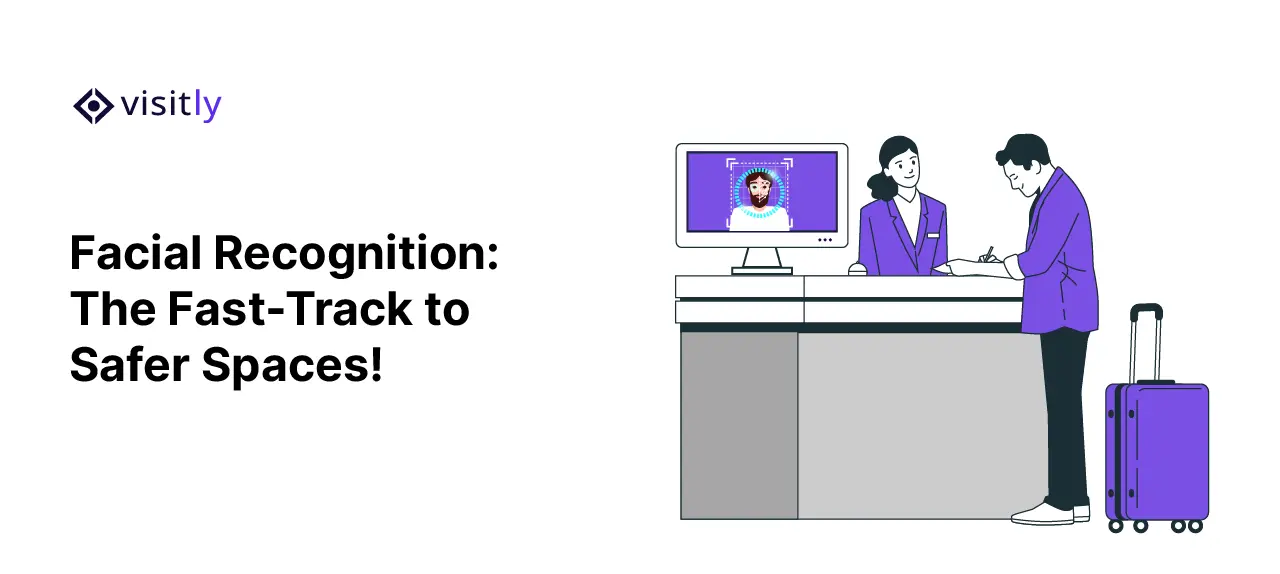
Walking into a building and gaining instant access without an ID check is a reality powered by facial recognition. This technology identifies individuals by analyzing unique facial features, ensuring fast and accurate verification. Businesses can now manage visitors efficiently, enhancing security while streamlining the check-in process.
Facial recognition works by capturing an image, mapping facial landmarks, and converting them into a digital signature that matches stored data. This real-time identity verification eliminates manual errors and enhances security.
No more misplaced ID cards or long check-in lines – just seamless and secure access in seconds.
But before we look into its benefits, let’s break down how this technology works.
What is Facial Recognition and How Does It Work?
Facial recognition is an AI-powered technology that maps facial features, converts them into data points, and matches them with stored profiles – all within seconds.
Here’s how it works:
- Face Detection
The system captures an image using a facial recognition security camera. It detects a human face in real time, filtering out background elements to focus on the subject.
- Feature Mapping
AI scans facial landmarks like the eyes, nose, and jawline to create a unique facial signature. It analyzes key measurements, such as the distance between the eyes or the shape of the chin, to ensure accuracy.
- Data Conversion
The unique facial pattern is converted into a mathematical formula known as a faceprint. This encrypted data is stored securely and used for future identity matching.
- Identity Matching
The system compares the newly captured facial data with existing records in its database. Advanced algorithms ensure high accuracy, even if facial angles or lighting conditions vary.
- Access Granted or Denied
If the system finds a match, the visitor is granted entry within seconds. If there’s no match or a security risk is detected, an alert is sent to security personnel for further action.
The Shift from Manual Check-Ins to AI Security
Security has come a long way from scribbling names in a logbook to AI-driven facial recognition. In the past, visitor management was slow, error-prone, and easy to bypass with fake IDs. ID cards improved security, but they could still be lost, stolen, or misused.
Furthermore, the average cost of a data breach in 2024 was approximately $4.45 million.
With the rise of digital solutions, barcode-based entry systems added efficiency but lacked real-time verification. Today, facial recognition eliminates these gaps, offering a seamless and foolproof check-in process.
But what’s next?
As AI advances, the future of visitor management will likely be even smarter, integrating predictive analytics and multi-layered authentication for ultimate security.
Fast forward to today, businesses that still rely on outdated methods risk workplace security breaches and inefficiency.
Key Benefits of Facial Recognition for Visitor Security
Time is money, and no one wants to waste it standing in line for a manual security check. Traditional methods are not only slow but also prone to human errors, making them unreliable for high-security environments.
Facial recognition speeds up the process by verifying identities in real time, reducing congestion at entry points. It also eliminates the risks of lost or stolen ID cards, ensuring only authorized individuals gain access.
Businesses that adopt this technology see higher efficiency, improved visitor experience, and enhanced security. Plus, automated logs help with compliance, making audits seamless and stress-free.
So, if security can be both fast and foolproof, why settle for outdated methods?
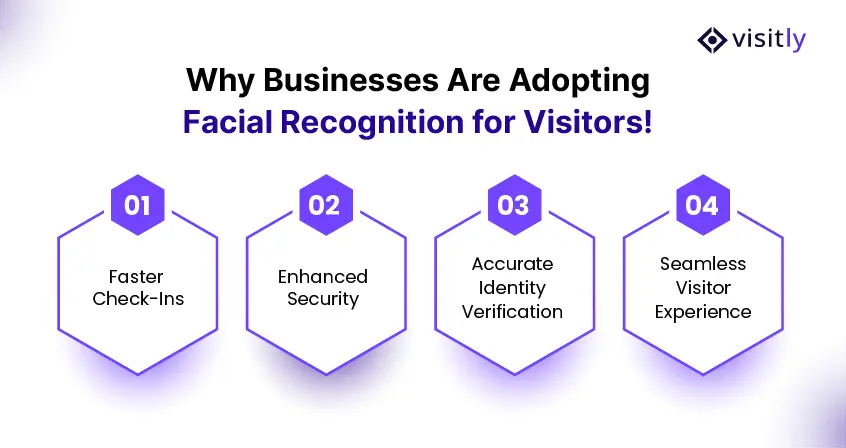
Now, let’s explore the major benefits:
- Faster Check-Ins – No More Long Queues!
Standing in line to register is a thing of the past. Facial recognition speeds up entry by instantly verifying visitors. At Heathrow Airport, facial recognition has reduced boarding time by 30%, allowing passengers to pass through security faster.
Quick Fact: 81% of people prefer contactless security solutions over traditional ID checks.
- Enhanced Security – No More Unauthorized Access
Tailgating and fake IDs? Not happening anymore. Facial recognition stops unauthorized people from entering restricted areas. Many financial institutions now use AI security cameras to prevent workplace threats by flagging suspicious visitors in real time.
- Accurate Identity Verification – Eliminating Impersonation Risks
ID theft is a growing problem. Facial recognition ensures that only verified visitors gain access. This reduces the risk of unauthorized individuals using fake IDs to enter secure areas.
- Seamless Visitor Experience – First Impressions Matter!
A smooth, contactless entry process creates a great first impression. Whether it’s an office, hotel, or event venue, a hassle-free check-in makes visitors feel valued. For instance, Walmart uses facial recognition in stores to improve customer experience and security.
Forbes Insight: AI-driven security systems increase operational efficiency by up to 50%, making them a smart investment for businesses.
Real-World Applications of Facial Recognition in Visitor Management
Security is no longer just about locked doors and ID badges. Businesses, schools, and even event venues are leveraging AI-powered facial recognition to enhance safety and streamline visitor management.
This technology ensures only authorized individuals gain entry, reducing risks of impersonation, unauthorized access, and long wait times. With real-time verification, organizations can improve efficiency while maintaining top-notch security.
As security needs evolve, facial recognition is becoming the gold standard for access control.
Let’s look at the real-world applications of facial recognition in visitor management.
- Corporate Offices – Employee and Guest Security
Many companies now use facial recognition to prevent unauthorized access to offices and meeting rooms. Lets look at an example: Amazon HQ uses facial recognition to verify employees and grant access to restricted zones.
- Healthcare Facilities – Protecting Patients and Staff
Hospitals must ensure only authorized personnel enter sensitive areas like ICUs and research labs. For instance, many health clinics have now adopted AI-powered facial recognition to monitor hospital visitors and restrict access to critical zones.
- Schools & Campuses – Student & Staff Safety
With increasing security threats, schools now use AI-driven visitor management to protect students. Facial recognition ensures that only authorized individuals, such as parents and staff, can access school premises.
- Event Venues – Streamlining Large Crowds
Concerts and sports arenas often face long wait times and security concerns. As such, facial recognition makes entry smoother and safer. The Tokyo 2020 Olympics used facial recognition to speed up security checks and enhance stadium safety.
Visitly – The Best Visitor Management System
Looking for a reliable solution? Visitly is a top-tier visitor management system integrating AI-powered facial recognition security cameras for seamless access control.
The following are some of the top features of Visitly:
- Visitor Watchlist
The system automatically flags unauthorized visitors by cross-referencing them with a pre-defined watchlist. This ensures that potential security threats are identified before they can enter the premises.
- Facial Recognition
Visitors can check in without touching a screen or presenting an ID, making the process faster and more hygienic. The system instantly verifies identities, reducing the risk of impersonation or unauthorized access.
- Emergency Evacuation
In case of an emergency, security teams can access a real-time list of all visitors on-site. This helps ensure quick roll calls, safer evacuations, and better coordination during critical situations.
- iPad-Enabled System
A sleek, modern interface allows visitors to check in quickly and efficiently using an iPad. The user-friendly design enhances the experience while ensuring compliance with security protocols.
Conclusion
Facial recognition is revolutionizing visitor security. The technology enhances speed, accuracy, and convenience, making workplaces and public spaces safer.
Businesses must adapt to workplace management trends and invest in smart security solutions. The future is here – will your company keep up?
Visitly can help you integrate facial recognition seamlessly into your visitor management system. Ready to upgrade your security? Schedule a demo now!