



Most global organizations invest heavily in cybersecurity yet leave their front desks running on paper registers, mismatched spreadsheets, and disconnected processes across every site. That is exactly where the risk lives.
Without a unified visitor management system, multi-site enterprises have no real-time visibility into who is entering their facilities, when, and why.
Over the past five years, according to Scoop Market, 60% of companies have experienced breaches in their physical security measures, and outdated or absent visitor management software is among the least-examined contributors.
The real cost isn’t the paper log. It’s the security incidents, compliance risk failures, and operational inefficiencies silently compounding across every location you operate.
This blog breaks down the 7 hidden costs of poor visitor management and how automated front-desk systems address them.
What Are the Hidden Costs of Visitor Management Challenges?
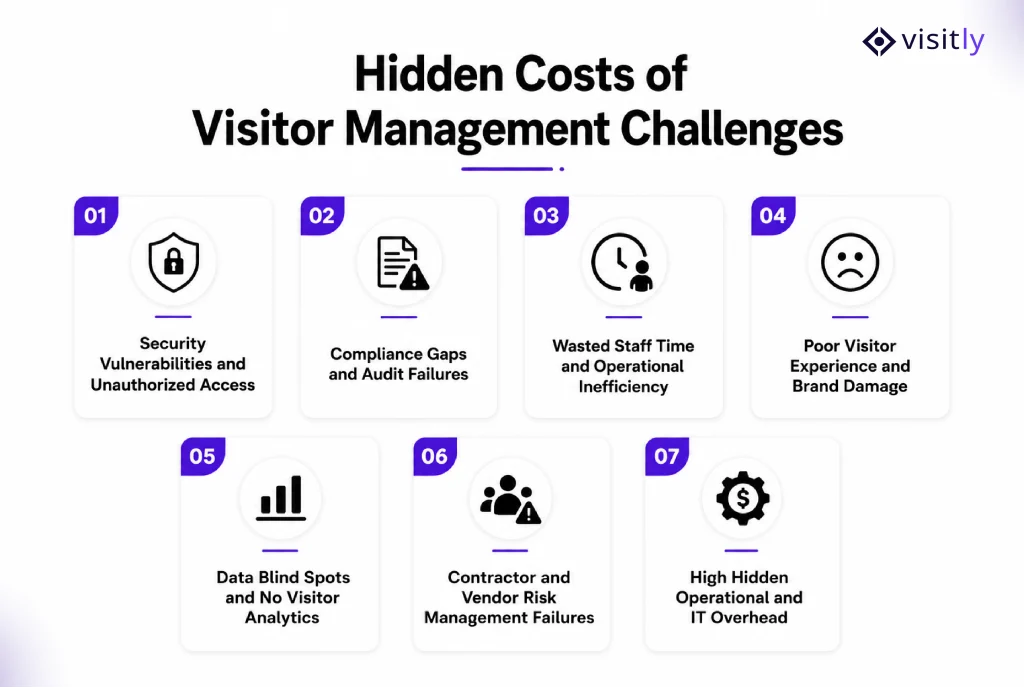
The hidden costs of visitor management challenges are:
1. Security Vulnerabilities and Unauthorized Access
2. Compliance Gaps and Audit Failures
3. Wasted Staff Time and Operational Inefficiency
4. Poor Visitor Experience and Brand Damage
5. Data Blind Spots and No Visitor Analytics
6. Contractor and Vendor Risk Management Failures
7. High Hidden Operational and IT Overhead
Across multi-site global organizations, poor visitor management doesn’t fail in one obvious way, it fails quietly, across multiple layers of operations, security, and compliance. What looks like a simple front-desk process issue actually creates cascading business costs that grow with every new office added to the network.
Below are the most critical hidden costs organizations face when visitor management is inconsistent or outdated.
1. Security Vulnerabilities and Unauthorized Access
A visitor who wasn’t properly screened, a contractor who slipped into a restricted floor, a former vendor whose access was never revoked—these are not edge cases. They are the predictable outcomes of running security-critical entry points without reliable visitor management software.
- Paper logs can be falsified, left incomplete, or simply misread
- No watchlist screening means a previously flagged or banned individual can re-enter undetected
- Contractors and vendors routinely access restricted areas without credential verification
- Tailgating goes undetected when there is no digital visitor check-in process to cross-reference the entry against
2. Compliance Gaps and Audit Failures
Visitor management compliance is not a one-time checkbox.
According to GDPR fines in 2026, GDPR carries a maximum penalty of €20 million or 4% of global annual revenue, and regulators issued €1.2 billion in fines in 2025. Visitor data, check-in timestamps, signed NDAs, ID records, and screening responses fall directly within the scope of these frameworks, and missing records are treated as violations.
- GDPR, SOC 2, ISO 27001, POSH, and local workplace safety checklists all require documented visitor records.
- Inconsistent data formats across sites make consolidated compliance reporting unreliable and time-consuming.
- No digital consent or NDA capture at check-in leaves organizations legally exposed from the moment a visitor walks in.
- When an audit happens, manually assembled visitor logs from paper registers often fail to meet evidentiary security standards.
3. Wasted Staff Time and Operational Inefficiency
Reception teams in most multi-site organizations are spending a significant portion of their day on tasks that an integrated visitor management system should handle automatically. This is not a people problem; it is a process problem.
- Every manual check-in requires staff to re-enter the same visitor data that could have been captured at visitor pre-registration.
- Hosts are repeatedly pulled out of meetings to confirm arrivals that an automated notification system would handle instantly.
- High-volume visitor days create front-desk bottlenecks that delay meetings, frustrate guests, and reduce staff productivity.
- Without bulk pre-registration, recurring visitors, contractors, auditors, and delivery personnel go through the same friction every single time.
4. Poor Visitor Experience and Brand Damage
Operational decisions made in a boardroom rarely affect brand perception as directly as what happens at your front desk. A slow, confusing, or inconsistent check-in process signals internal disorganization to the very clients, partners, and investors you are trying to impress.
- Visitors are waiting with no update because the host notification is manual or nonexistent
- Inconsistent check-in experiences across your locations send mixed signals about operational standards.
- Enterprise clients and senior stakeholders form judgments about your organization before the meeting even begins.
- A disorganized entry process undermines the credibility of whatever follows in the meeting room.
5. Data Blind Spots and No Visitor Analytics
Most organizations can tell you their quarterly revenue to the decimal. Very few can tell you how many visitors entered their facilities last week, which sites are busiest between 9 am and 11 am, or which contractors were on-site during a specific incident. That gap is a strategic vulnerability.
- No visibility into peak visitor hours, site-level traffic patterns, or repeat visitor frequency
- Security and staffing decisions get made on assumptions rather than actual footfall data
- Each site operates as an isolated data silo with no cross-location reporting or a centralized dashboard
- Increasingly required ESG and space utilization reporting cannot be completed accurately without verified visitor data

6. Contractor and Vendor Risk Management Failures
Contractors are not guests, but most organizations process them as if they were.
According to the Verizon 2025 Data Breach Investigations Report, breaches involving third-party partners, vendors, and service providers doubled year over year, rising from 15% to 30% across all industries. A significant share of that exposure begins not in the cloud, but at the building entrance.
- Contractors carrying zone-specific access rights are often waved through the same generic front-desk process as regular visitors
- No document verification, license checks, or credential validation means liabilities enter your facility unchecked
- Once inside, there is no mechanism to track which work zones a contractor accessed, for how long, or whether they left
- If an unverified contractor causes an incident on-site, the legal and operational liability falls entirely on the organization
7. High Hidden Operational and IT Overhead
The visible cost of a visitor management access control is a software subscription. The invisible cost of not having one shows up across IT hours, reactive fixes, duplicated contracts, and the operational scramble that follows every audit or security incident.
- Separate, siloed systems at each location mean multiple vendor contracts, renewal cycles, and support relationships
- IT teams spend hours on manual access control fixes and cross-system integrations that a unified platform would eliminate
- No centralized admin means every policy update has to be replicated manually across each site independently
- Reactive spend after a physical access control security incident, investigation, remediation, and legal review consistently exceeds what prevention would have cost
What Are the Best Practices to Fix These Visitor Management Issues?
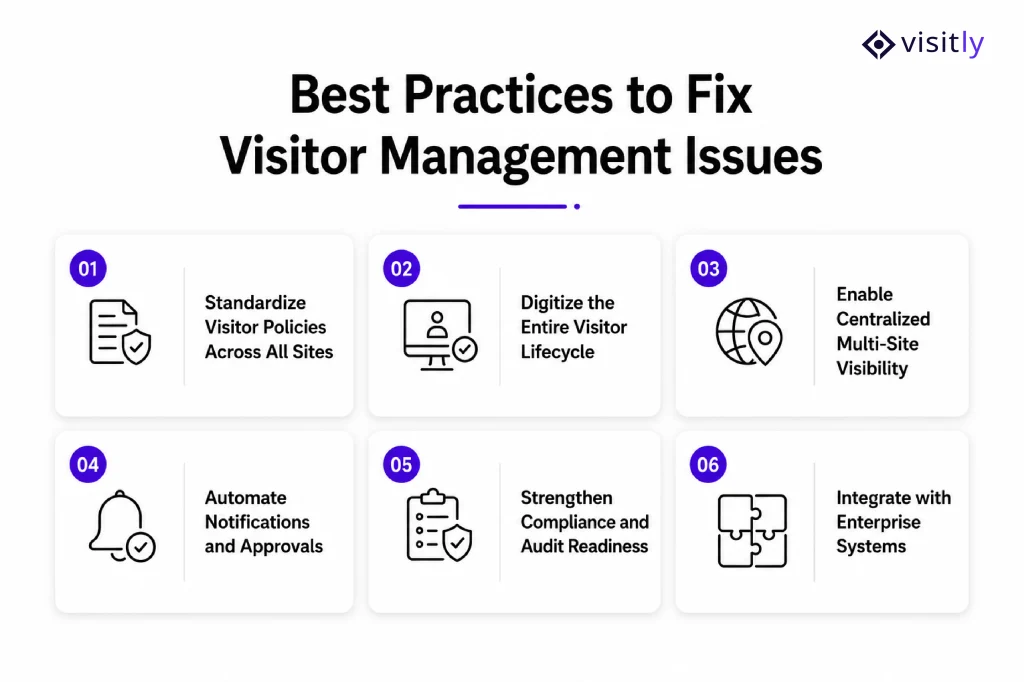
The best practices to fix these visitor management issues are:
1. Standardize Visitor Policies Across All Sites
2. Digitize the Entire Visitor Lifecycle
3. Enable Centralized Multi-Site Visibility
4. Automate Notifications and Approvals
5. Strengthen Compliance and Audit Readiness
6. Integrate with Enterprise Systems
Identifying the problem is only half the work. The other half is building systems and workflows that prevent these issues from recurring consistently across every site you operate.
Here are the six best practices that high-performing multi-site organizations are implementing right now.
1. Standardize Visitor Policies Across All Sites
One of the most critical visitor management best practices is eliminating inconsistencies across locations.
- Define unified entry rules for all offices, campuses, and facilities
- Implement consistent identity verification standards across regions
- Ensure every site follows the same approval and check-in workflow
2. Digitize the Entire Visitor Lifecycle
Manual systems are the root cause of most visitor management issues.
- Enable pre-registration for visitors before arrival
- Replace paper logs with QR code check-ins or app-less digital check-ins
- Capture digital ID verification, facial recognition security systems, NDAs, and consent forms automatically
- Maintain structured digital visitor records for every entry
3. Enable Centralized Multi-Site Visibility
Without centralized visibility, multi-site organizations operate in silos.
- Use a single dashboard to monitor all locations in real time
- Track visitor flow across offices, factories, and campuses
- Access consolidated reporting for security and compliance teams
4. Automate Notifications and Approvals
Manual coordination between the front desk and hosts creates delays and inefficiencies.
- Send instant alerts or emergency notifications when visitors arrive
- Automate approvals for repeat or trusted visitors
- Reduce dependency on manual confirmation calls or emails
5. Strengthen Compliance and Audit Readiness
Workplace compliance is one of the most overlooked areas in visitor management.
- Maintain automated, tamper-proof visitor logs
- Define retention policies aligned with GDPR, ISO, SOC 2, and local regulations
- Enable export-ready audit trails for quick reporting
6. Integrate with Enterprise Systems
The digital visitor management systems should not operate in isolation.
- Connect with HR systems for employee and host validation
- Integrate with access control systems to manage entry permissions
- Link with security monitoring tools for real-time risk alerts
How Does Visitly Help Global Organizations Overcome These Visitor Management Challenges?
Visitly helps global organizations overcome these visitor management challenges through the following:
1. Centralized Multi-Site Visitor Visibility
2. Secure and Automated Visitor Check-Ins
3. Improved Security and Compliance
4. Faster Front Desk Operations
5. Real-Time Host Notifications
Modern enterprises operating across multiple locations need more than a basic check-in system; they need a centralized, secure, and scalable reception management software platform. Visitly is designed specifically to address the complexity of multi-site operations while eliminating the hidden risks and inefficiencies highlighted earlier.
1. Centralized Multi-Site Visitor Visibility
Visitly gives organizations complete control and visibility across all locations.
- Real-time dashboard across all sites and facilities
- Instant visibility into who is inside which location
- Unified reporting for security and operations teams
2. Secure and Automated Visitor Check-Ins
Manual processes are replaced with a streamlined, secure digital workflow.
- Pre-registration to reduce on-site delays
- ID scanning and configurable screening questions
- Fully app-less experience for visitors for faster adoption
3. Improved Security and Compliance
Visitly strengthens compliance readiness and reduces workplace security risks.
- Structured, tamper-proof visitor logs for audits
- Secure data storage with defined retention controls
- Compliance-ready reporting aligned with enterprise requirements
4. Faster Front Desk Operations
Operational efficiency at reception improves significantly.
- Reduced manual data entry for reception teams
- Quick visitor badge printing and streamlined approvals
- Smooth visitor flow even during peak hours
5. Real-Time Host Notifications
Communication gaps between visitors and hosts are eliminated.
- Instant alerts when visitors arrive at any site
- Reduced waiting time at reception areas
- Fewer missed connections and scheduling delays
- Emergency evacuations

Closing Thoughts
Every untracked visitor, every paper log, and every siloed front desk is a cost your organization is already paying; it just does not appear on any invoice.
Poor visitor management challenges do not stay small. Across multiple sites, they scale into security vulnerabilities, compliance liabilities, and operational inefficiencies that quietly erode the stability of even the most well-run enterprises.
The organizations that get ahead of this are not doing anything extraordinary. They are simply replacing guesswork with visibility, manual processes with automation, and disconnected systems with one centralized platform.
That is exactly what Visitly is built to do, across every site you operate, every visitor who walks through your doors, and every compliance requirement you are accountable to.
The front desk is your first line of defence. It is time to treat it like one.
See how Visitly works across your locations; book a free demo today.
FAQs
1. What are the main challenges in visitor management?
The main challenges include a lack of visibility, manual check-ins, inconsistent processes across sites, compliance gaps, and security risks stemming from unverified or untracked visitors.
2. Why is visitor management important for multi-site organizations?
Multi-site organizations need centralized control to ensure consistent security, compliance, and operational efficiency across all locations. Without it, risks multiply across sites.
3. What are the hidden costs of poor visitor management?
Hidden costs include security breaches, compliance penalties, wasted staff time, poor visitor experience, data blind spots, and increased operational overhead.
4. How can companies improve visitor management?
Companies can improve it by digitizing check-ins, standardizing processes, enabling real-time visibility, automating approvals, and integrating systems across locations.
5. How does Visitly help with visitor management?
Visitly provides centralized multi-site visibility, automated check-ins, real-time notifications, and compliance-ready logs to simplify and secure visitor management at scale.