


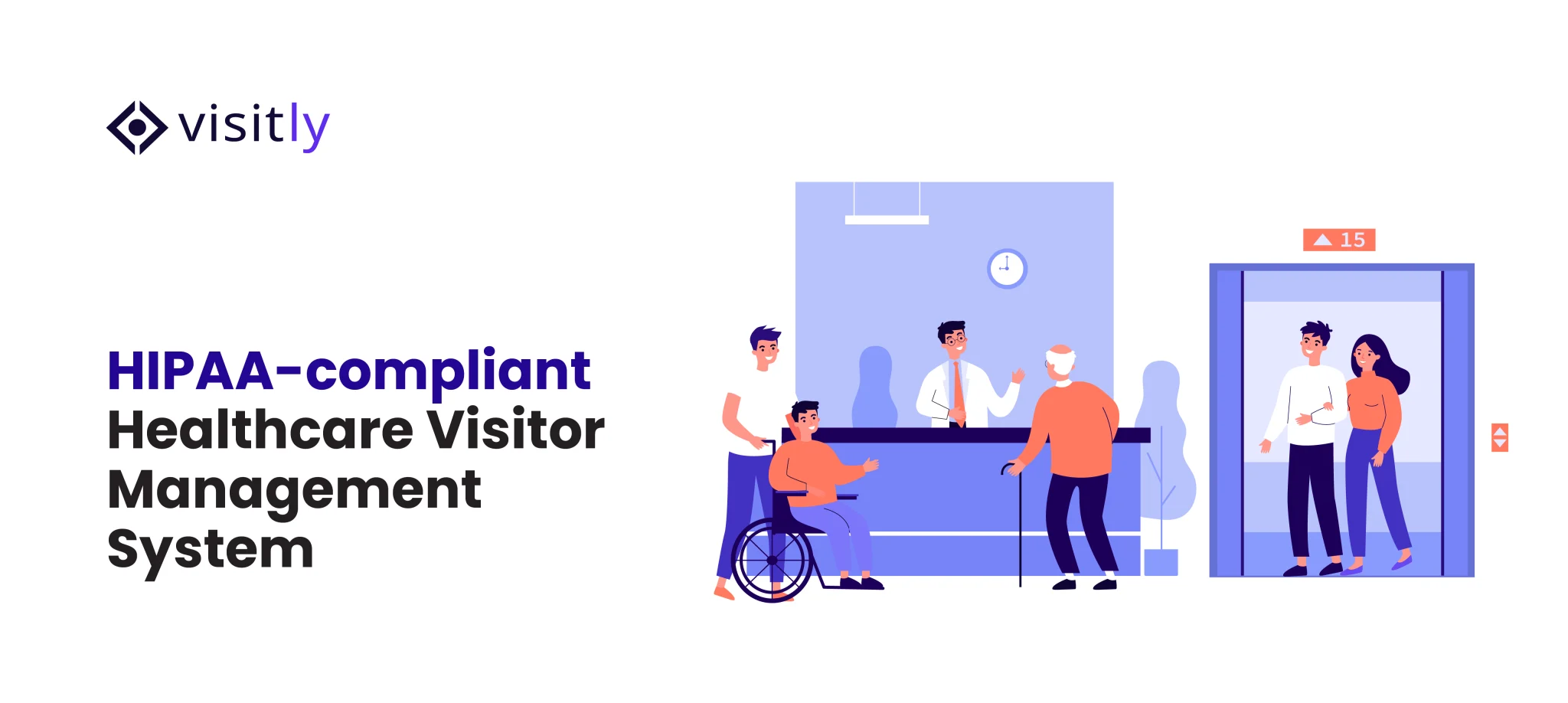
A visitor signs into your hospital using a paper logbook. The person behind them can clearly read the names, room numbers, and reasons for visits of everyone who signed in before them.
A contractor walks past the front desk with a quick wave; no ID check, no screening, no record. Meanwhile, your front-desk staff is juggling phone calls, delayed check-ins, and a growing queue. Without a proper automated visitor management system, this kind of gap is almost impossible to close manually.
This is the daily reality in thousands of healthcare facilities, and every part of it carries HIPAA risk.
Non-compliant visitor logs, missing audit records, and unauthorized access aren’t just operational headaches; they’re security risks. They’re security and compliance liabilities that can result in significant fines, reputational damage, and compromised patient safety, consequences no healthcare facility can afford to ignore.
A digital HIPAA-compliant visitor management system changes this entirely by streamlining front-desk check-ins, protecting patient data, screening every visitor, and keeping your facility fully audit-ready with real-time visibility at every entry point.
In today’s healthcare environment, that’s not optional. It’s essential.
What Is a Hospital Visitor Management System, and How Does It Enforce HIPAA at the Front Desk?
A hospital visitor management system is a digital platform that replaces manual sign-in with a secure, automated check-in workflow. This involves capturing visitor details, verifying identities, controlling access, and maintaining encrypted records for compliance reviews.
In simple terms, it’s what stands between your front desk and a HIPAA violation.
How Digital Check-In Protects Patient Health Information (PHI)
Unlike a paper logbook visible to anyone in the lobby, a digital system keeps visitor data private and access-controlled from the moment of check-in:
- Visitor data is captured digitally and never displayed publicly.
- All records are encrypted in transit and at rest.
- Role-based permissions prevent unauthorized access to visitor logs.
- Every interaction is timestamped and stored in a tamper-proof audit log.
Core Front-Desk Capabilities That Enforce HIPAA Compliance
- Custom HIPAA Screening Questions — Tailor check-in flows with health declarations and visit-purpose questions specific to your facility.
- ID Scanning and Identity Verification — Every visitor’s government-issued ID is scanned and verified at each visit.
- Digital Document Signing — Visitors sign NDAs and facility policies digitally at the kiosk, no paper, no missing signatures.
- Automatic Badge Printing — Visitor badges print instantly, with access zones and expiry times set.
- Real-Time Host Notifications — Hosts are alerted via email, SMS, Slack, or Teams without exposing any patient details.
What are the Benefits of HIPAA-Compliant Visitor Management?
The benefits of HIPAA-compliant visitor management are:
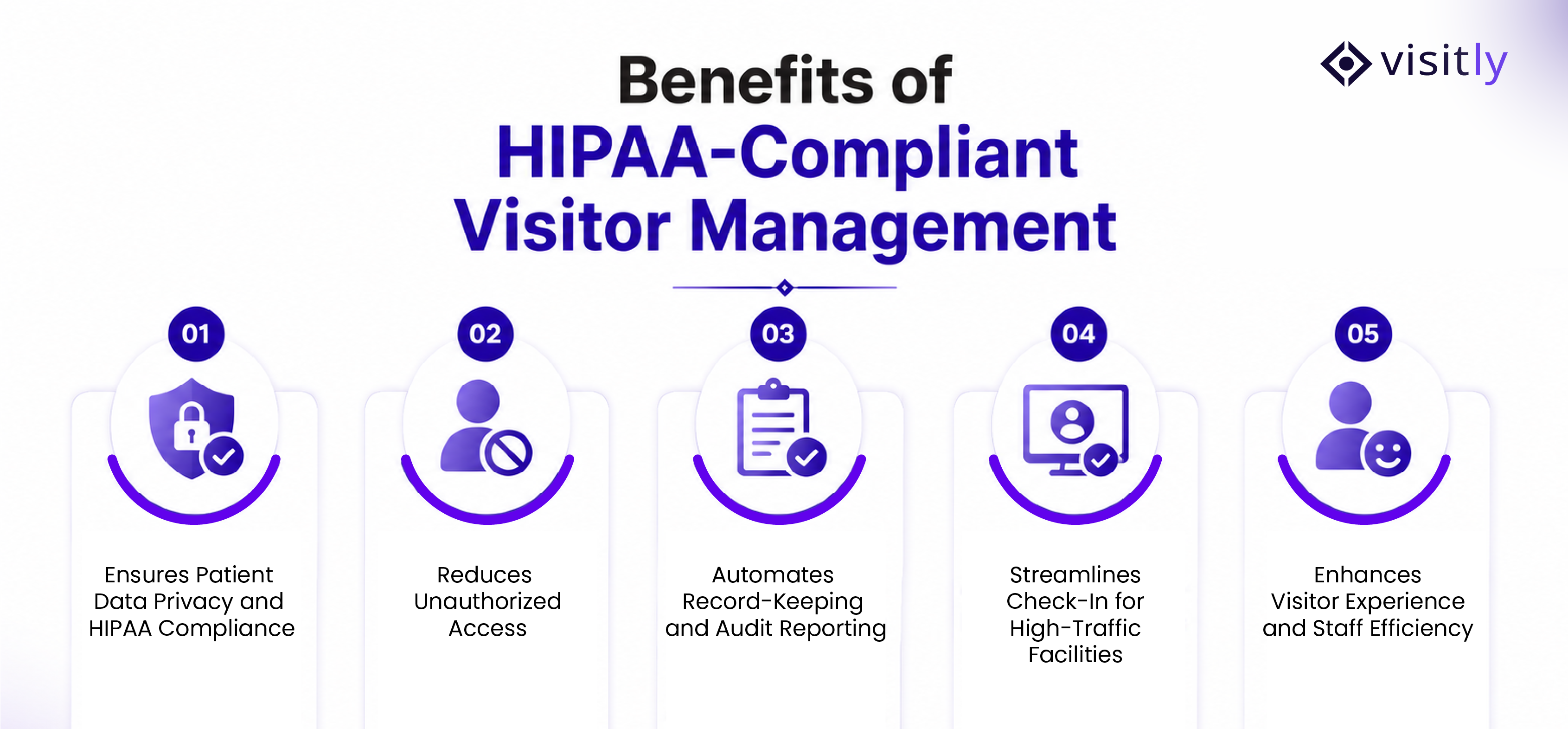
- Ensures patient data privacy and HIPAA compliance
- Reduces unauthorized access
- Automates record-keeping and audit reporting
- Streamlines check-in process for high-traffic facilities
- Enhances visitor experience and staff efficiency
A HIPAA-compliant visitor management system transforms front-desk operations while keeping sensitive patient data secure.
By using modern HIPAA compliance management software, hospitals can:
1. Ensures Patient Data Privacy and HIPAA Compliance
Visitor records are encrypted, access-controlled, and stored in line with HIPAA requirements. This helps eliminate the data-exposure risks posed by paper logs.
2. Reduces Unauthorized Access
ID verification, watchlist screening, and zone-restricted badge printing ensure that only authorized individuals enter sensitive areas such as ICUs, pharmacies, or patient floors.
3. Automates Record-Keeping and Audit Reporting
Every check-in is automatically logged with timestamps, visitor details, and access records. This provides compliance officers with audit-ready reports without manual compilation.
4. Streamlines Check-In for High-Traffic Facilities
Visitor pre-registration, digital screening, and instant badge printing significantly reduce front-desk congestion, even during peak visiting hours.
5. Enhances Visitor Experience and Staff Efficiency
A fast, paperless visitor check-in process reduces wait times while freeing front-desk staff from administrative tasks that add no value to compliance.
What Should Hospital Visitor Management Software Include to Be Truly HIPAA-Compliant?
Hospital visitor management software should include these things to be truly HIPAA-compliant:
- Business Associate Agreement (BAA) availability
- Data encryption in transit and at rest
- Custom screening and health questionnaires
- Restricted area access controls tied to visitor badges
- Pre-registration with identity verification
- Contactless, paperless check-in
- Searchable, exportable audit logs
- Multi-location management from one dashboard
Not all visitor management features are built for healthcare.
Before selecting a platform, compliance officers and IT leads need to evaluate against a clear set of non-negotiables.
Here’s what genuinely HIPAA-compliant hospital visitor management software must include:
- Business Associate Agreement (BAA) — Any vendor handling PHI must be willing to sign a BAA. If a vendor won’t provide one, walk away regardless of how good the product looks.
- Data Encryption in Transit and at Rest — Visitor data must be encrypted at every stage during capture, storage, and transmission, with no exceptions
- Custom Screening and Health Questionnaires — The system must support facility-specific check-in questions covering health declarations, visit purposes, and vaccination status
- Restricted Area Access Controls — Visitor badges must be tied to permitted zones, automatically preventing access to ICUs, pharmacies, or other sensitive areas
- Pre-Registration with Identity Verification — Visitors should be able to register in advance, with ID verification completed before they arrive at your front desk
- Contactless, Paperless Check-In — Zero paper forms, zero shared surfaces, zero exposed PHI in the lobby
- Searchable, Exportable Audit Logs — Compliance teams must be able to retrieve complete visitor records instantly, filterable by date, location, or individual
- Multi-Location Management from One Dashboard — Enterprise healthcare facilities need centralized visibility across every campus, building, or entry point
What to Avoid:
- Tools that store PHI insecurely or in unencrypted formats
- Software lacking a signed BAA or audit-ready reporting
- Systems that rely solely on paper logs or manual processes for compliance tracking
How HIPAA Compliance Monitoring Strengthens Security
HIPAA compliance monitoring strengthens security in the following ways:
- Continuous audit and reporting
- Alerts for suspicious visitor activity
- Integration with hospital IT and security systems
Compliance isn’t a one-time checkbox; it’s an ongoing operational responsibility. HIPAA compliance monitoring in a digital visitor management system means your facility continuously tracks, logs, and reviews every visitor interaction, not just during audits.
Here’s how active monitoring directly strengthens your facility’s security posture:
1. Continuous Audit and Reporting
Every visitor check-in, badge issuance, document signing, and checkout is automatically recorded in a centralized, tamper-proof log. Compliance officers can pull detailed reports at any time, filtered by date, location, visitor type, or access zone, without manually compiling records from multiple sources.
When a regulatory inspection arrives, your audit trail is already complete.
2. Alerts for Suspicious Visitor Activity
A robust system doesn’t just log activity; it flags anomalies in real time. This includes:
- Visitors attempting to access restricted zones beyond their permitted badge permissions.
- Individuals flagged during watchlist screening at check-in.
- Overstay alerts when a visitor remains on-site beyond their authorized time window.
- Repeat visit patterns that fall outside normal visiting behavior.
These automated alerts enable your security and compliance teams to respond before a situation escalates rather than discovering a problem during a post-incident review.
3. Integration with Hospital IT and Security Systems
Standalone compliance monitoring only goes so far. The real value comes when your hospital visitor management system connects with your broader IT and security infrastructure:
- Directory sync with Microsoft Entra ID, Okta, and Active Directory automatically keeps staff and contractor records up to date.
- Access control system integration ensures visitor badge permissions align with physical door controls in real time.
- Communication platform integrations: Slack, Teams, email, keep the right people informed instantly when emergency notifications are triggered.
- Emergency evacuation reports pull live on-site presence data, giving your team an accurate headcount when it matters most.
How Can Healthcare Facilities Implement HIPAA-Compliant Visitor Management Without Disrupting Front-Desk Operations?
Healthcare facilities implement HIPAA-compliant visitor management without disrupting front-desk operations in the following ways:
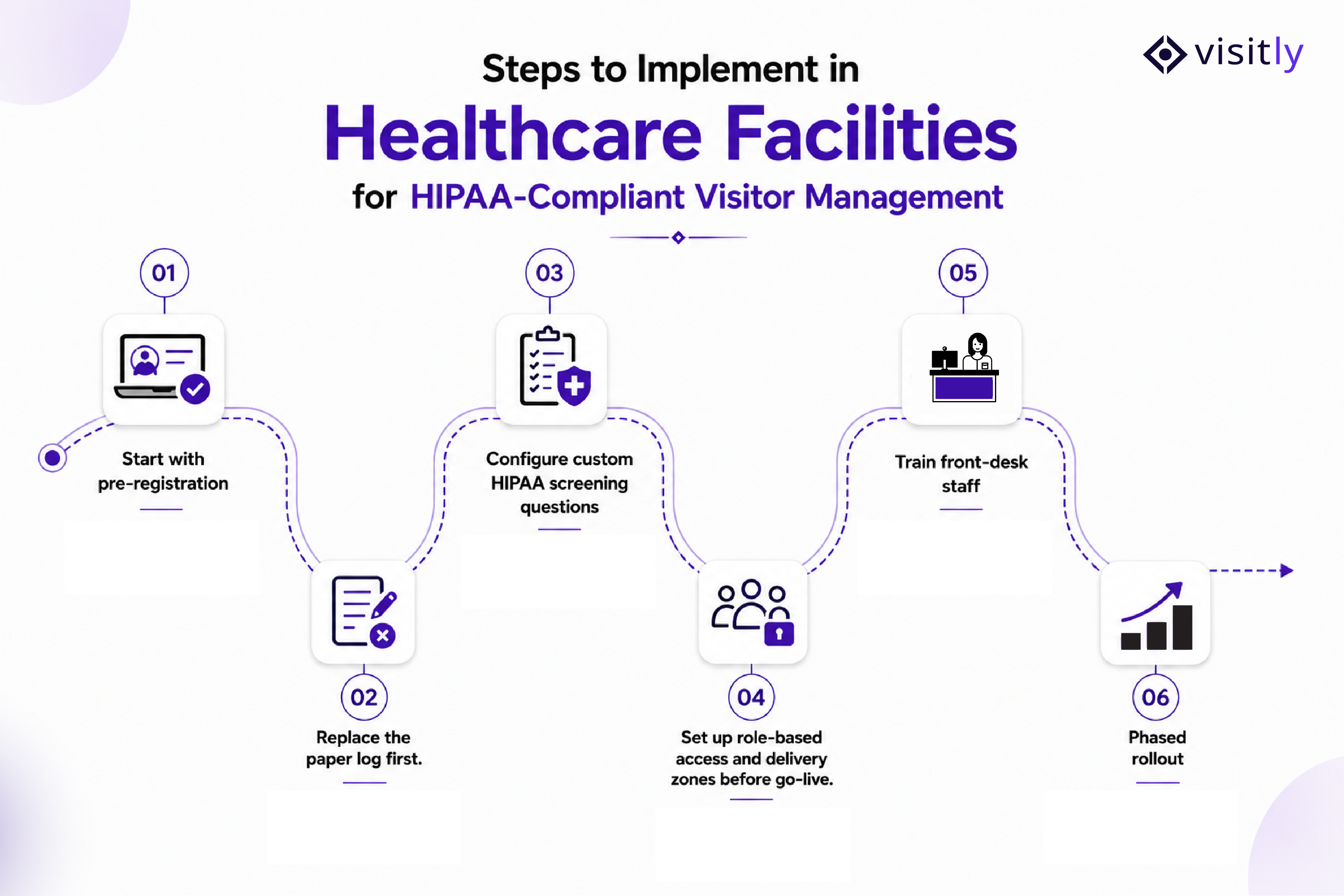
- Start with pre-registration
- Replace the paper log first.
- Configure custom HIPAA screening questions
- Set up role-based access and delivery zones before go-live.
- Train front-desk staff
- Phased rollout
The most common concern we hear from healthcare administrators isn’t whether to switch; it’s how to make the transition without creating chaos at the front desk. The good news is that implementation doesn’t have to be disruptive.
Here’s a practical, phased approach that works:
1. Start with Pre-Registration
Before changing any hardware or front-desk workflows, enable pre-registration for scheduled visitors. This alone reduces lobby congestion, shortens check-in time, and begins building a digital visitor record without touching your existing setup.
2. Replace the Paper Log First
Eliminating the paper sign-in sheet is the single fastest compliance win available to any healthcare facility. It immediately removes PHI exposure, requires minimal staff adjustments, and creates an instant, searchable digital audit trail from day one.
3. Configure Custom HIPAA Screening Questions
Once the digital check-in flow is live, tailor the screening questions to your facility’s specific requirements, such as health declarations, vaccination status, visit purpose, or contractor compliance acknowledgments. This takes only minutes to configure and ensures that every check-in captures the correct compliance data.
4. Set Up Role-Based Access and Entry Zones Before Go-Live
Define which staff members can access visitor records, configure restricted area permissions for visitor badges, and map your entry points within the system before opening it to visitors. Getting this right upfront prevents access control gaps from day one.
5. Train Front-Desk Staff
It takes less time than you think. Visitly requires no technical expertise. Front-desk staff interact with a straightforward iPad dashboard, and visitors complete check-in entirely on their own: no app download is required, and no staff assistance for routine sign-ins. Most teams are fully comfortable within a single shift.
6. Phased Rollout
Pilot one entrance, then scale. Start with your highest-traffic entry point, measure the compliance improvement and staff time saved, then roll out to additional entrances and locations with confidence. One iPad per entry point is all the hardware required.
How Integrated Access Control Services Work with Visitor Management?
A digital visitor management system that operates independently of your facility’s access control solves only half the problem.
When an integrated visitor management system is connected to access control, your visitor check-in platform, every person entering your facility, whether a visitor, contractor, or staff member, is verified, logged, and restricted to areas they’re actually authorized to access.
1. Linking Visitor Check-Ins with Restricted Area Access
When a visitor completes check-in, their badge is automatically configured with access permissions for permitted access zones, patient floors, waiting areas, or specific departments based on the purpose of their visit. Restricted areas like ICUs, pharmacies, operating rooms, and medication storage remain physically inaccessible without the right credentials, with access automatically enforced, eliminating the need for staff to manually redirect every individual.
2. Role-Based Permissions for Staff and Contractors
Not every person entering your facility requires the same level of access. Integrated access control services allow healthcare facilities to configure precise, role-based permissions across every entry point:
- General visitors are restricted to approved floors and waiting areas only.
- Contractors and vendors are granted time-limited access to specific work zones.
- Clinical staff access sensitive areas based on their verified role and shift
- Compliance and facility managers have full visibility across all access events and visitor records.
3. Real-Time Verification and Alerting
Integration means your system isn’t just logging access after the fact; it’s verifying and responding in real time. When an unauthorized access attempt is made, security teams are alerted instantly.
When a visitor’s badge expires, and they remain on-site, an automated overstay notification is triggered. When a watchlist match is identified at check-in, the alert reaches the right people before that individual moves further into your facility.
How Does Visitly’s iPad-Based System Support HIPAA-Compliant Visitor Management at the Front Desk?
Most healthcare facilities assume that upgrading their front desk means complex installations, expensive hardware, and lengthy IT projects.
Visitly proves otherwise. Its entire hospital visitor management workflow runs on a single iPad purpose-built for secure, compliant, and efficient healthcare check-ins.
Here’s what Visitly brings to your front desk specifically:
- No App Download Required — Visitors complete the entire check-in process on the iPad kiosk software without downloading anything. Faster for visitors, simpler for staff, and one less friction point at a busy front desk
- Custom HIPAA Screening Flows — Configure check-in questions, health declarations, and compliance acknowledgments specific to your facility type, whether you’re running a hospital, clinic, or specialist center
- Digital Document Signing at Check-In — NDAs, confidentiality agreements, and facility policies are signed digitally on the spot, stored securely, and retrievable instantly for compliance reviews.
- ID Scanning and Instant Verification — Government-issued IDs are scanned and verified at check-in, creating a reliable, timestamped identity record for every single visitor
- Instant Badge Printing with Zone Restrictions — Visitor badges print automatically with authorized areas and expiry times. Doors stay with your access control system, which Visitly integrates with.
- Secure, Encrypted Visitor Records — Every interaction is logged in Visitly’s encrypted, centralized dashboard, accessible only to authorized staff and exportable for on-demand audits.
Closing Thoughts
If your facility is still relying on paper sign-in sheets, the honest answer is probably not.
Manual visitor logs expose patient data, leave no verifiable audit trail, and create compliance gaps that grow more costly with every passing inspection. The risks are real — and entirely avoidable.
A digital hospital visitor management system brings everything together under a unified strategy: HIPAA compliance monitoring that runs continuously in the background, hospital visitor management software that protects PHI at every check-in touchpoint, and front-desk automation that simultaneously improves security, efficiency, and the visitor experience.
Visitly delivers all of this from a single iPad at your front desk — check-ins that support your HIPAA program, encrypted audit logs, access control integration, and multi-location visibility, all without disrupting your existing workflows or requiring your team to have technical expertise.
Modern healthcare facilities can’t afford to treat visitor management as an afterthought. The right platform makes compliance effortless, scalable, and audit-ready from day one.
Contact the Visitly team today. Visitly is HIPAA compliant and signs a BAA at contract.
FAQs
What does HIPAA require for visitor management?
HIPAA does not name visitor management software, but its Security Rule requires physical safeguards for facilities that house electronic health information. Those include facility access controls, with procedures to validate a person's access and control visitors. The Privacy Rule also limits what patient information other people can see. Your privacy officer decides how each applies.
Is a paper sign-in sheet a HIPAA violation?
Not by itself. HHS guidance permits sign-in sheets when the information on them is limited. The risk comes from what the sheet shows: a log that lets the next person read patient names, room numbers or reasons for a visit exposes more than it should. A digital check-in shows each visitor only their own entry.
Does a visitor management vendor need to sign a business associate agreement?
A business associate agreement is required when the vendor creates, receives, maintains or transmits protected health information for a covered entity. Whether visitor records meet that test at your facility is the privacy officer's call. Many hospitals ask for one regardless. Visitly signs a BAA at contract.
Is contactless check-in required for HIPAA?
No. HIPAA does not prescribe a check-in method. Contactless and paperless check-in help in a narrower way: a visitor who registers on their own phone or by QR code never sees other people's entries, and the record goes straight into an access-controlled log instead of a clipboard on the desk.
Can a visitor management platform work with hospital access control and identity systems?
Yes. The common links are the staff directory, so hosts stay current, and the access control system, so a visitor badge opens only approved doors. Visitly syncs with Microsoft Entra ID, Okta and Active Directory. Its access control integrations include Genetec Security Center, LenelS2 Netbox and C CURE 9000. Our team can show you how they work at your sites.
How can a hospital move to digital visitor check-in without disrupting the front desk?
Phase it. Start with pre-registration for scheduled visitors, then replace the paper log at one high-traffic entrance, and add screening questions and badge zones once staff are comfortable. Set who can view visitor records before go-live. With Visitly, a basic setup takes under an hour, and integrations such as single sign-on take a couple of days.