


A single missing security standard control can delay an ISO 27001 audit, expose sensitive data, or cost an enterprise its next major contract. Enterprises today aren't just protecting servers; they're safeguarding customer data, employee records, physical facilities, and digital infrastructure simultaneously, often across multiple locations and teams.
This is exactly why enterprise security compliance has moved from a checkbox exercise to a boardroom priority. ISO 27001 gives organizations a structured framework to build a genuine Information Security Management System (ISMS), not just pass an audit but create repeatable, defensible security practices.
But most enterprises walk into certification with scattered policies, inconsistent access controls, weak audit documentation, and zero real-time visibility into risk.
That's where a clear, actionable compliance checklist becomes non-negotiable for maintaining long-term security and compliance across the organization.
What Are the Key Areas Covered in an ISO 27001 Compliance Checklist?
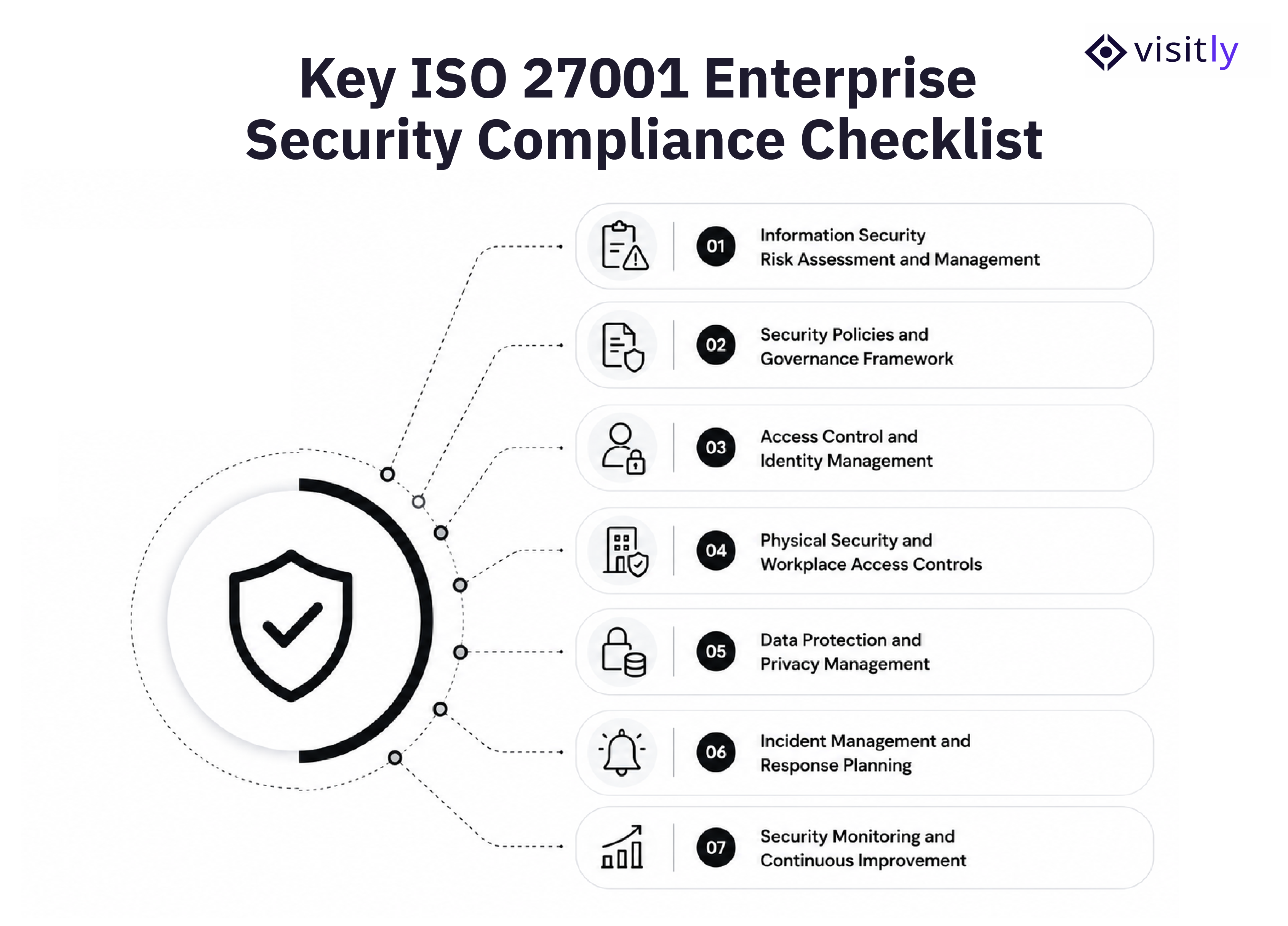
The key areas covered in an ISO 27001 compliance checklist are:
1. Information Security Risk Assessment and Management
2. Security Policies and Governance Framework
3. Access Control and Identity Management
4. Physical Security and Workplace Access Controls
5. Data Protection and Privacy Management
6. Incident Management and Response Planning
7. Security Monitoring and Continuous Improvement
Here's the thing about ISO 27001: it doesn't ask you to be perfect. It asks you to be consistent. And that consistency shows up across seven core areas that every enterprise security compliance checklist needs to cover.
Let's walk through each one.
1. Information Security Risk Assessment and Management
Every ISO 27001 implementation begins with understanding what needs protection and where the biggest compliance risks exist. Organizations should identify critical business assets, evaluate cybersecurity threats and vulnerabilities, assess business impact, and document risk treatment plans.
Maintaining an up-to-date risk register and reviewing risks regularly ensures security controls remain effective as the business evolves.
ISO 27001 Checklist:
- Have all information assets been identified?
- Are security risks documented and prioritized?
- Are mitigation plans assigned to the appropriate owners?
- Is the risk register reviewed and updated regularly?
2. Security Policies and Governance Framework
Security controls only work when supported by clear governance. ISO 27001 requires documented information, workplace security policies, defined responsibilities, and executive oversight to ensure security practices are applied consistently across every department.
Employees should understand their responsibilities, while leadership remains accountable for maintaining the compliance risk management system.
ISO 27001 Checklist:
- Is the information security policy formally approved?
- Are security roles and responsibilities clearly assigned?
- Are workplace security policies reviewed and updated periodically?
- Are employees aware of applicable security policies?
3. Access Control and Identity Management
One of the most common causes of security incidents is an excessive or unmanaged access control system. ISO 27001 emphasizes granting users only the access they need, reviewing permissions regularly, and removing access immediately when employees, contractors, or third-party vendors leave the organization.
Strong identity and access management significantly reduces workplace threats and unauthorized access to sensitive systems.
ISO 27001 Checklist:
- Are user access reviews performed regularly?
- Are role-based permissions implemented across critical systems?
- Is least-privilege access enforced?
- Is access removed immediately after the employee or contractor's exit?
4. Physical Security and Workplace Access Controls
ISO 27001 goes beyond cybersecurity. Physical access control security is equally important because unauthorized access to offices, server rooms, restricted workspaces, or critical infrastructure can compromise sensitive information just as easily as a cyberattack.
Organizations should maintain complete visibility into who enters secure facilities, why they visit, and when they leave. A Digital visitor management system strengthens enterprise security compliance by replacing paper visitor logs with auditable records that support both security teams and compliance audits.
ISO 27001 Checklist:
- Is every visitor check-in recorded digitally?
- Are visitors screened before accessing restricted areas?
- Is unauthorized entry prevented through controlled access?
- Can visitor records be retrieved quickly during an enterprise compliance audit?
How Visitly Supports Physical Security Compliance
Visitly helps enterprises strengthen workplace security by digitizing visitor management through:
- Digital visitors log monitoring system with searchable audit history.
- Custom visitor screening questionnaires
- ID verification during the visitor check-in process
- Real-time emergency notifications for every visitor
- Centralized visitor records for compliance audits
5. Data Protection and Privacy Management
Protecting sensitive information is a fundamental requirement of ISO 27001. Organizations must define how business and customer data is classified, collected, stored, accessed, shared, retained, and securely disposed of throughout its lifecycle.
Well-defined data governance policies reduce security risks while supporting regulatory requirements and customer trust.
ISO 27001 Checklist:
- Has sensitive data been classified?
- Are privacy and security controls implemented?
- Are data retention and deletion policies documented?
- Is sensitive information encrypted where appropriate?
6. Incident Management and Response Planning
Even mature organizations experience security incidents. ISO 27001 focuses on how quickly an organization can detect, respond to, contain, and recover from those incidents while minimizing business impact.
An effective incident response program also captures lessons learned to continuously strengthen future security controls.
ISO 27001 Checklist:
- Is the incident response process documented?
- Are reporting and escalation workflows clearly defined?
- Are incidents investigated and documented?
- Are post-incident reviews and lessons learned completed?
7. Security Monitoring and Continuous Improvement
ISO 27001 certification is not a one-time achievement. Organizations must continuously monitor security controls, conduct internal audits, review compliance performance, and implement corrective actions whenever weaknesses are identified.
Continuous improvement demonstrates that enterprise security compliance is embedded into daily operations rather than treated as an annual compliance exercise.
ISO 27001 Checklist
- Are security controls reviewed on a regular schedule?
- Are internal security audits conducted periodically?
- Are corrective actions tracked until completion?
- Is management reviewing compliance performance regularly?
How Does Enterprise Security and Compliance Work Across Departments?
Enterprise security and compliance require every department to follow consistent security processes. ISO 27001 readiness depends on collaboration between IT, HR, facilities, operations, and compliance teams, not just the security department.
1. IT and Security Teams
IT and security teams manage the technical controls that protect enterprise systems and data. They monitor threats, secure networks, manage user access, and address vulnerabilities.
Responsibilities:
- Monitor security threats
- Manage access control entry system
- Maintain security management systems
- Perform vulnerability assessments
2. HR Teams
HR helps protect the organization by managing secure employee check-in, onboarding and offboarding, controlling access approvals, and promoting security awareness.
Responsibilities:
- Manage onboarding and offboarding
- Coordinate access approvals
- Conduct security awareness training
3. Facility and Operations Teams
Facility teams protect physical workplaces by controlling access, monitoring visitors, and maintaining workplace safety checklists and security procedures.
Responsibilities:
- Manage physical access
- Monitor visitor activity
- Maintain workplace security
Visitly helps by providing:
- Digital visitor logs
- Visitor screening
- ID verification
- Real-time host notifications
4. Compliance Teams
Compliance teams keep the organization audit-ready by maintaining documentation, collecting evidence, and coordinating ISO 27001 audits.
Responsibilities:
- Prepare for audits
- Manage compliance documentation
- Collect audit evidence
- Track corrective actions
ISO 27001 Compliance Checklist: Questions Enterprises Should Ask Before an Audit
Preparing for an ISO 27001 audit is about validating that your security controls are effective, consistently applied, and supported by evidence. These questions can help assess your organization's audit readiness and identify areas that need attention before certification.
Pre-Audit Checklist
- Do we have complete visibility into who can access sensitive resources?
- Are physical and digital access controls properly managed and reviewed regularly?
- Can we provide documented evidence of security controls during an audit?
- Are visitor, contractor, and employee access records securely maintained?
- Are security policies consistently implemented across all departments and locations?
- Do we have processes for continuous security monitoring and ongoing improvement?
If your team cannot confidently answer "Yes" to these questions, it may indicate gaps in your enterprise security compliance program. Addressing these issues before an audit can reduce compliance risks, simplify evidence collection, and improve your chances of achieving ISO 27001 certification.
How Does Visitly Support Enterprise Security Compliance?
ISO 27001 compliance requires organizations to protect both digital assets and physical environments. While cybersecurity controls safeguard systems and data, physical access controls help prevent unauthorized entry into sensitive areas.
Visitly helps enterprises strengthen enterprise security compliance by creating secure, trackable, and audit-ready visitor management workflows.
1. Secure Visitor Access Management
Visitly enables organizations to manage visitor access through a secure digital check-in process. Enterprises can verify visitor identities, capture required information, and ensure only authorized individuals access workplace facilities.
Key capabilities include:
- Digital visitor registration
- Visitor identity verification
- Secure check-in workflows
- Automated host notifications
2. Compliance-Ready Visitor Records
ISO 27001 audits require organizations to demonstrate evidence of security controls. Visitly maintains digital visitor records that provide visibility into facility access history and support faster audit preparation.
Key capabilities include:
- Digital audit trails
- Searchable visitor history
- Clear access visibility
- Organized compliance records
3. Better Workplace Security Controls
Visitly helps security and facility teams improve workplace protection by adding stronger visitor screening and monitoring processes. Organizations can collect relevant visitor details, manage contractors, and maintain visibility during critical situations.
Key capabilities include:
- Custom visitor screening questions
- Real-time host notifications
- Contractor access management
- Emergency visitor visibility
Enterprise ISO 27001 Compliance Checklist Template
Use this checklist to evaluate your organization’s ISO 27001 readiness across key security areas. Reviewing these controls before an audit helps identify gaps, improve documentation, and strengthen your enterprise security compliance program.
Closing Thoughts
ISO 27001 compliance is not achieved by passing an audit once; it requires continuous improvement across people, processes, and technology. Enterprises need ongoing visibility into security controls, access activity, and operational risks to maintain a strong compliance posture.
The right technology platforms help organizations simplify compliance management by creating consistent workflows, improving visibility, and maintaining reliable audit records. Beyond meeting certification requirements, strong enterprise security compliance builds customer trust, strengthens business resilience, and demonstrates a commitment to protecting sensitive information.
Strengthen your enterprise security compliance strategy with Visitly’s secure visitor management platform. Book a demo today to see how it can help improve workplace security, maintain audit-ready visitor records, and simplify compliance management.
FAQs
1. What is an ISO 27001 compliance checklist?
An ISO 27001 compliance checklist is a structured guide that helps organizations evaluate security controls required for certification. It covers areas such as risk management, access control, data protection, physical security, and incident response.
2. What are the key requirements for ISO 27001 compliance?
The key ISO 27001 requirements include establishing an Information Security Management System (ISMS), conducting risk assessments, implementing security controls, managing access, protecting data, monitoring risks, and continuously improving security processes.
3. How does ISO 27001 improve enterprise security compliance?
ISO 27001 helps enterprises create consistent security processes by identifying risks, defining responsibilities, improving access controls, maintaining documentation, and ensuring security practices are regularly reviewed and updated.
4. Why is physical security important for ISO 27001 compliance?
Physical security is a critical part of ISO 27001 because unauthorized access to offices, restricted areas, or sensitive facilities can expose confidential information. Visitor management, access tracking, and audit records help strengthen physical security controls.
5. How do enterprises prepare for an ISO 27001 audit?
Enterprises prepare by reviewing security policies, identifying risks, validating access controls, organizing audit evidence, maintaining documentation, and ensuring security processes are consistently followed across departments and locations.