


How can enterprises maintain workplace security while staying prepared for compliance requirements?
Managing visitors, contractors, and vendors through manual logs can create security gaps, inaccurate records, and challenges during audits.
A modern visitor management system helps organizations replace outdated processes with secure digital check-ins, real-time visitor tracking, and automated compliance records.
With increasing focus on security and compliance, enterprises need better visibility into who enters their facilities, why they visit, who approves access, and when they leave. The right visitor management software improves audit readiness, strengthens workplace safety, and enhances operational efficiency.
This guide explores the key features decision-makers should evaluate when choosing an automated visitor management system for enterprise compliance.
What are the Key Features to Evaluate in Enterprise Compliance Software?
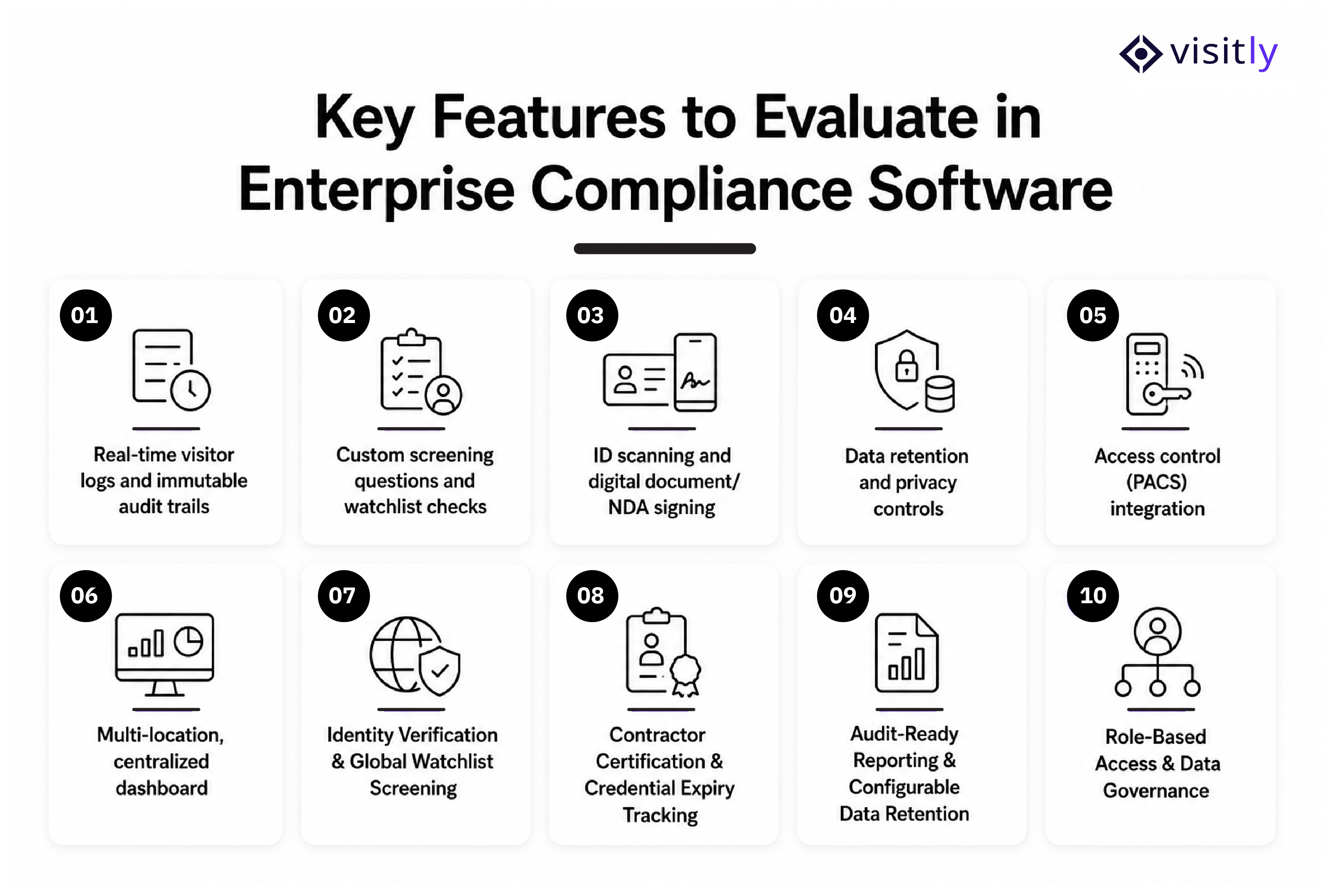
The key features to evaluate in enterprise compliance software are:
- Real-time visitor logs and immutable audit trails
- Custom screening questions and watchlist checks
- ID scanning and digital document/NDA signing
- Data retention and privacy controls (GDPR, CCPA, India's DPDP Act)
- Access control (PACS) integration
- Multi-location, centralized dashboard
- Identity Verification & Global Watchlist Screening
- Contractor Certification & Credential Expiry Tracking
- Audit-Ready Reporting & Configurable Data Retention
- Role-Based Access & Data Governance
Choosing enterprise compliance software for visitor management requires more than looking at basic check-in capabilities. Enterprises need features that help maintain accurate records, enforce security policies, support audits, and provide visibility across facilities.
The right system should combine security controls, compliance workflows, and operational efficiency in one platform.
1. Real-Time Visitor Logs and Immutable Audit Trails
A compliant digital visitor management system should automatically capture every visitor interaction from check-in to check-out. Digital visitor logs provide a reliable record of who accessed the facility, when they arrived, who they met, and when they exited.
Unlike manual registers, automated audit trails reduce missing information and provide security teams with accurate records during compliance reviews, investigations, or audits.
Key capabilities to evaluate:
- Timestamped visitor entry and exit records
- Searchable visitor history
- Complete access to activity records
- Exportable reports for compliance audits
2. Custom Screening Questions and Watchlist Checks
Visitor screening is essential for enterprises operating in regulated industries or handling sensitive facilities. A touchless visitor management system should allow organizations to create customized screening workflows based on their security policies.
For example, enterprises can collect information about visitors' purposes, health declarations, safety requirements, or authorization details before granting access.
Important capabilities include:
- Custom visitor questionnaires
- Pre-visit screening workflows
- Watchlist and restricted visitor checks
- Automated approval or rejection workflows
3. ID Scanning and Digital Document/NDA Signing
Enterprises often require visitors, contractors, and vendors to verify their identity or acknowledge workplace security policies before entering a facility. Manual document collection creates delays and makes record management difficult.
A modern system should support digital identity verification and document signing to ensure workplace compliance requirements are completed before access is granted.
Essential features include the following:
- Government-issued ID scanning
- Digital NDA signing
- Safety acknowledgement forms
- Paperless document storage
4. Data Retention and Privacy Controls (GDPR, CCPA, India's DPDP Act)
Visitor information contains sensitive personal data, making privacy management a critical part of enterprise compliance. Organizations should evaluate whether an enterprise visitor management system provides control over how visitor data is collected, stored, accessed, and deleted.
The platform should support privacy requirements while allowing compliance teams to maintain necessary records.
Evaluate capabilities such as:
- Configurable data retention periods
- Secure visitor data storage
- Access permissions for sensitive information
- Privacy compliance support for regulations like GDPR, CCPA, and India's DPDP Act
5. Access Control (PACS) Integration
Visitor management compliance should not operate as an isolated system.
Integration with Physical Access Control Systems (PACS) allows enterprises to connect visitor approvals with actual facility access.
This creates a stronger security workflow where only approved visitors receive access permissions.
Look for:
- Integration with access control systems
- Automated visitor badge printing or access activation
- Temporary visitor access management
- Immediate access removal after visit completion
6. Multi-Location Centralized Dashboard
Enterprises managing multiple offices, campuses, or facilities need centralized visibility instead of separate visitor records for each location.
A multi-location visitor management system allows security and compliance teams to monitor visitor activity, enforce policies, and generate reports across all facilities from one dashboard.
Key capabilities:
- Centralized visitor data management
- Location-specific compliance policies
- Cross-site reporting
- Standardized visitor workflows
7. Identity Verification and Global Watchlist Screening
For enterprises with strict security standards and requirements, verifying visitor identity before granting access is essential. Identity verification capabilities help reduce unauthorized entry and improve confidence in visitor screening processes.
Important features include the following:
- Identity validation workflows
- Watchlist screening
- Risk-based visitor approvals
- Enhanced verification for high-security facilities
8. Contractor Certification and Credential Expiry Tracking
Contractors often require additional verification, including certifications, licenses, insurance documents, or safety training records. Managing these manually can result in expired credentials and compliance risks.
An integrated visitor management system should help enterprises track contractor eligibility before allowing access.
Evaluate:
- Contractor profile management
- Certification tracking
- Expiry notifications
- Compliance document verification
9. Audit-Ready Reporting and Configurable Data Retention
Compliance teams need quick access to accurate reports during internal reviews, regulatory audits, or security investigations. A digital sign-in and out system should provide configurable reporting instead of requiring manual data collection.
Required reporting capabilities:
- Visitor activity reports
- Contractor access history
- Compliance audit exports
- Custom reporting filters
10. Role-Based Access and Data Governance
Not every employee should have access to all visitor information. Enterprise compliance software should provide role-based permissions to control who can view, edit, or manage visitor data.
This improves data governance while reducing the risk of unauthorized access to sensitive information.
Important controls include:
- User permission management
- Department-level access controls
- Administrative privileges
- Secure data visibility rules
Choosing the Right Enterprise Compliance Solutions for Regulated Industries
Different industries have different security requirements, regulatory obligations, and visitor risks. The right enterprise compliance solutions should help organizations enforce industry-specific access policies while maintaining accurate visitor records, audit trails, and workplace security standards.
1. BFSI
Banks and financial institutions manage sensitive customer data, restricted areas, and high-security facilities. A visitor management system should support identity verification, visitor screening, access tracking, and detailed audit records to meet strict security and regulatory requirements.
2. Healthcare
Healthcare organizations must protect patient privacy, control facility access, and manage visitors, vendors, and contractors in sensitive environments. Compliance-focused visitor management helps maintain visitor logs, verify identities, and support privacy requirements such as HIPAA and other healthcare data protection standards.
3. Manufacturing
Manufacturing facilities often manage contractors, suppliers, and visitors accessing production areas with safety and operational risks. Enterprises need solutions that support contractor credential tracking, safety acknowledgements, restricted access controls, and real-time visibility into facility occupancy.
4. Education
Schools and universities need to balance open campus experiences with visitor safety and security requirements. A visitor management system helps institutions verify guests, manage authorized access, maintain visitor records, and improve emergency preparedness.
Questions to Ask Before You Choose a Visitor Management System
Before investing in a visitor management system, enterprises should evaluate whether the solution can meet their security, compliance, and operational requirements. These questions can help decision-makers identify the right platform for their workplace needs:
1. Does the visitor management system provide complete audit trails and compliance-ready reports?
Ensure the platform can maintain accurate visitor records, generate reports, and support internal or regulatory audits.
2. Can the system integrate with our existing security and workplace systems?
Check whether it connects with access control systems, HR platforms, SSO solutions, and other enterprise tools.
3. Does it support identity verification, visitor screening, and custom approval workflows?
Evaluate whether the solution can enforce security policies based on visitor type, location, or risk level.
4. How does the platform protect and manage visitor data?
Understand its data retention policies, privacy controls, and support for regulations such as GDPR, CCPA, and India's DPDP Act.
5. Can it scale across multiple locations and departments?
Enterprises should ensure the system supports centralized management while allowing location-specific compliance requirements.
6. Does it improve emergency response and workplace safety?
Confirm whether the platform provides real-time visitor headcount, occupancy visibility, and quick access to visitor information during emergencies.
Why Visitly Fits Enterprise Compliance Needs
Enterprise compliance requires more than maintaining visitor records. Organizations need a visitor management system that improves security, supports audits, and provides real-time visibility into workplace access.
Visitly helps enterprises replace manual processes with a secure digital check-in experience for visitors, contractors, and employees.
Key capabilities include:
- Modern visitor sign-in experience: Digital check-ins replace manual logs and create accurate visitor records.
- Secure visitor management: Manage visitors, contractors, and employees with structured access workflows.
- Custom screening questions: Collect required information and enforce workplace safety policies before access.
- Bulk visitor pre-registration: Register multiple visitors in advance for meetings, events, or contractor visits.
- Real-time host notifications: Alert employees through emergency notifications instantly when visitors arrive.
- Digital document signing: Collect NDAs, waivers, and safety acknowledgements digitally.
- ID scanning: Verify visitor identities and maintain reliable access records.
With these capabilities, Visitly helps enterprises improve security and compliance, simplify visitor operations, and maintain better workplace visibility.
Why Enterprises Choose Visitly for Visitor Management
- Faster check-ins: Reduce waiting times with automated digital workflows.
- Better compliance visibility: Access centralized visitor records and audit-ready reports.
- Improved workplace safety: Strengthen visitor verification and access control.
- Simple implementation: Quickly adopt a user-friendly visitor management solution.
- Scalable operations: Support growing visitor volumes and multiple locations.

Closing Thoughts
Visitor management has become a critical part of enterprise security and compliance strategies. The right solution helps organizations maintain accurate visitor records, improve workplace visibility, reduce security risks, and simplify compliance audits.
Before selecting a platform, enterprises should evaluate key capabilities such as automation, security controls, integrations, reporting, and scalability to ensure the solution can support future business needs.
With customizable workflows, secure check-ins, digital records, and compliance-focused features, Visitly helps enterprises create safer, smarter, and more efficient visitor experiences.
Make every visitor interaction secure, compliant, and effortless with Visitly. Book a demo today to see how Visitly can support your enterprise compliance goals.
FAQs
1. What is a visitor management system for enterprise compliance?
A visitor management system for enterprise compliance is a digital platform that helps organizations manage visitor access, maintain audit trails, verify identities, and meet workplace security requirements through automated processes.
2. How does a visitor management system improve enterprise security and compliance?
A visitor management system improves security and compliance by maintaining accurate visitor records, enabling identity verification, supporting visitor screening, providing real-time notifications, and simplifying audit preparation.
3. What features should enterprises look for in visitor management software?
Enterprises should look for features such as digital visitor logs, audit trails, ID scanning, custom screening workflows, access control integrations, data privacy controls, reporting, and multi-location management.
4. Can visitor management systems support compliance requirements across multiple locations?
Yes. Enterprise visitor management systems can provide centralized dashboards, standardized security policies, location-specific workflows, and reporting across multiple offices or facilities.
5. How does visitor management software help during compliance audits?
Visitor management software helps during audits by providing accurate visitor histories, digital records, access logs, signed documents, and reports that demonstrate compliance with workplace security policies.