



A single unauthorized access at a defense facility can spark a federal investigation, contract suspension, and million-dollar penalties.
What makes this even more alarming is that ITAR violations don’t require intent. Something as simple as a foreign national walking through the wrong corridor, a subcontractor handling a controlled drawing without clearance, or an unsigned NDA at check-in can constitute a federal violation under U.S. law.
Despite this, many organizations focus on digital security and compliance but neglect proper management of physical facility access.
A paper sign-in sheet is not a visitor management system, and in an ITAR-regulated environment, that gap carries serious legal consequences.
The truth is, contractor management doesn’t end at credential vetting. It means enforcing access control entry, capturing the required documentation, and maintaining audit-ready records every time someone enters a controlled area.
This guide walks you through exactly what ITAR requires of defense contractors, where most organizations fall short, and what a solid, defensible compliance posture looks like in practice.
What Is ITAR and Who Does It Apply To?
ITAR, or the International Traffic in Arms Regulations, is a set of U.S. federal regulations that control the export and import of defense-related articles, services, and technical data.
Administered by the U.S. Department of State’s Directorate of Defense Trade Controls (DDTC), ITAR exists to ensure that sensitive defense technology doesn’t reach unauthorized foreign entities, intentionally or otherwise.
What Does ITAR Actually Govern?
At its core, ITAR governs three categories:
- Defense articles – Physical items listed on the U.S. Munitions List (USML), from firearms to satellite components
- Defense services – Technical assistance, training, or support related to USML items
- Technical data – Blueprints, drawings, specifications, software, and any information directly tied to USML-listed items
What Are the Core ITAR Requirements for Contractors?
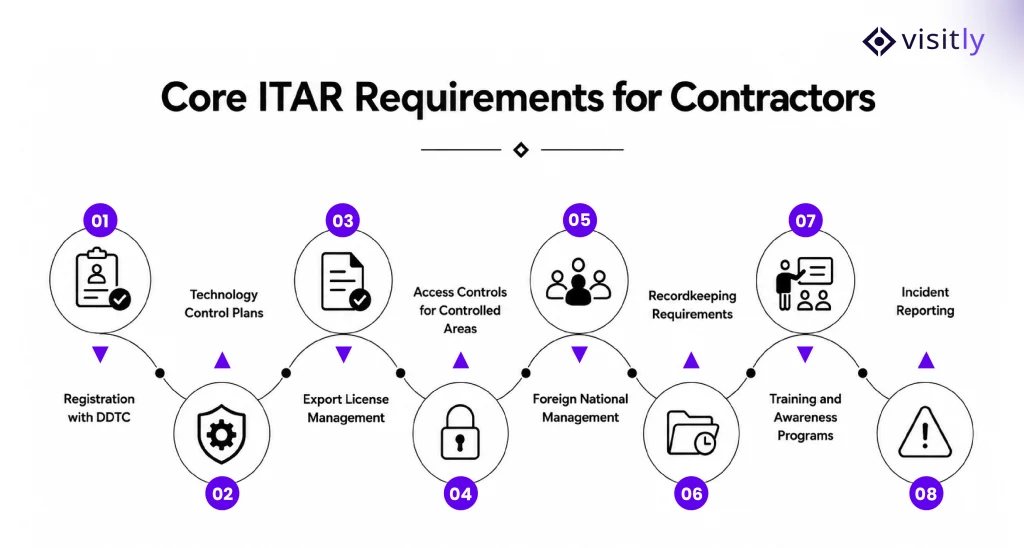
The core ITAR requirements for contractors are:
- Registration with DDTC
- Technology Control Plans (TCP)
- Export license management
- Access controls for controlled areas
- Foreign national management
- Recordkeeping requirements
- Training and awareness programs
- Incident reporting
Understanding your ITAR obligations as a defense contractor isn’t just about knowing the rules; it’s about building operational systems to consistently meet them. The regulations cover a broad range of activities, from how you register your organization to how you manage every person who walks into a controlled area.
Here is a breakdown of the eight core requirements every defense contractor needs to have in place.
1. Registration With DDTC
Any contractor involved in manufacturing, exporting, or brokering USML-listed items must register with the Directorate of Defense Trade Controls before beginning work. Registration must be renewed annually and kept current at all times. Key points to know:
- Operating without active DDTC registration is a violation in itself.
- Registration applies to manufacturers, exporters, brokers, and service providers handling USML items
- Subcontractors must assess whether their scope of work triggers an independent registration requirement
2. Technology Control Plan (TCP)
A Technology Control Plan is your organization’s written guide for ITAR compliance. It specifies how technical data is identified, handled, stored, and shared. A compliant TCP covers:
- Physical security measures for controlled areas
- Digital access controls for systems handling USML-related data
- Employee and contractor responsibilities under ITAR
- Procedures for managing foreign national access requests
3. Export License Management
Not all USML transactions need a license, but you must have a clear process for:
- Determining license requirements before any transaction or access decision
- Applying for and tracking license approvals through DDTC
- Maintaining records of all applications, approvals, and related correspondence
4. Access Controls for Controlled Areas
Physical and digital access to controlled areas must be restricted exclusively to authorized U.S. persons. This is not just an IT responsibility — it is a facility-wide compliance requirement. Access controls must include:
- Role-based access permissions for both physical zones and digital systems
- Documented entry and exit logging for every controlled area
- Automated restrictions that prevent unauthorized access outside defined business hours
- Real-time alerts when access rules are triggered or violated
5. Foreign National Management
Under ITAR’s deemed export rule, granting a foreign national access to controlled technical data even visually constitutes an export. This makes foreign national management one of the highest-risk areas for any defense contractor. Requirements include:
- Individual vetting and tracking of every non-U.S. person requiring facility access
- Export license coverage is required before access is granted
- Screening against DDTC denied parties lists prior to entry
- Documented records of all foreign national access decisions and approvals
6. Recordkeeping Requirements
ITAR requires contractors to maintain detailed records of all transactions involving defense articles, services, and technical data for a minimum of five years. Records that must be maintained include:
- Export licenses and shipping documentation
- Facility access logs with timestamps for all controlled areas
- ITAR training completion records for all personnel
- Correspondence related to controlled items or data transfers
7. Training and Awareness Programs
Every individual with access to ITAR-controlled data or restricted areas must complete documented ITAR training before that access is granted. Training must cover:
- How to identify controlled technical data and USML-listed items
- Proper handling, storage, and sharing procedures
- Reporting obligations when a potential violation is suspected
- Personal legal consequences of non-compliance: ITAR liability is individual, not just organizational
8. Incident Reporting
ITAR requires contractors to report potential violations to the DDTC. Delaying disclosure consistently makes outcomes worse. A mature incident reporting process includes:
- A documented internal procedure for identifying and escalating potential violations
- Prompt voluntary disclosure through DDTC’s self-reporting program
- Legal counsel involvement from the moment a potential violation is identified
- Post-incident corrective action documentation to demonstrate remediation
What Are the ITAR Cybersecurity Requirements for Defense Contractors?
When most people think about ITAR cybersecurity requirements, they think about firewalls, encrypted drives, and IT policies. And while those matter, the reality is broader. ITAR’s cybersecurity obligations sit at the intersection of federal defense regulations, data protection standards, and physical access control, and defense contractors need to understand how all three connect.
Key Cybersecurity Controls Required Under ITAR
For defense contractors handling USML-related technical data, the following cybersecurity controls are non-negotiable:
- Access control for IT systems – Only authorized U.S. persons should have access to systems storing or processing controlled technical data, with role-based permissions enforced at the system level
- Multi-factor authentication (MFA) – All systems containing USML-related data must require MFA to eliminate single-point credential vulnerabilities.
- Encryption at rest and in transit – Controlled technical data must be encrypted, whether it is stored on local servers, cloud systems, or transmitted across networks
- Audit logging – Every access event on systems handling controlled digital assets must be logged, timestamped, and retained for a minimum of five years
- Incident response plans – A documented, tested response plan must be in place for data breaches, unauthorized access events, or suspected ITAR violations involving digital assets.
What Happens If You Violate ITAR in Defense Facilities? Understanding the Consequences
No defense contractor aims to violate ITAR. However, intent is not considered in a violation prosecution. A single access-control lapse, an unscreened contractor, or a missing export license can have consequences that affect contracts, reputation, and personal freedom.
Here is exactly what is at stake.
Civil Penalties
- Up to $1,308,326 per violation, and each incident is counted separately.
- Multiple access events or transactions can quickly add up to an eight-figure liability.
- Negligence is enough; criminal intent is not required for civil penalties to apply.
Criminal Penalties
- Up to $1 million per violation in fines
- Up to 20 years imprisonment per violation
- Personal liability for individual employees and executives, not just the organization
- Cases are prosecuted directly by the Department of Justice.
Contract Debarment
- Immediate suspension or termination of existing defense contracts
- Disqualification from bidding on future federal contracts
- Flow-down debarment risk to subcontractors and affiliated entities
- Recovery can take years; if reinstatement is possible at all
Reputational Damage
- ITAR enforcement actions are publicly disclosed by DDTC, not kept confidential
- Violation details and penalty amounts are published in public consent agreements
- Industry partners, government agencies, and procurement teams actively review this record
- In defense contracting, a public ITAR violation can close doors that financial recovery cannot reopen
Voluntary Disclosure: Your Best Option If Something Goes Wrong
- Self-reporting through DDTC’s Voluntary Disclosure program typically results in substantially reduced penalties
- It demonstrates a proactive compliance culture and good faith to regulators
- Delayed or concealed violations are treated significantly more harshly when independently discovered
- A documented incident response procedure before a violation occurs is what separates a manageable event from a catastrophic one
ITAR Compliance Checklist for Defense Contractors – Are You Covered?
Use this ITAR compliance checklist as a practical starting point to assess where your organization stands. If any item is unchecked, it represents an active compliance gap that needs to be addressed before your next audit or your next contractor walks through the door.
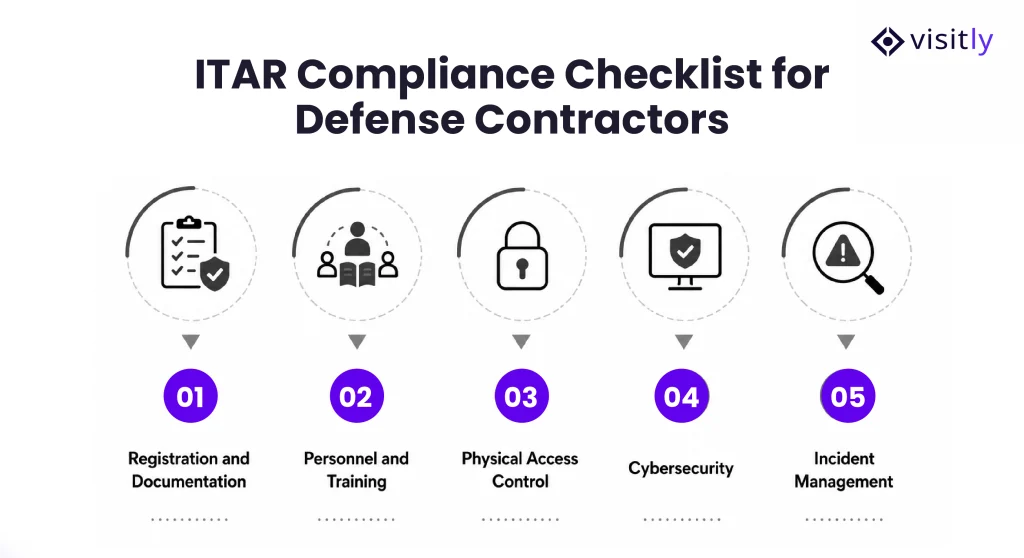
1.Registration and Documentation
- Registered with DDTC as required for your scope of work
- Active and documented Technology Control Plan (TCP) in place
- Records retained for a minimum of five years across all controlled transactions
2. Personnel and Training
- All personnel with controlled data access verified as U.S. persons
- ITAR training completed and documented before access is granted
- Foreign nationals’ access is individually tracked and licensed where required
3. Physical Access Control
- Physical access to controlled areas is restricted, monitored, and logged
- Identity verified and citizenship screened at the point of entry for every individual
- Digital NDAs and ITAR acknowledgment forms collected at check-in
- Audit-ready contractor and access logs are maintained and immediately exportable
4. Cybersecurity
- Cybersecurity controls aligned with NIST SP 800-171 and CMMC requirements
- Audit logging is active on all systems handling controlled technical data
- Multi-factor authentication is enforced on all USML-related systems
5. Incident Management
- Incident response procedures documented and tested
- Voluntary disclosure process established and understood by compliance teams
- Corrective action documentation process in place for post-incident remediation
How Does Visitly Help Defense Contractors Meet ITAR Requirements?
Managing ITAR compliance at the facility level is operationally demanding. Every contractor who walks through your door needs to be verified, screened, documented, and logged every single time. Manual processes can’t keep up at scale, and a single gap in your records can become a federal liability.
Here is how Visitly automatically closes that gap.
1. Contractor Identity Verification and Watchlist Screening
- Smart ID scanning and validation flags expired, or invalid documents before access is granted
- Real-time watchlist screening triggers instant alerts for flagged individuals
- Offender check screens contractor IDs against high-risk registries at entry
- Visitor approvals allow security teams to approve or deny access before entry
2. Digital Documentation at the Point of Entry
- Contractors sign NDAs and ITAR acknowledgment agreements directly on the iPad kiosk at check-in
- Every signed document is timestamped, stored securely, and instantly accessible via the admin portal
- Bulk pre-registration ensures documentation is collected before arrival, not scrambled at the door
3. Access Control That Enforces Itself
- Off-business-hours rules automatically restrict visitor check-in outside defined working hours
- Facial recognition watchlist triggers an immediate alert when a flagged individual attempts to check in
- Safelist overrides allow trusted recurring contractors to move through without unnecessary friction
4. Audit-Ready Logs Without the Administrative Burden
- Every entry and exit is recorded with timestamps, identity details, and visit purpose
- Access logs are instantly exportable for compliance audits and regulatory reviews
- Centralized multi-location dashboard manages contractor access across all facilities in one place
5. Compliance Credentials That Hold Up Under Scrutiny
- SOC 2 Type 2 Certified
- ISO 27001 Certified
- GDPR compliant; HIPAA compliant, BAA signed at contract
Closing Thoughts
ITAR compliance is not a one-time checkbox; it is an ongoing operational responsibility that extends to every contractor, subcontractor, and third party working within a defense facility. From the moment someone steps through your door to the moment they leave, your organization is accountable for what they access, what they see, and whether your records can prove it.
The contractors who stay out of trouble aren’t necessarily the ones with the biggest compliance teams. They are the ones who have built the right systems to enforce access controls, capture documentation, and maintain audit-ready records consistently and automatically.
Visitly gives defense facility managers exactly that a purpose-built platform to manage contractor check-ins, enforce access policies, and stay audit-ready without the administrative burden.
See how Visitly supports the ITAR program at defense facilities from the front desk forward.
FAQs
What are the ITAR requirements for contractors?
Contractors that make, export or broker items on the US Munitions List register with the State Department. Any contractor that receives the technical data must control who can access it, manage foreign persons on site and keep records. Prime contractors pass these duties down. Counsel confirms whether a contract involves controlled work.
How does ITAR affect visitor and employee access?
ITAR restricts who may see or reach controlled items and technical data, and that includes people inside your own building. Letting a foreign person view controlled data in the US is treated as an export. Facilities therefore identify each visitor's citizenship, keep foreign persons out of controlled areas or escort them, and log every visit.
What is a technology control plan?
A technology control plan is the written document that says how a facility keeps export-controlled items and data from unauthorized foreign persons. It usually names the controlled areas, who may enter, badge and escort rules, visitor procedures, IT access limits and training. Customers and government reviewers commonly ask to see it with the records that prove it is followed.
Can foreign nationals visit an ITAR-controlled facility?
Yes, but they cannot access controlled technical data or defense articles without authorization from the State Department. Most facilities record citizenship at check-in, issue a distinct badge, require an escort and keep the visit to areas with no controlled work. Visitly supports this with citizenship gating by area, a signed US-person declaration and an escort workflow.
What cybersecurity measures does ITAR require?
ITAR does not prescribe a list of cybersecurity controls. It requires that technical data is not released to unauthorized foreign persons, and leaves the method to the company. Contractors that also handle Controlled Unclassified Information for the Department of Defense are held to NIST SP 800-171, which sets specific requirements for access control, encryption and audit logging.
How can contractors stay ready for an ITAR audit?
Keep the records that show your controls ran, and keep them searchable. That means registration and license files, training records, the technology control plan and visitor logs with citizenship, host, escort and signed acknowledgments. ITAR recordkeeping rules generally require records to be kept for five years. Visitly exports the visitor audit trail when a reviewer asks.