



One compliance gap. One undocumented contractor visit. One undertrained employee with access to controlled technical data. That is all it takes to trigger an ITAR violation.
According to research, failing to meet ITAR requirements can result in severe penalties, including fines that reach up to $1 million per violation and potential criminal charges.
International Traffic in Arms Regulations (ITAR) is not a checkbox exercise. Whether you are a defense contractor in the U.S., an aerospace supplier in India, or a global enterprise managing regulated facilities, your security and compliance posture is under scrutiny every single day.
Most ITAR compliance checklist failures are not deliberate export crimes. They are procedural breakdowns, missing training records, unlogged visitor access, and contractor documentation that would not survive a DDTC audit.
This enterprise audit playbook gives you a structured, phase-by-phase framework to assess your ITAR compliance requirements, close critical gaps, and build a workplace compliance program that holds up in practice.
Let us get into how you can implement ITAR requirements and secure your organization’s future.
Why Are ITAR Compliance Requirements Crucial for Your Organization?
ITAR compliance requirements are crucial for your organization in the following ways:
- Preventing Penalties
- Ensuring National Security
- Building Trust with Partners
- Protecting Employee and Company Data
Adhering to ITAR requirements not only ensures national security but also protects your organization from costly penalties, strengthens relationships with key partners, and safeguards sensitive data.
Below, we explore the key reasons why ITAR compliance should be a top priority for your organization.
1. Preventing Penalties
Non-compliance with ITAR can lead to severe financial and legal penalties, including fines up to $1 million per violation. In some cases, it could even result in the suspension of export licenses, which can cripple your business operations.
2. Ensuring National Security
ITAR regulations are designed to safeguard sensitive defense-related technologies and prevent them from falling into the wrong hands. By adhering to these guidelines, your organization helps protect national security standards and maintain global peace.
3. Building Trust with Partners
When your organization demonstrates strict adherence to ITAR, it builds trust with government agencies and defense contractors. Compliance signals that your business is responsible and dependable, making it easier to form long-term partnerships and secure more contracts.
4. Protecting Employee and Company Data
ITAR compliance ensures that sensitive data, including employee and company information, is properly secured. With robust access controls and audit trails, you reduce the risk of data breaches and leaks, protecting both your employees and your organization's reputation.
ITAR Compliance Checklist: Key Areas Organizations Should Review
Maintaining ITAR compliance requires controls across people, processes, technology, and physical facilities.
Use this checklist to review your organization’s compliance readiness:
1. Registration and documentation
- Determine whether your activities require DDTC registration
- Maintain current registration information
- Document ITAR-controlled items, technical data, and activities
- Maintain required records related to ITAR activities
2. Access control
- Identify employees, contractors, and visitors who require access
- Restrict access to authorized personnel only
- Maintain access records for controlled areas and systems
3. Employee and contractor controls
- Provide ITAR awareness training
- Define employee responsibilities for handling controlled data
- Review contractor access before granting permissions
- Ensure third parties understand export-control obligations
4. Physical security
- Secure areas containing ITAR-controlled items or technical data
- Control visitor entry into restricted areas
- Maintain visitor logs and badge records
- Monitor access to controlled locations
5. Cybersecurity
- Protect ITAR-controlled technical data with appropriate access controls
- Restrict unauthorized data sharing
- Monitor systems handling controlled information
- Maintain incident response procedures
6. Audit preparation
- Maintain compliance documentation.
- Review access logs periodically
- Conduct internal compliance reviews.
- Correctly identified gaps promptly
What Are the Core ITAR Compliance Requirements for Your Workforce?
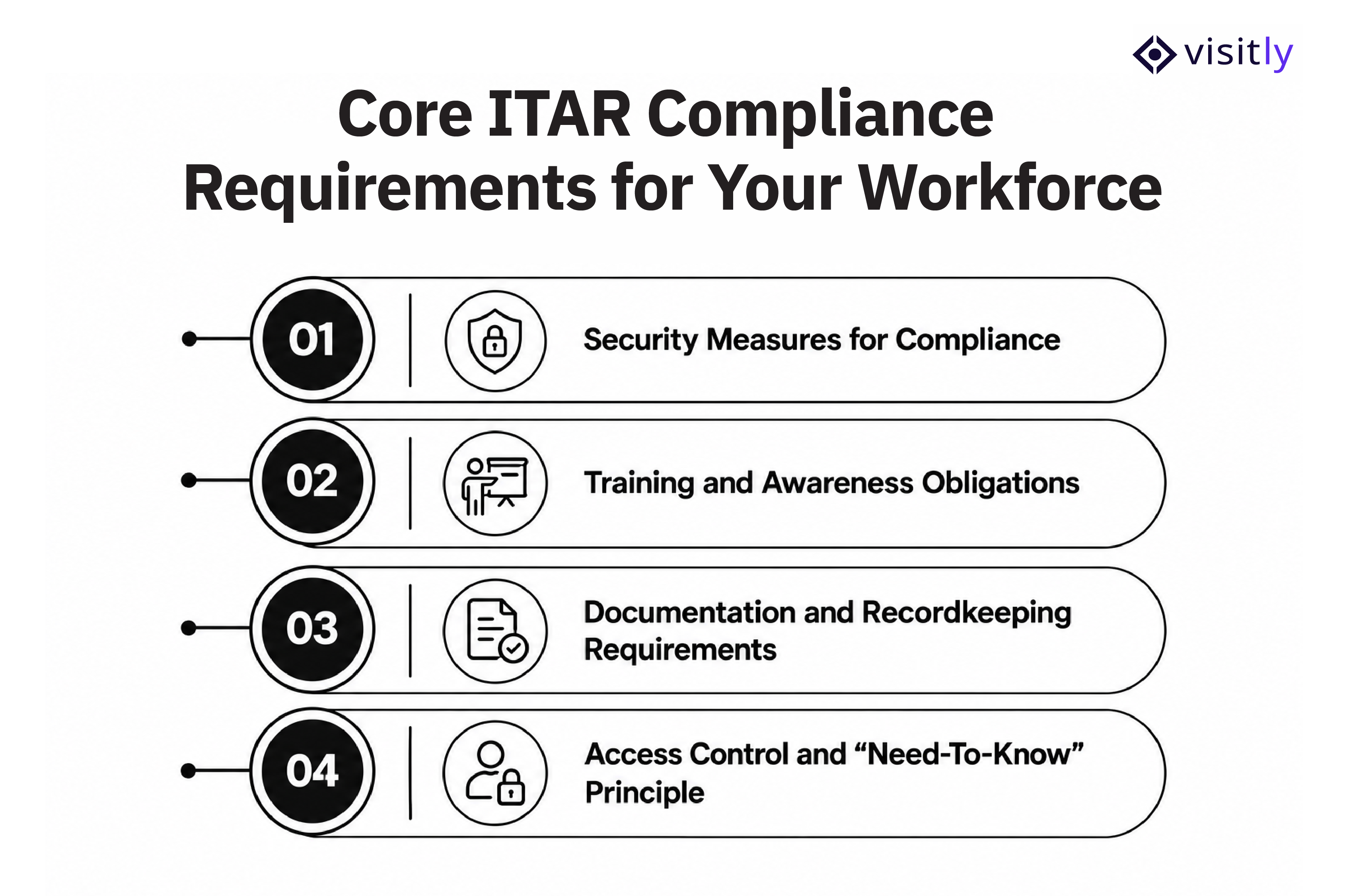
The core ITAR compliance requirements for employees are:
1. Security Measures for Compliance
2. Training and Awareness Obligations
3. Documentation and Recordkeeping Requirements
4. Access Control and "Need-To-Know" Principle
Staying ITAR-compliant is more than just ticking boxes; it’s about creating a culture of responsibility and security that filters into every layer of your workforce. It’s not just about what your employees do; it’s about how they think and act when handling sensitive defense-related data.
Let’s break down the core compliance requirements that keep your organization in the clear.
1. Security Measures for Compliance
Think of workplace security like a fortress. Your employees need to be the watchmen. This isn’t just about setting up firewalls or installing encryption software. It's about developing a robust security posture to ensure that only authorized personnel can access ITAR-controlled information.
Employees should be equipped with the right security tools and understand how to use them effectively. From secure sign-ins to encrypted communications, it’s all about ensuring information stays safe—both online and offline.
2. Training and Awareness Obligations
Ever heard the saying, "You don’t know what you don’t know"? Well, in the world of ITAR, ignorance is not bliss; it's a risk. That’s why training isn’t optional; it’s a must.
Your employees need to be fully aware of the regulations they’re working under and how to handle sensitive information appropriately.
Whether it’s annual refresher courses or onboarding training, everyone in the organization must understand their role in maintaining compliance. A well-trained workforce reduces the likelihood of accidental violations.
3. Documentation and Recordkeeping Requirements
Here’s where the paperwork comes in. And while documentation may not sound like the most exciting part, it’s one of the most critical aspects of ITAR compliance.
From business rule extraction to detailed records of employee access to controlled technologies, maintaining thorough, organized documentation is non-negotiable. This serves not only as a safeguard but also as a way to demonstrate your organization's compliance if a regulatory audit comes knocking.
Remember, "if it’s not documented, it didn’t happen."
4. Access Control and the "Need-to-Know" Principle
"Need-to-know" isn’t just a guideline; it’s a core principle in ITAR compliance. Not every employee needs access to every piece of sensitive information.
Restricting access based on role and necessity is key to minimizing risk. Think of it like a treasure chest: you wouldn’t let just anyone have the key. Only those who absolutely need to access specific data should be allowed to do so.
By implementing a strict access control system, your company can ensure sensitive information remains protected from unauthorized access.

What Are the Key ITAR Cybersecurity Requirements for Employee Access?
ITAR cybersecurity requirements sit at the intersection of your digital and physical controls, and most enterprise audit gaps do too.
Protecting Controlled Technical Data in Digital Environments
Your IT environment must enforce access controls that are tightly aligned with your ITAR authorization lists. "Everyone on the team can access the shared folder" is not a defensible position for compliance. Role-based access controls (RBAC), multi-factor authentication, and network segmentation are the baseline, not the gold standard.
Your ITAR cybersecurity policies should document and enforce the following:
- Role-based access controls (RBAC) that restrict USML-related data to authorized personnel only
- Multi-factor authentication (MFA) for any system storing or transmitting controlled technical data
- Data encryption at rest and in transit across all controlled environments
- Audit logging that captures who accessed what data, from where, and when
- Network segmentation isolates controlled data systems from the general business infrastructure.
- Offboarding protocols that immediately revoke access when an employee or contractor departs
How Physical Access Control Connects to Cyber Compliance
Here is the blind spot that trips up even mature ITAR compliance programs: sophisticated digital access controls mean very little if your physical perimeter is unmanaged.
A visitor who walks unchecked into a controlled facility can read a whiteboard, photograph a printed schematic, or simply observe a conversation about controlled technical data. That is an ITAR exposure event, and it will not show up in your SIEM logs.
Restricting and tracking employee access to controlled areas is as much a cybersecurity obligation as firewall configuration. Logical and physical access controls must mirror each other. If an employee is not authorized to access ITAR data in your IT system, they should not be able to enter the room where that data is actively being used.
This is where monitoring tools and purpose-built visitor access management systems become essential to your compliance posture.
Visitly’s visitor and employee management platform creates a real-time, timestamped record of every person who enters a controlled facility. This aligns with custom ITAR screening questions, digital acknowledgment signing, and host-approval workflows built directly into the check-in process.
It does not replace your cybersecurity stack. It closes the physical gap that your cybersecurity stack cannot see.
When your next DDTC audit asks who was in your controlled facility on a given date and what they acknowledged before entering, Visitly gives you an answer in seconds, not a search through paper binders.
How Can Visitly’s ITAR Visitor Management Systems Enhance Compliance?
An ITAR visitor management system from Visitly enhances compliance in the following ways:
1. Pre-Registration and Screening
2. Real-Time Host Notifications
3. Digital Documentation and Compliance
4. Maintaining Detailed Records
An ITAR visitor management system replaces that vulnerability with a structured, documented, and defensible access control process that covers every person who crosses your threshold: visitors, vendors, contractors, and temporary staff alike.
Here is how a purpose-built system like Visitly strengthens your ITAR compliance posture at every stage of the visit lifecycle.
1. Pre-Registration and Screening
The most effective access control happens before a visitor arrives, not after they are already standing at your reception desk. Visitly's bulk visitor pre-registration feature lets hosts validate authorization in advance, capturing identity details, visit purpose, and ITAR-specific screening responses before anyone steps through the door.
A compliant pre-screening workflow should cover the following:
- Citizenship and foreign national status: Flagging visitors who require additional authorization under ITAR
- Export control acknowledgment: Confirming the visitor understands restrictions on controlled technical data
- NDA agreement: Collecting digital consent before access is granted
- Purpose of visit: Documenting the specific business justification for facility entry
2. Real-Time Host Notifications
An unescorted visitor in a controlled facility is an exposure event, not an inconvenience. One of the most overlooked ITAR access risks is the unsupervised visitor whose host is unavailable or simply unaware they have arrived.
Visitly eliminates that gap with instant, multichannel host alerts the moment a visitor completes check-in:
- Instant emergency notifications are delivered via email, SMS, or app, so hosts are never caught off guard.
- The visitor detail summary included in the alert includes who arrived, why they are there, and where they should be escorted.
- Accountability chain documentation: A timestamped record confirming an authorized employee was notified before entry
3. Digital Documentation and Compliance
Manual, paper-based visitor processes create compounding compliance risks, illegible records, lost documents, poor integration with broader compliance systems, and an inability to trigger automated alerts.
Visitly's digital check-in workflow resolves all of these within a single, customizable iPad-based experience that requires no app download on visitors' devices.
Every check-in captures:
- Digital NDA and ITAR acknowledgment signing: Timestamped and stored against the visitor's record
- ID scanning: Creating a verifiable identity log for every visitor and contractor
- Custom ITAR screening questions: Configured to your specific compliance requirements, not a generic template
- Exportable records: Audit-ready documentation available on demand, not buried in a filing cabinet
4. Maintaining Detailed Records
When a DDTC investigator asks you to produce a complete record of everyone who accessed your controlled facility over the past three years, your answer should take minutes, not days.
Visitly maintains a comprehensive, searchable, and exportable log of every visit, giving your audit team a complete picture of your physical access history.
Each visitor record includes:
- Full check-in and check-out timestamps: Precise entry and exit documentation for every individual
- Host and purpose records: Who they met, why they were there, and what they acknowledged
- Signed compliance documents: NDAs, acknowledgment forms, and screening responses attached to the visit record
- Contractor access tracking: Visitly's contractor management module handles recurring vendor visits, documents signed at check-in and the record of who was on site in one place.
ITAR Requirements for Contractors: How They Differ from Employee Compliance
Contractors carry a uniquely high-risk profile in any ITAR compliance program. They move between client sites, bring their own training backgrounds, and are far less integrated into your monitoring processes than permanent staff.
Under ITAR, their access to controlled technical data creates the same legal exposure as that of any employee and often draws greater audit scrutiny.
1. Special Compliance Measures for Contractors
Contractors must meet the same ITAR compliance requirements as employees: training, authorization, and documentation. But the burden of verification falls entirely on you. Before granting access, confirm and document:
- U.S. person status: Foreign national access requires specific State Department authorization
- ITAR training completion: Conducted by your organization or verified through prior documentation
- Scope of access: Permitted areas, systems, and data with a defined timeframe
- Signed NDA and ITAR acknowledgment before they enter any controlled environment
2. Documentation for Contractor Access
Gaps in contractor documentation carry the same audit consequences as gaps in employee records. Each contractor file should contain:
- Identity verification: Government-issued ID scan retained with the access log
- Authorization scope: Documented and date-stamped at time of access grant
- Role-specific access permissions: Authorized systems, files, and physical areas
- Signed compliance documents: NDA, ITAR acknowledgment, and applicable TCP provisions
- Visit-level access logs: Timestamped entry and exit records for every visit
3. Periodic Reviews of Contractor Compliance
Contractor access has a defined lifecycle that must be monitored. An authorization granted at project start does not remain valid indefinitely. Periodic reviews should cover:
- Access expiry alerts: Automated reminders before authorization windows close
- Reauthorization sign-off: Formal confirmation that continued access is still required
- Training currency checks: ITAR certifications remain current for ongoing engagements
- Scope alignment reviews: Contractor activities still match their original authorization.
4. ITAR Audits for Contractors
From a DDTC perspective, anyone who accessed your controlled environment is in scope, regardless of employment status. Your contractor audit process should include:
- Training record verification: Current ITAR training on file for every active contractor
- Access log reconciliation: Visit logs cross-referenced against authorization records
- Documentation completeness: Full compliance file, not just onboarding paperwork
- Offboarding confirmation: Access formally revoked at engagement end, with a dated record
How Do You Build an Enterprise ITAR Audit Playbook? (Step-by-Step)
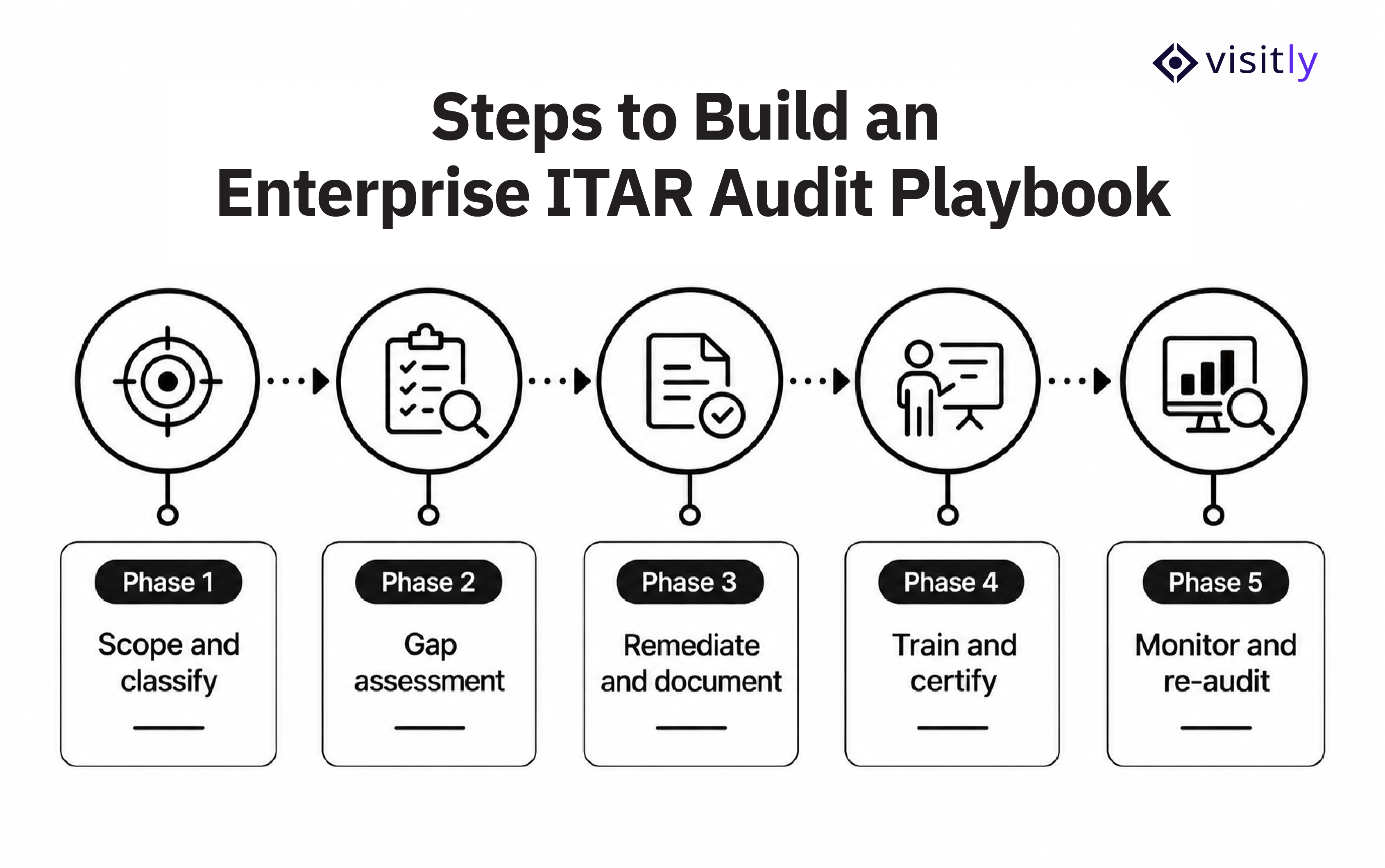
To build an enterprise ITAR audit playbook, follow these steps:
- Phase 1: Scope and classify
- Phase 2: Gap assessment
- Phase 3: Remediate and document
- Phase 4: Train and certify
- Phase 5: Monitor and re-audit
Creating an ITAR audit playbook for your enterprise isn’t just about ensuring compliance – it’s about implementing a structured, effective process to mitigate risk and safeguard sensitive information.
Here's a step-by-step breakdown of how to build an enterprise ITAR audit playbook:
Phase 1: Scope and Classify
The first step in developing your ITAR audit playbook is to define the scope and classify the information and systems subject to ITAR regulations. This involves identifying:
- What systems, applications, and data are subject to ITAR controls?
- The types of personnel who will have access to these areas (employees, contractors, visitors, etc.).
- The locations and environments (physical and digital) where controlled data is stored and processed.
Phase 2: Gap Assessment
Once you've scoped and classified your ITAR-sensitive data and systems, the next step is to assess any gaps in your current compliance measures. This includes:
- Evaluating the current state of your ITAR compliance procedures.
- Identifying weaknesses in your employee access control processes.
- Assessing how well your cybersecurity measures protect ITAR data.
- Reviewing past audits and finding areas where compliance fell short.
Phase 3: Remediate and Document
After identifying compliance gaps, it’s time to take corrective action. Remediation is the process of fixing issues to bring your organization into full compliance with ITAR regulations. This includes:
- Updating or implementing stricter access controls.
- Strengthening cybersecurity protocols.
- Correcting gaps in documentation related to employee access, contractor roles, and visitor records.
- Formalizing procedures for ongoing compliance tracking.
Phase 4: Train and Certify
Compliance is not just about systems and processes; it’s also about people. Employee education and training are critical to ensuring compliance with ITAR regulations. During this phase:
- Develop a comprehensive training program for employees, contractors, and any third parties who handle ITAR-controlled data.
- Ensure your training program includes specific ITAR compliance modules covering access control, data security, and the legal ramifications of noncompliance.
- Implement periodic certification processes to ensure employees are regularly updated on ITAR regulations and their role in compliance.
Phase 5: Monitor and Re-Audit
ITAR compliance isn’t a one-time activity. It requires continuous monitoring and periodic audits to ensure ongoing adherence to the regulations. This final phase involves:
- Regularly monitoring employee access and system activity to detect any unusual or unauthorized access to sensitive information.
- Conducting periodic re-audits to assess the effectiveness of your ITAR compliance program.
- Making necessary adjustments based on audit findings to further tighten security and improve compliance processes.

Closing Thoughts
Compliance with the International Traffic in Arms Regulations (ITAR) is crucial for organizations, especially those in the defense and aerospace industries. Failing to implement effective ITAR compliance practices can lead to severe penalties, reputational damage, and a compromise of national security.
By streamlining processes for employee access, cybersecurity, and documentation, your enterprise can avoid costly missteps and ensure sensitive data remains protected.
To simplify and strengthen your ITAR compliance efforts, consider leveraging Visitly’s cutting-edge visitor management and compliance software. Visitly provides a secure, efficient system that supports your ITAR program while minimizing administrative burden.
Ready to elevate your compliance practices?
Contact Visitly today for a demo of how Visitly supports your ITAR program at your sites. Let us help you streamline your processes and safeguard your organization’s most sensitive information.
FAQs
What are the ITAR requirements for employees?
Employees who work with ITAR-controlled items or technical data must be US persons or be covered by a State Department authorization. They need training on what is controlled, access limited to what their job requires, and a record of both. The employer is responsible for verifying status, restricting access and keeping the documentation.
Who counts as a US person under ITAR?
Under ITAR, a US person is a US citizen, a lawful permanent resident (green card holder) or a protected individual such as a refugee or asylee. The term also covers companies organized under US law. Anyone else is a foreign person, including employees on work visas, and needs authorization before accessing controlled technical data.
What ITAR training do employees need?
ITAR sets no fixed training syllabus, but the State Department's compliance program guidelines list training as a core element. Train every employee who touches controlled work. Typical content covers what counts as technical data, who is a foreign person, visitor and escort rules, and how to report a suspected violation. Keep dated attendance records.
How do ITAR requirements differ for employees and contractors?
The rule is the same for both: only US persons or authorized foreign persons may access controlled items and data. The difference is in how you verify and record it. Employees are checked at hiring through HR. Contractors and vendors arrive from other companies, so their status, access scope and acknowledgments need checking and logging at each engagement or visit.
How does visitor management software help employees follow ITAR visitor rules?
It takes the checks off the employee who hosts the visit. The system records each visitor's citizenship, who hosted or escorted them and what they signed, so a host does not judge access alone. Visitly adds citizenship gating by area and a signed US-person declaration at check-in. It supports your ITAR program, and your compliance lead still owns the determinations.
How do you build an ITAR audit playbook?
Build it in phases. First scope the work: list the controlled items, data, areas and the people with access. Then compare current practice with your technology control plan, fix the gaps, and document each fix. Finish with training and a repeat review on a set schedule, so records stay current between audits.