



A multinational law firm’s London reception desk processes roughly two hundred visitors per week. Each visitor check-in process captures a government-issued ID scan, a photograph for the visitor badge, and a digital NDA signature. That data flows into a cloud-hosted visitor management dashboard accessible to office managers, security teams, and counsel across its global network, including New York.
An internal audit reveals that the visitor’s ID scan, captured under GDPR’s consent framework, is now accessible in a jurisdiction with different consent requirements, retention limits, and data subject rights.
The question that lands on the DPO’s desk: Who owns this problem?
“What keeps me up at night is not one regulation. It’s the delta between three of them. We built our digital privacy program over the years. Our lobby check-in was built over a weekend.”
– Enterprise DPO
The answer is that everyone does, but very few have planned for it. Physical-space visitor data represents one of the most underexamined security and compliance surfaces in the modern enterprise.
While data protection programs have matured around digital flows, cookies, CRM records, and marketing consent, one area still lags behind. The data collected when someone walks into a building is often overlooked. In most cases, it is governed by whatever the facilities team set up when the office first opened.
That gap is closing fast. European DPAs are scrutinizing physical-space data collection. Singapore’s PDPC has issued guidance on visitor registration systems. The US state-level patchwork expands quarterly.
This blog piece addresses how enterprises operating across GDPR, CCPA, PDPA, and other regimes can build a visitor data posture that is legally defensible, operationally coherent, and respectful of the visitor experience.
Why Is the Lobby the Last Unmanaged Privacy Surface in Enterprise Compliance?
Visitor data is unlike other enterprise data categories. Here’s what makes it uniquely difficult to govern:
- Jurisdictional specificity: It is collected at a physical entry point tied to a specific facility and, therefore, to a specific jurisdiction.
- Sensitive data types: It routinely includes identity documents, such as passports, national IDs, and driver’s licenses.
- Biometric exposure: In many facilities, it now includes biometric data, such as facial photographs, fingerprint scans, or both.
- Untrained handlers: Front-desk staff or security officers who have not had any training in data governance.
- Disconnected systems: Legacy systems, from paper logbooks to standalone tablets, are not integrated into the enterprise data governance infrastructure.
How Did Visitor Data Fall Through the Governance Gap?
Historically, the visitor management system was a facilities function in the same operational category as HVAC and parking. Even organizations that have adopted a digital visitor management system often treat it as a point solution, disconnected from the policy engines, consent management frameworks, and data lifecycle tools governing the rest of the enterprise’s data inventory.
The multi-jurisdictional dimension transforms this operational gap into a genuine compliance crisis. A single enterprise with offices in London, New York, and Singapore faces three fundamentally different answers to four deceptively simple questions:
- What constitutes valid consent for collecting a visitor’s photograph?
- How long can a visitor’s personal data be retained?
- Is the visitor entitled to request deletion, and within what timeframe?
- Can visitor data be transferred to a server in another country?
What Are the Real Stakes of Non-Compliance?
The consequences extend well beyond regulatory fines:
- Financial penalties: GDPR alone authorizes sanctions of up to 4% of annual worldwide turnover.
- Operational disruption: Failed audits delay real estate transactions and client onboarding.
- Reputational damage: Professional services firms lose client trust when they cannot explain how they handle visitor data, especially when visitors are the client’s own executives.
- Internal governance failure: Accountability vacuums emerge when no single function owns the problem, and regulators are increasingly unwilling to tolerate them.
What Do GDPR, CCPA, and PDPA Actually Require for Visitor Data?
The regulatory landscape for visitor data is not merely complex. It is structurally contradictory. Understanding where the three major frameworks align and diverge is a necessary precondition for any defensible compliance architecture. The following comparison is scoped specifically to visitor and lobby data, not to the general provisions of each regulation.
| Dimension | GDPR (EU/EEA) | CCPA/CPRA (California) | PDPA (Singapore) |
|---|---|---|---|
| Consent Model | Opt-in. Explicit consent is required for special category data (e.g., biometrics and photographs used for identification). Legitimate interest may apply for basic name/company collection but requires a documented balancing test. | Opt-out. No affirmative consent is required for collection at the point of entry, but visitors must be informed and given the right to opt out of sale/sharing. Sensitive data (biometrics) requires opt-in under CPRA. | Deemed consent is permissible where collection is reasonably necessary for a business purpose, and the individual has been notified. Explicit consent required for sensitive data categories. |
| Data Residency | No blanket residency requirement, but cross-border transfers outside the EEA require adequate safeguards (SCCs, adequacy decisions, or BCRs). | No state-level residency mandate, though sector-specific federal rules may apply. Emerging state laws vary. | No general residency requirement, but transfers outside Singapore require the receiving jurisdiction to provide comparable protection under the PDPA's transfer limitation obligation. |
| Retention Requirements | Data minimization principle: retain only as long as necessary for the stated purpose. No fixed period, but the controller must define and justify it. | No prescribed retention period, but businesses must disclose retention periods or criteria in their privacy notice. Retention must be proportionate to the purpose. | Retention is limited to purposeful fulfillment. Organizations must cease retention when the purpose is no longer served and must document retention policies. |
| Deletion / Erasure Rights | The right to erasure (Article 17) must be exercised without undue delay, typically interpreted as within one month. Exemptions for legal obligation, public interest, and legal claims. | The right to delete must be exercised within 45 days (extendable by an additional 45 days). Exemptions for security, legal obligation, and certain internal uses. | Right to request correction or deletion. No statutory timeframe specified, but PDPC guidance expects reasonable responsiveness. |
| Cross-Border Transfer Rules | Restricted. Requires adequacy decisions, SCCs, BCRs, or derogations. Schrems II implications for US transfers remain a live issue even post-DPF. | No explicit cross-border transfer restriction at the state level, but the CPRA's enforcement posture implies accountability for data processed by service providers in other jurisdictions. | The transfer limitation obligations require a comparable standard of protection. PDPC has issued specific guidance on contractual and organizational safeguards. |
| Enforcement Posture | Active and intensifying. DPAs have issued fines for physical-space data collection (CCTV, biometric access). Proactive audits are increasing. | Enforcement is expanding under CPRA and the California Privacy Protection Agency. Biometric-specific enforcement actions are emerging. BIPA (Illinois) remains the most aggressive biometric statute in the US. | Enforcement is measured but consistent. PDPC has issued decisions on visitor registration data and CCTV. Guidance-driven regulatory culture with escalating penalties for repeat non-compliance. |

Where Do the Three Frameworks Conflict Most?
Three friction points deserve particular attention for multinational enterprises:
1. The Consent Model Divergence Is Structural, Not a Matter of Degree
GDPR requires affirmative opt-in before a visitor’s photograph is captured. CCPA operates on an opt-out; the photograph can be taken as long as the visitor is informed. PDPA may allow deemed consent with adequate notice. A single static check-in flow, one screen, one checkbox, and one tap cannot satisfy all three. Jurisdiction-aware workflows at the system level, not just at the notice level, are required.
2. The Retention Conflict Is Operationally Significant
GDPR’s data minimization principle may require deletion of visitor records within 30 days. But local security regulations in Singapore, or a client’s contractual requirements, may mandate 6+ months of access log retention. Enterprises must navigate this tension without violating minimization principles or undermining security obligations.
3. The Cross-Border Transfer Problem Is Not Hypothetical
When London visitor data becomes accessible on a New York dashboard, GDPR’s transfer provisions are triggered, even if the data is not ‘transferred’ in the traditional sense. Post-Schrems II, the legal basis for that accessibility must be documented, with supplementary measures where required. Most enterprises have addressed this for HR and customer data. Most have left visitor data unaddressed.
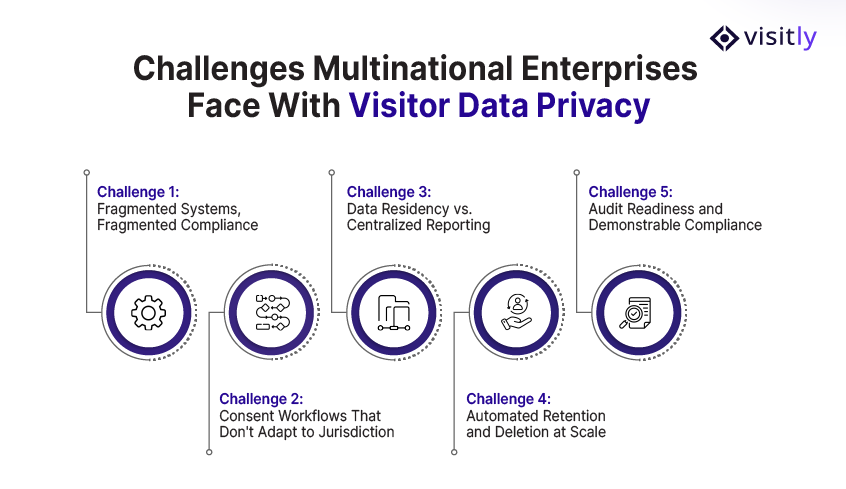
What Are the Major Challenges Multinational Enterprises Face With Visitor Data Privacy?
The major challenges multinational enterprises face with visitor data privacy are:
Challenge 1: Fragmented Systems, Fragmented Compliance
Challenge 2: Consent Workflows That Don’t Adapt to Jurisdiction
Challenge 3: Data Residency vs. Centralized Reporting
Challenge 4: Automated Retention and Deletion at Scale
Challenge 5: Audit Readiness and Demonstrable Compliance
Even organizations with mature digital privacy programs regularly encounter these five operational barriers when it comes to visitor data:
Challenge 1: Fragmented Systems, Fragmented Compliance
Most multinational enterprises do not operate a single visitor management platform. Different offices use different tools: one site runs a SaaS platform, another uses a locally installed legacy system, and a third still relies on paper logbooks.
- Each system creates its own data lifecycle and retention behavior
- Policy unification requires either platform consolidation or a governance layer across heterogeneous systems
- Neither option is trivial; both require significant cross-functional alignment
Challenge 2: Consent Workflows That Don’t Adapt to Jurisdiction
The check-in tablet in London and the one in New York often display the same consent screen, but what GDPR requires in London differs materially from what CCPA requires in California. Jurisdiction-aware consent logic must dynamically adapt:
- Which data elements to collect
- Which consent model to apply (opt-in vs. opt-out vs. deemed consent)
- Which privacy notice version to display
- Which downstream processing rules to enforce
Challenge 3: Data Residency vs. Centralized Reporting
Security teams want a single dashboard that shows who is in every building in real time. GDPR’s transfer restrictions and PDPA’s transfer limitation obligation may prohibit centralizing that data on a single server. The tension between operational visibility and data sovereignty is real, and most organizations resolve it by defaulting to centralization and hoping the risk doesn’t materialize. That posture is increasingly indefensible.
Challenge 4: Automated Retention and Deletion at Scale
A defensible retention policy must account for the fact that ‘stated purpose’ varies by jurisdiction, data type, and context:
- A visitor’s name may be retained longer than their ID scan
- A visitor who signed an NDA may have data subject to a legal hold that overrides standard retention
- A visitor exercising GDPR erasure rights must have data deleted within the statutory timeframe, even if another jurisdiction’s security regulation would otherwise require retention
Manual processes cannot manage this complexity at scale.
Challenge 5: Audit Readiness and Demonstrable Compliance
Regulators do not accept assertions; they require evidence. For visitor data, that means:
- Consent logs tied to specific privacy notice versions
- Access event records showing who entered which facility and when
- Deletion audit trails proving data was purged on schedule
- Legal hold documentation for records preserved beyond standard retention
Most enterprises cannot produce this evidence today, not because they are non-compliant in intent, but because their visitor management infrastructure was never designed to generate it.
How Does Visitly Help Multinational Enterprises Navigate Visitor Data Privacy?
Visitly is purpose-built for enterprise visitor management with a compliance architecture designed for organizations operating across multiple jurisdictions. Check-in supports more than 150 languages.
Here’s how Visitly addresses each of the core compliance challenges:
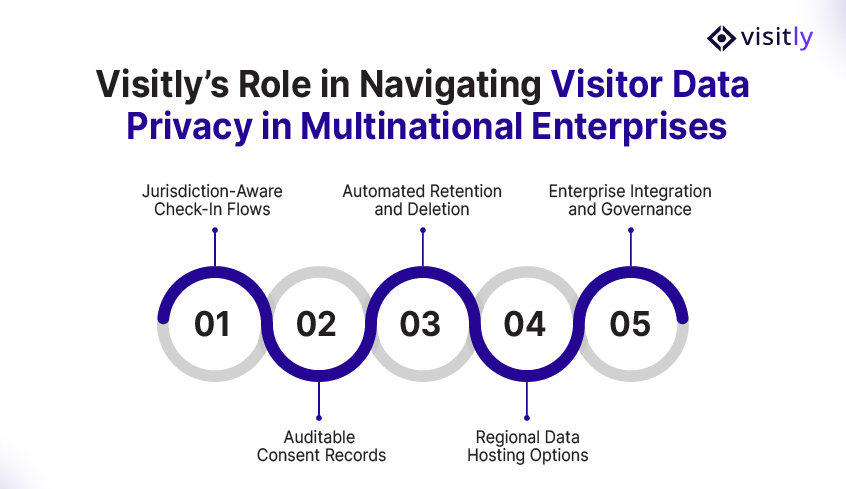
1. Jurisdiction-Aware Check-In Flows
Visitly automatically detects facility locations to adjust the check-in experience, ensuring the correct privacy notice, consent model, and collection of only the data legally required for that jurisdiction. Workplace compliance logic executes based on geography, not on manual configuration.
2. Auditable Consent Records
Every consent event is logged with a timestamp, tied to the specific privacy notice version displayed, and linked to the data elements the visitor agreed to provide. When the notice is updated, the record reflects which version was in effect. Consent records are retrievable on demand for regulatory inquiry or data subject requests.
3. Automated Retention and Deletion
Visitly applies jurisdiction-specific retention periods to each data element and executes deletion on schedule without human intervention. Legal holds can override the usual retention rules, and all actions related to retaining or deleting data, even complex ones with different rules for various data types, are recorded for review.
4. Regional Data Hosting Options
Visitly supports regional data residency configurations, allowing enterprises to isolate visitor data by geography. EU visitor data can be hosted within the EEA. Singapore data can remain in-country. Cross-border access is controlled and auditable, with appropriate legal mechanisms documented.
5. Enterprise Integration and Governance
Visitly works with company identity systems, physical access control, and IT governance setups, ensuring visitor data is integrated into the organization’s overall data collection rather than being a separate solution. This enables DPOs and IT governance teams to include visitor data in enterprise-wide privacy impact assessments and audit reporting.
How Should Enterprises Build a Defensible Visitor Privacy Posture?
These five principles represent the minimum defensible posture for an enterprise operating across regulated jurisdictions, whether building internally or evaluating a vendor like Visitly.
- Principle 1: Jurisdiction-aware by design, not by exception. Compliance logic, including which data to collect, which consent model to apply, and which retention period to enforce, must execute automatically based on the facility location before the visitor interacts with the check-in screen.
- Principle 2: Data minimization as an operational default. Collect only what each jurisdiction legally requires and what the facility’s security posture genuinely demands. Minimization reduces the complexity of the consent workflow, storage obligations, and the scope of breaches.
- Principle 3: Consent as a living, auditable record. Consent is a documented legal event timestamped, tied to a specific privacy notice version, linked to specific data elements, and retrievable on demand. Reconsent logic must apply when notices are updated or when a returning visitor’s prior consent may have lapsed.
- Principle 4: Data residency and sovereignty are choices about infrastructure. Where visitor data is stored must be an intentional architectural choice, not a default determined by the vendor’s provisioning region. Ensure that cross-border flows comply with applicable legal mechanisms by mapping residency requirements for each jurisdiction.
- Principle 5: Retention and deletion policies that are automated, granular, and auditable. Manual deletion is not a compliance strategy. Policy engines must apply jurisdiction-specific periods to each data element, execute deletion on schedule, honor legal holds, and log every action for audit purposes.
What’s Coming Next: AI, Biometrics, and the Expanding Frontier of Lobby Data Risk
The compliance challenges above reflect the current environment. Three converging forces are reshaping how enterprises must think about visitor data at the lobby level:
AI-Powered Visitor Screening
Organizations are beginning to deploy automated systems that assess visitor risk profiles, flag watchlist matches, or pre-approve recurring visitors based on behavioral patterns. Under GDPR Article 22, automated decision-making with legal or similarly significant effects triggers specific obligations:
- The right to human intervention
- The right to an explanation
- The right to contest the decision
CCPA and PDPA are developing analogous frameworks. The moment an enterprise visitor management system moves from recording who arrived to deciding who should be admitted, its regulatory classification changes fundamentally.
Biometric Data at the Lobby
Facial recognition, fingerprint-based access, and voice authentication are moving from high-security facilities into mainstream corporate environments.
The regulatory landscape is unforgiving:
- Under the GDPR, biometric data processed for identification purposes is a special category that requires explicit consent and a documented necessity assessment.
- Illinois’ Biometric Information Privacy Act (BIPA) creates a private right of action with statutory damages and has generated over 1,000 lawsuits since enactment.
- Enterprises are adopting these technologies faster than their compliance frameworks can accommodate them.
“Biometric identifiers are a different risk category entirely. The moment you deploy facial recognition at a lobby kiosk, you’re not in visitor management anymore. You’re in regulated data processing.”
– Privacy Attorney
The Expanding Global Regulatory Landscape
Brazil’s LGPD, India’s Digital Personal Data Protection Act, and emerging frameworks across the Middle East and Southeast Asia are adding new jurisdictions to the compliance matrix quarterly. Regulatory differences are increasing rapidly, and the cost of keeping up with rules that vary by region grows significantly with each new set of regulations.
The Convergence of Physical and Digital Identity
Enterprise visitor management systems are increasingly integrated with identity providers, physical access control systems, and workplace experience platforms. A visitor who checks in at the lobby, connects to guest Wi-Fi, and accesses a meeting room booking system has generated data across three or four systems, each with its own governance model. Holistic governance spanning physical and digital entry points is the emerging requirement.

Conclusion: The Lobby Is a Compliance Surface – Time to Govern It Like One
The lobby is where the physical world meets the regulatory world, and for most multinational enterprises, it remains the last major privacy surface operating without deliberate governance. That is not a sustainable position.
Three forces are converging to make deliberate action urgent:
- Enforcement is intensifying across the GDPR, CCPA/CPRA, PDPA, and BIPA – including actions targeting the collection of physical space data.
- The data types collected at check-in, including identity documents, photographs, biometrics, and NDAs, are among the most sensitive categories recognized by privacy law.
- The multi-jurisdictional dimension ensures that no single policy, workflow, or system configuration can satisfy every obligation simultaneously.
The five principles outlined in this post, jurisdiction-aware design, data minimization, auditable consent, intentional data residency, and automated retention, are not aspirational. They are the minimum defensible posture for an enterprise operating across regulated jurisdictions.
Deliberate architecture outperforms reactive patching. The enterprises that invest in privacy-first, jurisdiction-aware visitor management today will be better positioned as enforcement accelerates, biometric regulation matures, and the global privacy landscape continues to fragment.
Connect with Visitly for more information on compliance.
FAQs
Does GDPR apply to visitor data collected in the lobby?
Yes. GDPR applies to personal data your organization collects from visitors at sites in the EU or EEA, including names, photos and ID details taken at reception. You need a lawful basis for each item, usually legitimate interest for basic sign-in data, a privacy notice at the point of collection, and defined retention and deletion periods.
Is a paper visitor logbook a GDPR risk?
Yes. An open logbook shows each visitor the names and companies of everyone who signed in before them, which conflicts with GDPR's confidentiality principle. Paper also has no access control, no record of who read it and no scheduled deletion, so retention limits are hard to prove. A digital register with restricted access removes those gaps.
Can one consent screen cover visitors at all our global offices?
No, one static screen will not fit GDPR, CCPA and Singapore's PDPA together. GDPR needs a lawful basis and explicit consent for biometric identification, CCPA works on notice with a right to opt out of sale or sharing, and PDPA allows deemed consent after notification. Set the notice and the fields collected per location, with your privacy counsel approving each version.
How long can we keep visitor data under GDPR?
GDPR sets no fixed period. Visitor data may be kept only as long as the purpose you stated requires, and you must be able to justify the period you chose. Many organizations set a short default for routine visits and a longer one where a security or legal duty applies. Your data protection officer should document the reasoning.
What should we do when a visitor asks us to delete their data?
Respond without undue delay and within one month under GDPR, or within 45 days under CCPA, which allows one 45-day extension. Delete the record in every system that holds it, including access control and badge systems, unless an exemption such as a legal obligation applies. Keep a log showing what was deleted and when.
How does Visitly support visitor privacy across jurisdictions?
Visitly is GDPR and CCPA compliant as a vendor, signs a data processing agreement at contract and publishes its sub-processor list. You set the retention periods, per tenant, and Visitly applies them without imposing a period of its own. Data is hosted in the US by default. Our team can help you pin it to an EU or APAC region.