



If your organization already utilizes a visitor management system (VMS), congratulations—you’ve moved past the paper logbook era.
But as we enter Q4 2025, the question shifts from Do you have a VMS? – to – Is your VMS capable of meeting 2026’s security, compliance, and experience demands?
The VMS has evolved from a simple digital check-in tool to the central intelligence layer for physical security and workplace safety. Today’s facility, security, and IT leaders are looking for more than just feature updates; they seek a platform that provides predictive and proactive security and compliance.
This analysis provides a hyper-focused look at the trends that must drive your 2026 budget and technology decisions, ensuring your VMS is a strategic asset, not a feature backlog.
Why upgrading (and trend awareness) matters now
- Evolving threat landscape — Security and compliance expectations are growing faster than many legacy VMS can adapt.
- Hybrid and distributed workplaces — Multiple entry points, satellite offices, and shared spaces demand a scalable, centralized command plane.
- Data & ESG pressure — Stakeholders increasingly want proof that visitor systems are privacy-aware and contribute to sustainability goals.
- Vendor lock & tech debt — Older systems may hamper integrating AI, biometrics, or emergency features—making future retrofits costly.
If your current system feels “good enough,” you risk falling behind on security, privacy, or experience enhancements that newer systems will offer as standard.
Top Trends to Watch Out for in Visitor Management in 2026
The top trends to watch in visitor management for 2026 are:
- Convergence of Security and AI
- Reimagining the Visitor Experience
- The New Mandate for Data Privacy
- The VMS as the Hybrid Workplace Backbone
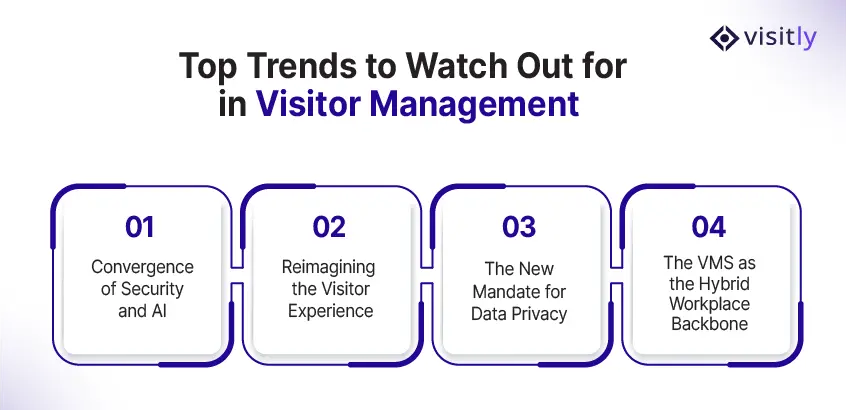
Let’s explore the top trends that can shape your security protocols and enhance your visitor management system in 2026.
- Convergence of Security and AI
The era of reactive security—alerting staff only after a threat is identified—is over. Future-proof visitor management is defined by its ability to predict and preempt risk using AI.
AI-Driven Predictive Security and Multimodal Biometrics
- The Shift to Predictive Screening: Advanced VMS platforms are now utilizing AI to analyze check-in data in real-time. This goes beyond simple watchlist checks; AI looks for behavioral anomalies, such as re-entry attempts with different details or deviations in typical visitor flow, generating a risk score before an individual gains deep access.
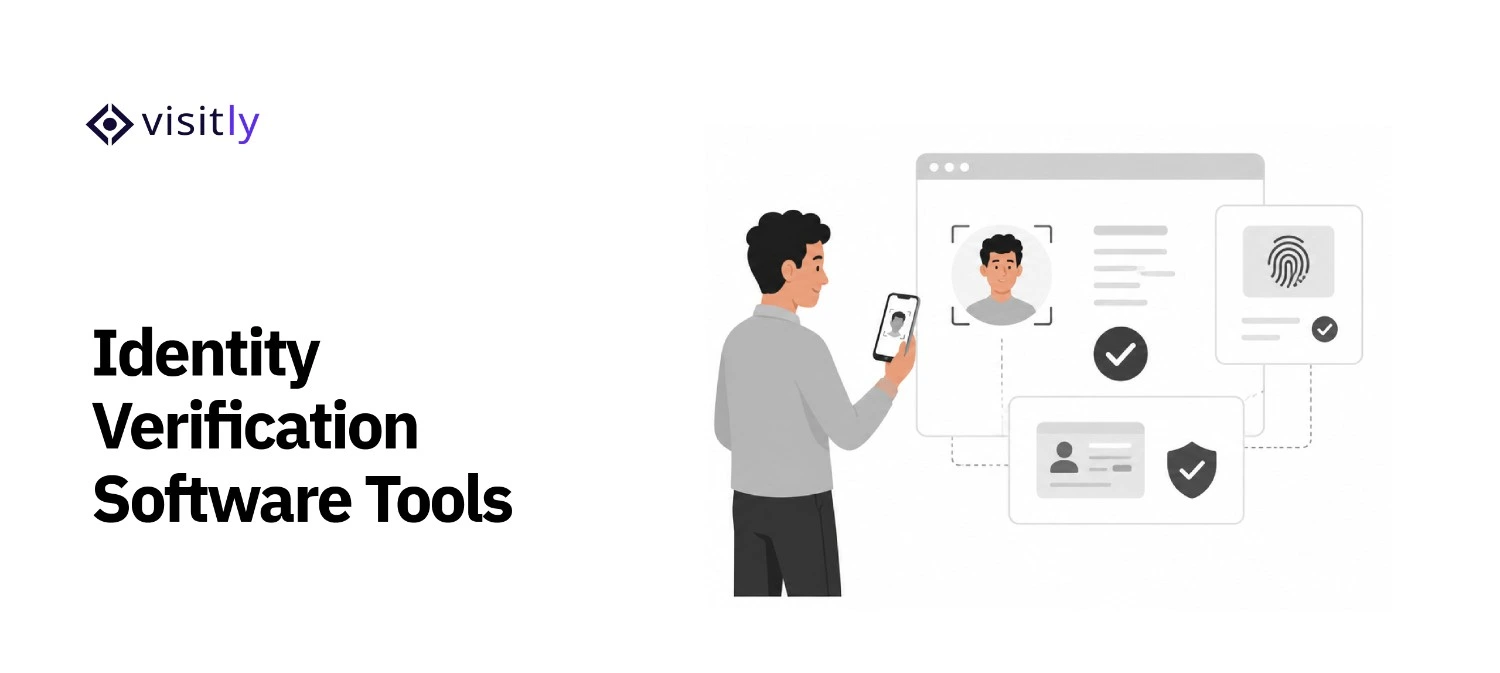
- Multimodal Authentication: Single-point biometrics (like basic facial recognition) is giving way to multimodal systems. These VMS platforms combine instant ID verification (Driver’s License scan) with biometric matching and digital credential validation, creating an unforgeable, layered security check that is still completed in seconds.
- Proactive Risk Mitigation: VMS is integrating with external threat intelligence and internal security systems to automate access denial and instantly notify the security team based on a calculated risk score. This is where your VMS moves from a data logger to a risk mitigation engine.
- Reimagining the Visitor Experience
In 2026, a great visitor experience is synonymous with a secure one. Visitors expect the same frictionless, personalized digital experience they get from other consumer technologies.
Mobile-First and Contactless Ecosystems
- The Mobile-First Mandate: The entire pre-registration and check-in workflow must be executable on a visitor’s personal device (BYOD). This includes digital NDA signing, viewing safety videos, and receiving a dynamic, time-sensitive mobile pass (QR/NFC) that can be stored in their phone’s digital wallet.
- Hyper-Personalization at Scale: The VMS utilizes stored, consented data to provide genuine personalization, including a personalized welcome screen in the visitor’s preferred language, pre-populated forms based on their return status, and immediate direction to the correct meeting room via digital signage integrated with the VMS.
- Smart Building Integration: The modern VMS acts as the access key to the entire facility. Successful check-in instantly triggers temporary access permissions through the access control system and, via IoT integration, cues the meeting room’s digital display, lights, and temperature settings.
- The New Mandate for Data Privacy
Simply adhering to GDPR is no longer enough; the trend is moving towards architectural compliance that minimizes organizational liability.
Compliance Evolution: From GDPR Audits to Self-Sovereign Identity
The most significant trend for enterprise compliance is the rise of Self-Sovereign Identity (SSI).
- What is SSI? SSI technology empowers visitors to own and control their digital identity credentials (e.g., a “verified employee” status or “cleared contractor” license). Instead of submitting a driver’s license for the VMS to collect and store, the visitor’s digital wallet presents proof of the required credential.
- Minimizing Organizational Liability: The VMS verifies this cryptographic proof without ever collecting, storing, or becoming liable for the underlying Personal Identifiable Information (PII). This fundamentally transforms your data retention risk.
- Predictive Compliance: The best VMS platforms, like Visitly, offer automated compliance tools that audit your stored data for you. They proactively alert administrators to necessary data anonymization dates or expiring legal consent forms, ensuring your records are perpetually audit-ready.
- The VMS as the Hybrid Workplace Backbone
Hybrid work models and multi-site operations demand a VMS that offers consistency, control, and specialized workflows across highly dynamic environments.
Unified Ecosystems for Multi-Site and Flexible Operations
- Centralized Command & Control: For organizations with a global or multi-building footprint, a cloud-native VMS is non-negotiable. It must provide unified reporting, centralized policy management, and one dashboard to monitor all visitor activity, contractor compliance, and security alerts.
- Automated Workflow Specialization: The days of a “one-size-fits-all” check-in are over. Your VMS must handle unique, specialized workflows:
- Contractors: Require safety videos, insurance uploads, and temporary access codes.
- Deliveries: Simple QR code scan for drop-off without requiring PII.
- VIP Clients: Silent, pre-approved entry with immediate host notification and personalized amenities.
- Workplace Analytics: By leveraging check-in and zone data, the VMS provides high-value footfall analytics. This data informs real estate strategy, helps optimize meeting room usage, and allows Facility Management to schedule labor (security, cleaning) based on predictive peak traffic times.
Preparing Your VMS Strategy for 2026
If you are currently running an older VMS, Q4 is the critical time to pivot your strategy and budget for the following year.
3 Immediate Steps for Facility Leaders
- Audit Your Integrations (The Compatibility Test): Assess your current VMS’s API openness. Can it easily integrate with the latest generation of Access Control Systems (like S2, SALTO, or Kisi) and core HR/Workforce Management tools? If you rely on custom coding or clunky middleware, budget for an upgrade to a vendor with robust, native integrations.
- The Capex vs. Opex Decision: For 2026, justify the transition to a modern, cloud-native VMS subscription (Opex) that includes maintenance, updates, and feature upgrades. This minimizes the risk and upfront cost (Capex) associated with purchasing and maintaining expensive on-premise servers and bespoke kiosk hardware.
- Prioritize Future-Proofing: When vetting vendors, ask about their roadmap for SSI and AI-driven behavioral analytics. If a potential vendor’s primary features are only touchless check-in and badge printing, they are already behind the 2026 curve.
Implementation roadmap for Q4 & beyond
Here’s a staged plan (6–9 months) to modernize visitor ops without disruption:
- Baseline audit
- Map existing workflows & technical debt
- Identify account admin roles, APIs used, and dependency systems
- Enable mobile credential module
- Pilot in one building or high-traffic lobby
- Tie into door controllers, track fail rates
- Define retention, privacy & DSR policies
- Set default site-level retention windows
- Publish visitor privacy notices + DSR forms
- Enable self-service DSR in a staging site
- Deploy muster & emergency features
- Link visitor logs + access events
- Run monthly drills, analyze results
- Integrate with mass notification tools
- Activate AI models & analytics
- Turn on arrival prediction and anomaly detectors
- Set threshold alerts, calibrate model sensitivity
- Gate biometric / verification zones
- Roll out face/ID in high-risk areas
- Monitor opt-in rates and fallback usage
- Fuse occupancy analytics & ESG dashboards
- Connect non-PII sensors
- Publish monthly reports: utilization, energy per visitor, wait times
- Iterate, expand, unify
- Extend modules to other buildings or regions
- Add watchlist/risk module as needed
- Consolidate separate systems into a unified console
- Review compliance & audit annually
- Test DSR flows, purge triggers, breach drills
- Adjust policies as regulations evolve (e.g., DPDP in India)

Conclusion: The VMS of Tomorrow is Here Today
The most exciting aspect of these visitor management trends is that the technologies defining the future—AI screening, SSI compliance, and cloud-based scalability—are already available.
For organizations looking to future-proof their security posture, enhance their brand experience, and simplify complex compliance mandates, the choice is clear.
Visitly is engineered to be the ultimate digital receptionist and industry-leading VMS, offering:
- Enterprise-Grade Security built on predictive, AI-ready architecture.
- Unrivaled Customization for any contractor, vendor, or guest workflow.
- Audit-Ready Compliance that anticipates global data privacy demands.
It’s time to upgrade your VMS from a logbook replacement to a strategic intelligence partner.
→ Request a FREE Trial of Visitly to see how your facility can be future-ready today.
FAQs
1. What are the key visitor management trends in 2025?
Key trends include AI-driven security, self-sovereign identity, touchless check-ins, and cloud scalability. These innovations help enhance security, streamline visitor processes, and ensure compliance across multi-site operations.
2. How is AI transforming visitor management?
AI in visitor management enables predictive security, behavioral anomaly detection, and multimodal biometrics, providing real-time threat mitigation and enhancing visitor experiences.
3. Why is self-sovereign identity important in visitor management?
Self-sovereign identity (SSI) gives visitors control over their digital credentials, ensuring privacy, compliance with data regulations, and reducing liability for organizations managing personal data.
4. How does cloud-based VMS support hybrid workplaces?
Cloud-based visitor management systems provide centralized control, seamless scalability, and efficient visitor tracking across multiple locations, making them ideal for hybrid and multi-site environments.