


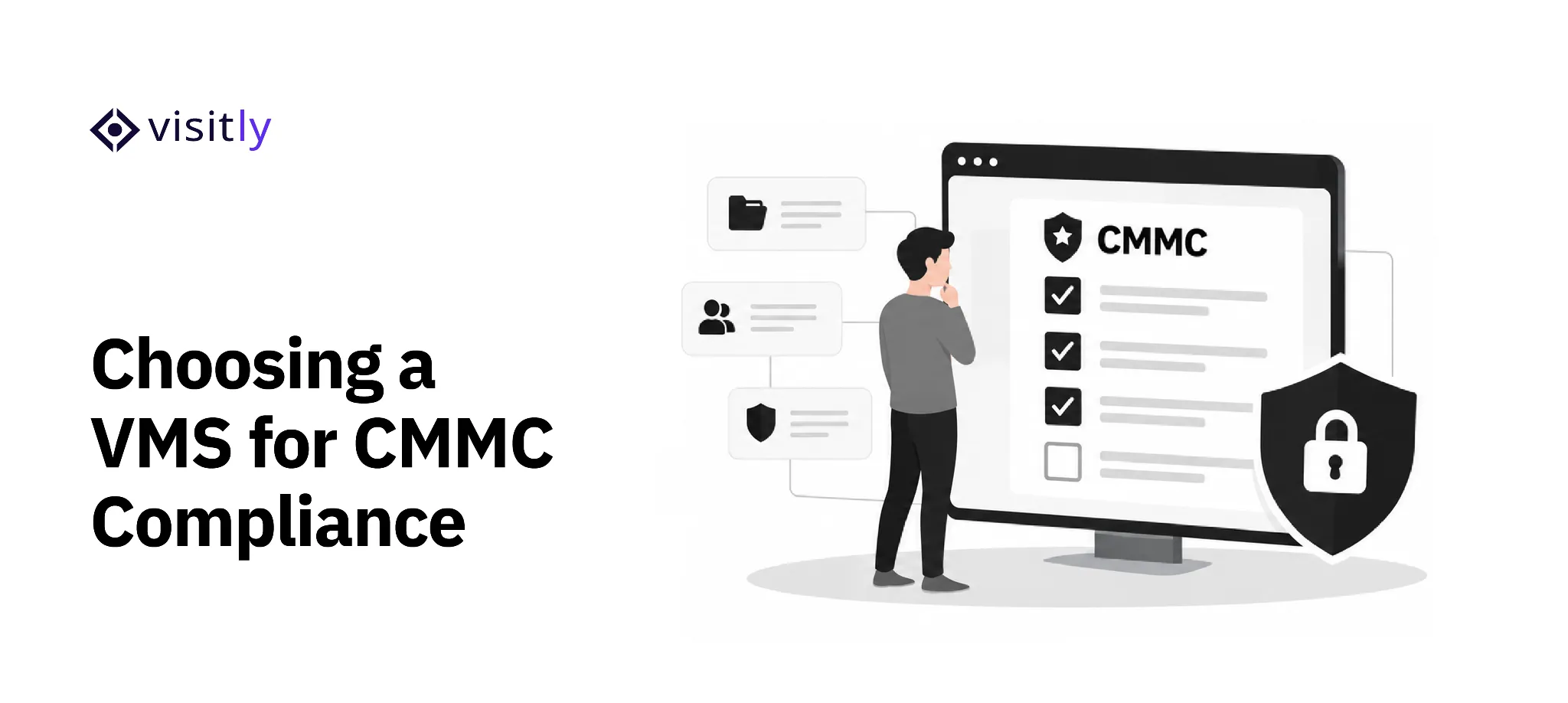
Learn which features to look for in a visitor management system for CMMC compliance, including visitor screening, audit trails, NDA capture, contractor controls, SSO, and evidence support.
A visitor management system can support the physical-protection evidence your organization needs for CMMC, but not every VMS gives security teams the same level of control or evidence.
For organizations working toward CMMC Level 2, the important question isn't whether a platform calls itself “CMMC-ready.” It's whether the system helps you consistently control visitor access, monitor visitor activity, maintain physical-access records, and produce the evidence your team needs for its assessment.
Five features matter most: watchlist screening, audit trail export, NDA capture, contractor management, and SSO integration. Here's what to look for in each, how the leading platforms stack up, and the questions worth asking before you sign.
CMMC 2026 update:
The Department of War suspended CMMC Phase II requirements in July 2026 while it reviews the program. Phase I self-assessment requirements remain in place. The visitor-management controls discussed below are still useful for organizations maintaining their NIST SP 800-171 Rev. 2 security baseline and preparing for future CMMC requirements.
Why generic VMS platforms fail CMMC assessments
Paper logs and consumer-grade check-in apps weren't built for compliance audits; they were built for front-desk convenience. That gap shows up fast during a CMMC Level 2 assessment. Sign-in sheets and basic iPad kiosks routinely fail PE 3.10.3 and PE 3.10.4, which require organizations to escort visitors and maintain visitor access records, and AU 3.3.1, which requires audit records that support after-the-fact investigation of security incidents. A clipboard doesn't export. A generic lobby app that logs a name and a timestamp doesn't produce a defensible, signed record a C3PAO assessor will accept.
The platforms built for CMMC compliance solve a different problem than the platforms built for visitor experience. That distinction is what the next five features test for.
The 5 must-have features for a CMMC-ready VMS
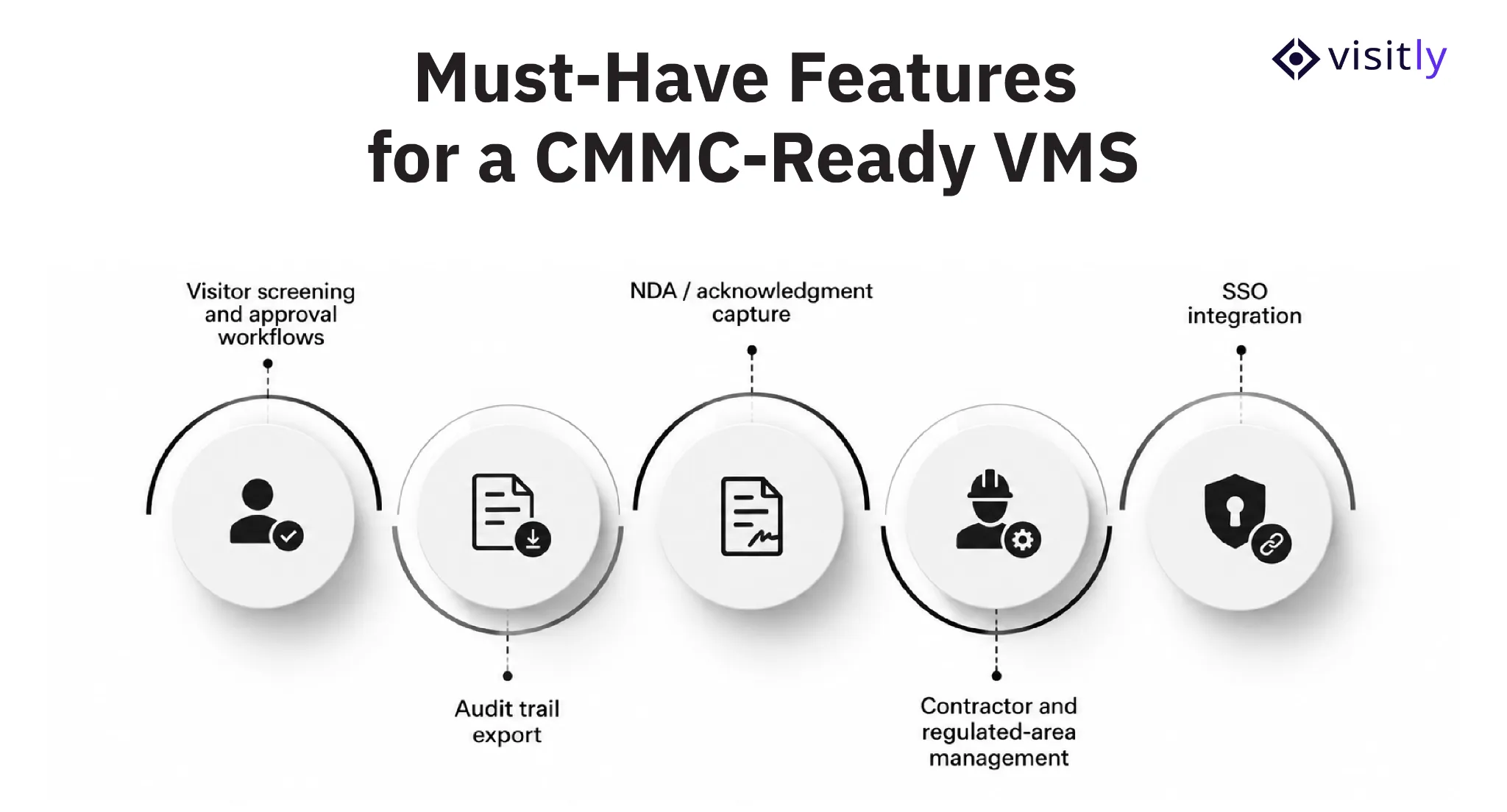
1. Visitor screening and approval workflows
A CMMC-focused VMS should do more than record that someone entered the building. It should help your team control who is allowed to enter, identify visitors against the lists your organization uses, and document approvals or escort requirements.
Look for screening that happens before or during check-in, visitor approval workflows, escort tracking, and clear records of the decision made for each visit. Visitly supports internal and banned-visitor screening, visitor approvals, escort workflows, and configurable match handling.
2. Audit trail export
Your visitor records need to be immutable, timestamped, and exportable in a format your C3PAO can actually use, CSV at minimum, SIEM streaming ideally. This is the control that satisfies AU 3.3.1 directly. Look for configurable retention periods and the ability to search historical records quickly; assessors will ask for specific date ranges, and a platform that makes you dig through spreadsheets to produce them costs you time you don't have during an assessment window.
3. NDA / acknowledgment capture
Every visitor should sign a timestamped acknowledgment at check-in, not a paper form filed in a drawer, but a digital signature tied to that specific visit record. This closes the gap between "we have a policy" and "we can prove the policy was followed" for every individual who entered the facility.
It's a small feature that assessors check for specifically, because it's exactly the kind of evidence that's easy to skip and hard to reconstruct later.
4. Contractor and regulated-area management
Recurring contractors often need a different visitor workflow from one-time guests. A VMS should let you maintain recurring visitor profiles, apply the right documents or acknowledgments, track visits, and apply additional rules where certain areas have restricted access requirements.
For organizations with ITAR-controlled areas, look for controls that can capture or verify citizenship information and apply area-specific restrictions. Visitly Enterprise includes recurring-contractor profiles, ITAR-aware citizenship gating, configurable visitor workflows, and per-visitor-type or zone-based badge controls.
This lets your organization apply its existing security policies consistently instead of relying on front-desk staff to remember different requirements for every visitor type.
5. SSO integration
Your visitor platform's admin and host access should run through the identity provider you already have: Microsoft Entra ID, Okta, or any SAML-based SSO. This isn't just convenience; it ties visitor system access into the same identity and access controls (PS, IA) your broader CMMC program already governs.
A platform that requires a separate login system is a separate attack surface and a separate audit finding waiting to happen.
How the leading platforms compare
The gap that matters most for defense manufacturers: most platforms in this category weren't built with CMMC scope boundaries in mind. That's the difference covered next.
Why Visitly for CMMC compliance specifically
Visitly is designed to provide the visitor-side controls and evidence that security teams can use as part of their CMMC program. Visitly provides a NIST 800-171 Rev. 2 control-mapping reference under NDA, along with visitor-side evidence tooling for regulated environments. Your organization remains responsible for its overall CMMC program and assessment.
For physical security teams, that means one workflow for visitor screening, approvals, escort requirements, digital acknowledgments, audit records, and regulated-area controls. Visitly's Enterprise offering adds ITAR-aware citizenship gating, SIEM event streaming, SCIM 2.0, on-premises Active Directory, access-control integrations, and CMMC-related compliance tooling.
Visitly is also designed to work with the infrastructure you already have. The platform supports PACS integrations and can connect visitor records with access control and security systems, rather than requiring you to replace the hardware already deployed at your facilities.
For manufacturing plants and other regulated organizations, that combination matters: the VMS needs to work for the front desk, while producing the records security, IT, and compliance teams need to review later.
Hitachi runs Visitly across 14 plants with zero ITAR audit findings. That's the outcome a CMMC-focused visitor platform should produce: not just a feature checklist, but a clean assessment.
Questions to ask before you buy
Bring these into your next vendor call:
- Does watchlist screening run at check-in, or only in a report afterward?
- Can I export audit logs to CSV and stream to our SIEM without a support ticket?
- Does visitor data touch our CUI boundary, or does it require SSP documentation?
- Does the platform support citizenship gating for ITAR-restricted areas?
- What's the actual deployment timeline, days, or months?
- Does SSO cover both host and admin access, or just one?
See it before your next assessment
Your CMMC assessment has a date. Don't let your visitor log be the reason you don't pass.
See Your CMMC Evidence Package in 15 Minutes →
Download the PE & AU Control Guide
Closing Thoughts
Choosing the best VMS for CMMC compliance means looking beyond basic visitor check-in. Your platform should help you control visitor access, maintain physical-access records, capture NDAs and acknowledgments, manage contractors, and connect with the identity and security systems your organization already uses.
Visitly brings these capabilities together with visitor screening, audit trails, digital document signing, contractor controls, SSO, ITAR-aware citizenship gating, and integrations with existing access-control and security systems. It also provides CMMC-focused evidence supports to help organizations manage the visitor-side requirements of their broader CMMC program.
Ready to see how Visitly can support your CMMC visitor management? Explore Visitly or book a demo to see the platform in action.