


When the alarm sounds, getting people out of the building is the first job. The second is knowing that everyone made it out. That second job happens at the muster point, and it is where most evacuation plans are weakest, because the people hardest to count are the ones who are not on the employee list.
What is a muster point?
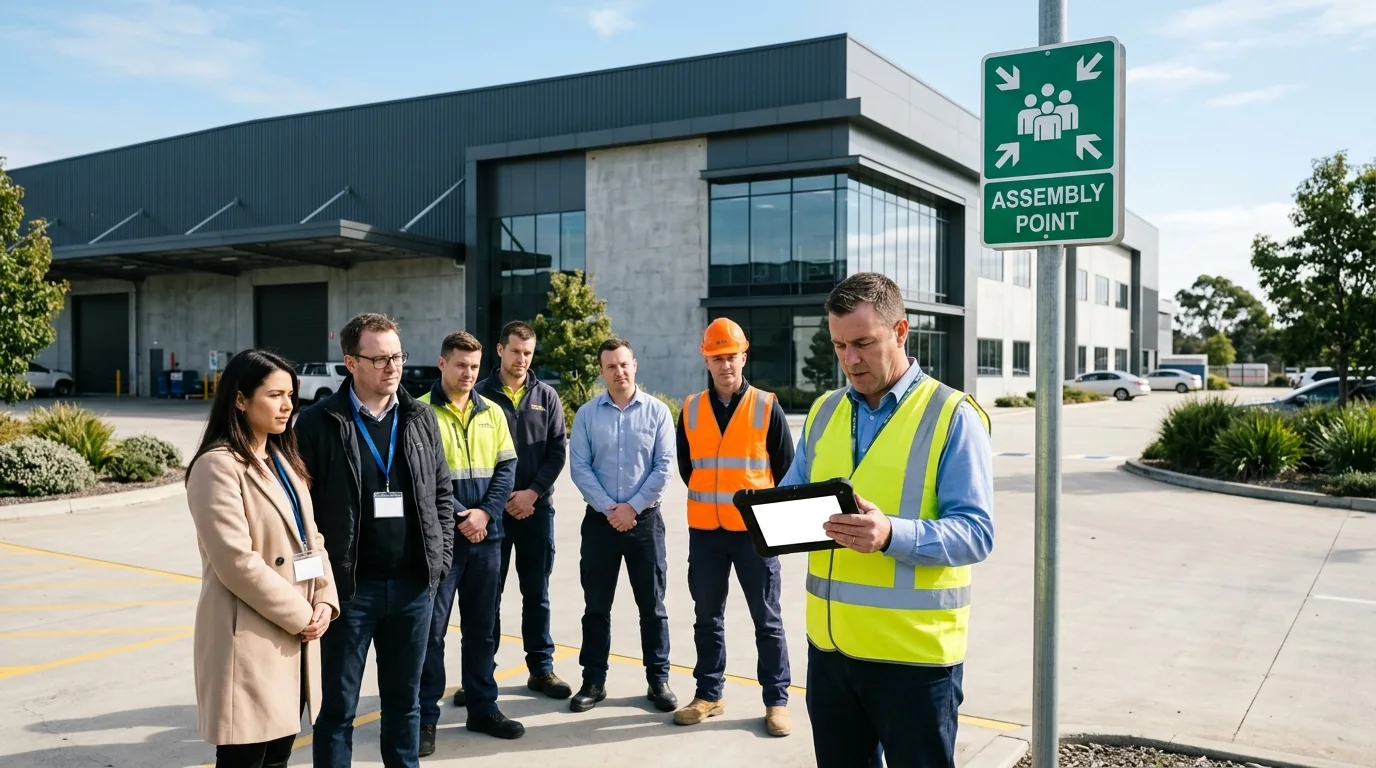
A muster point is the safe location where people gather after evacuating a building, so the site can confirm that everyone got out. It is also called an assembly point or a muster area; on ships and offshore platforms, the same place is usually called a muster station.
"Mustering" is the whole process: moving people to the muster point and accounting for each person there. A muster point that nobody counts at is just a parking lot.
Why visitors and contractors are the people a roll call misses
Employee lists are easy to come by. Visitors and contractors are not on them. A visitor may have arrived ten minutes before the alarm, signed a paper sheet at reception and never met anyone but their host. A contractor may be on a roof or in a plant room with no reason to pass the front desk again. When the building empties, the paper sign-in sheet usually stays at reception, inside the building you just evacuated.
That is the gap the roll call has to close. OSHA's emergency action plan rule (29 CFR 1910.38) requires procedures to account for all employees after an evacuation. Safety teams and fire services want the same answer for everyone on site, and at a busy plant or office, visitors and contractors can be a large share of the people present on any given day.
How do you choose a muster point?
A good muster point does four things:
- It is far enough from the building to be clear of smoke, falling glass and the path of fire trucks and ambulances. Your fire authority or safety consultant can confirm the distance for your site.
- It can be reached by a short, unobstructed route that does not cross vehicle traffic or pass hazards such as gas lines or chemical storage.
- It holds everyone who could be on site at peak, including visitors, contractors and delivery drivers.
- It has a backup. Wind direction, a fire near the main exit or a chemical release can rule out the first choice, so name a second muster point and say when to use it.
Sites with several buildings or shifts often need more than one muster point. Assign each area of the site to a specific point so that each roll call has a clear list.
What should a muster point sign show?
A muster point sign tells people where to go when they are not thinking clearly. It should:
- Use the standard green and white emergency assembly symbol, which most people recognize without reading.
- Say "Muster point" or "Assembly point" with a number or letter if the site has more than one.
- Be visible from the evacuation routes leading to it, not only from the point itself.
- Be lit or reflective if people may evacuate in the dark.
Show the same muster point on the evacuation maps posted inside the building, and tell visitors where it is when they check in.
How does roll call work at the muster point?
A roll call compares two lists: who was in the building when the alarm sounded, and who has arrived at the muster point. Anyone on the first list and missing from the second is reported to the fire service, with where they were last expected to be.
With paper, the first list is the problem. The sign-in sheet is at reception, it is often incomplete, and nobody wrote down who left early. Wardens end up shouting names from memory.
With a live roster, the first list comes with you. A digital visitor management system knows who is checked in at that moment, at which site and for which host. The warden opens the roster on a phone or tablet, marks people as accounted for as they arrive, and sees at a glance who is still missing. At busy sites, asking hosts to confirm their own visitors speeds things up. Our guide to emergency evacuation software compares the tools that keep this roster.
How do you account for visitors and contractors during an evacuation?
At a factory or plant, the people most likely to be missing from a roll call are contractors working in restricted or remote areas, and visitors who arrived on a tour or for a meeting. Four habits close that gap:
- Check everyone in, every time. Visitors, contractors and delivery drivers all sign in through the same system, so the roster is complete before anything goes wrong.
- Tell people where the muster point is at check-in. A line on the screen or the visitor badge, and a word from the host, is enough.
- Stop new arrivals once the evacuation starts. Nobody should be checking in to a building that is being emptied.
- Make hosts responsible for their visitors. A host who knows they must report for their guest at the muster point keeps track of them.
Contractors who are on site for days or weeks should also be part of evacuation drills, not only employees.
How do you run muster points across several sites?
Each site needs its own muster points, its own wardens and its own roster, but the safety team needs one view. A multi-site organization should be able to see, per location, how many people were on site when the alarm sounded and how many are still unaccounted for. Run drills at every site, not only headquarters, and compare how long each roll call took.
Muster point and roll call checklist
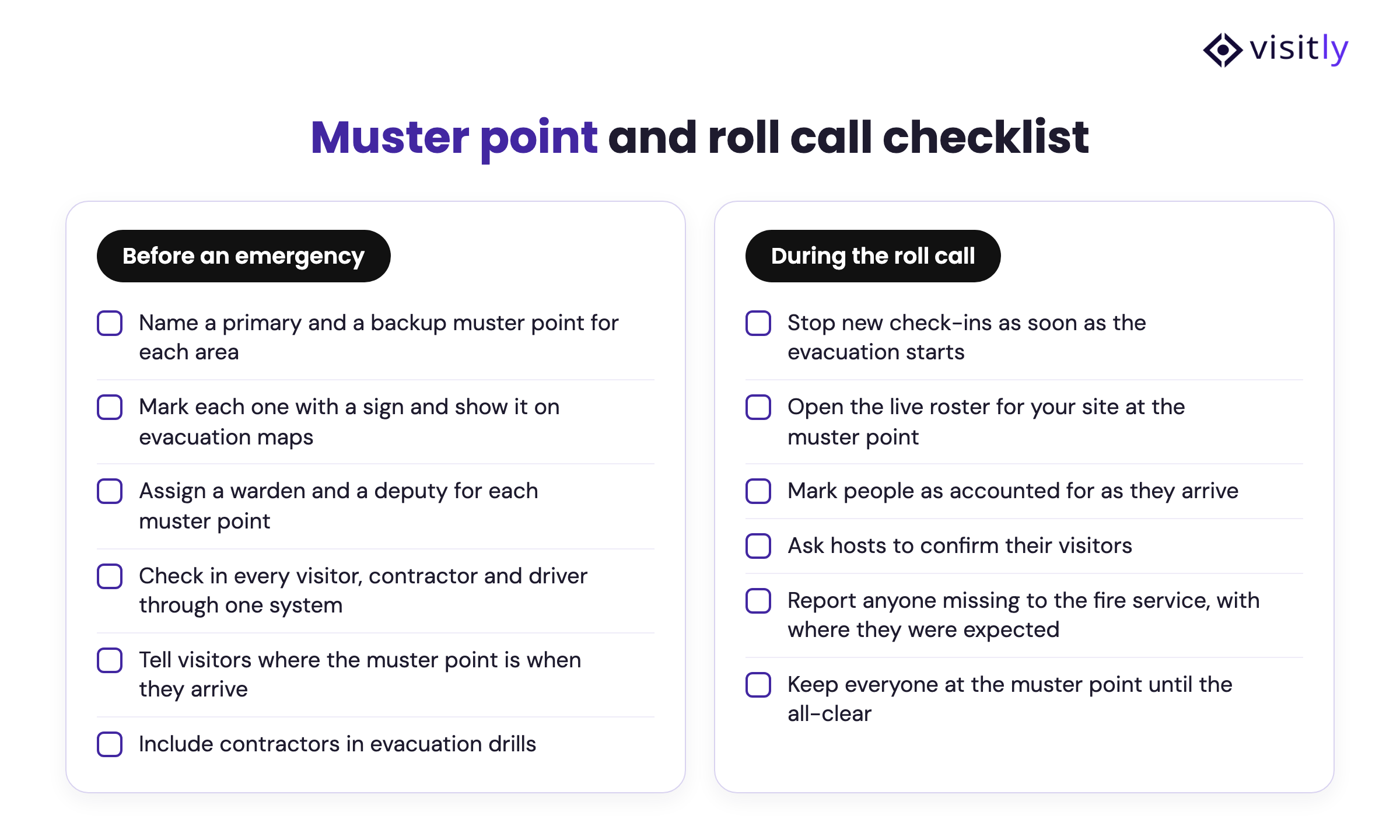
Before an emergency:
- Name a primary and a backup muster point for each area of the site
- Mark each one with a clear sign and show it on the evacuation maps
- Assign a warden and a deputy for each muster point
- Check in every visitor, contractor and driver through one system
- Tell visitors where the muster point is when they arrive
- Include contractors in evacuation drills
During the roll call:
- Stop new check-ins as soon as the evacuation starts
- Open the live roster for your site at the muster point
- Mark people as accounted for as they arrive
- Ask hosts to confirm their visitors
- Report anyone missing to the fire service, with where they were expected to be
- Keep everyone at the muster point until the all-clear
How Visitly supports muster and roll call
Visitly keeps a live roster of every visitor, employee and contractor checked in at each site. When an evacuation starts, the kiosk stops new check-ins, emergency alerts go out by SMS, email and voice call, and incident commanders have the full roster in real time. Muster reporting shows who has checked in at each muster point, and headcounts are kept per location across the organization. Drill mode lets you practice the same process without a real alert, and Visitly connects to emergency notification systems including AlertMedia, Everbridge, InformaCast, Omnilert and Rave Mobile Safety.
FAQs
What does muster point mean?
A muster point is the safe place where people gather after leaving a building in an emergency, so the site can check that everyone got out. It is also called an assembly point or muster area. The word comes from "muster", meaning to gather a group together and count it.
What is a muster station?
A muster station is the term ships, offshore platforms and some industrial sites use for a muster point. It is where people assemble during an emergency, are counted, and receive instructions. On a ship, each passenger and crew member is assigned a specific muster station.
What is a muster area?
A muster area is another name for a muster point. Some organizations use "area" because the gathering place is a wide open space rather than a single spot. It serves the same purpose: people assemble there after an evacuation and are accounted for.
Who takes the roll call at a muster point?
A trained fire warden or emergency coordinator usually takes the roll call, with a deputy in case they are absent. At sites with many visitors, hosts help by confirming their own guests. The warden reports anyone missing to the fire service.
How do you account for visitors who did not sign in?
You cannot count someone you never knew was there, which is why every visitor, contractor and delivery driver should check in through one system. If someone may have entered without signing in, ask hosts and supervisors to report anyone they expected on site, and pass that information to the fire service.
What does OSHA require for accounting for people after an evacuation?
OSHA's emergency action plan rule, 29 CFR 1910.38, requires procedures to account for all employees after an evacuation. Accounting for visitors and contractors is not spelled out in that rule, but most safety teams and fire services expect a full count of everyone on site.