


Hospitals must stay accessible to patients and families while protecting staff, visitors, and sensitive clinical areas. Yet recent 2026 data shows that security risks inside healthcare facilities remain significant.
According to a June 2026 National Nurses United survey:
- 84.8% of nurses reported experiencing at least one form of workplace violence in the previous year.
- 70.3% said they had been verbally threatened.
- 36.4% reported that workplace violence in their unit had increased.
- Only 35.5% said staff were always available to respond to violent incidents.
These numbers show why CCTV cameras, paper visitor logs, and manual sign-ins alone are not enough for modern healthcare environments.
Today’s hospital security systems bring together visitor management systems for hospitals, access control, visitor screening, watchlists, emergency response tools, and digital audit records to strengthen patient and staff safety.
This guide compares five leading hospital security systems based on their security capabilities, compliance support, integrations, scalability, and suitability for different healthcare environments.
What are the Top 5 Hospital Security Systems for Patient Safety in 2027?
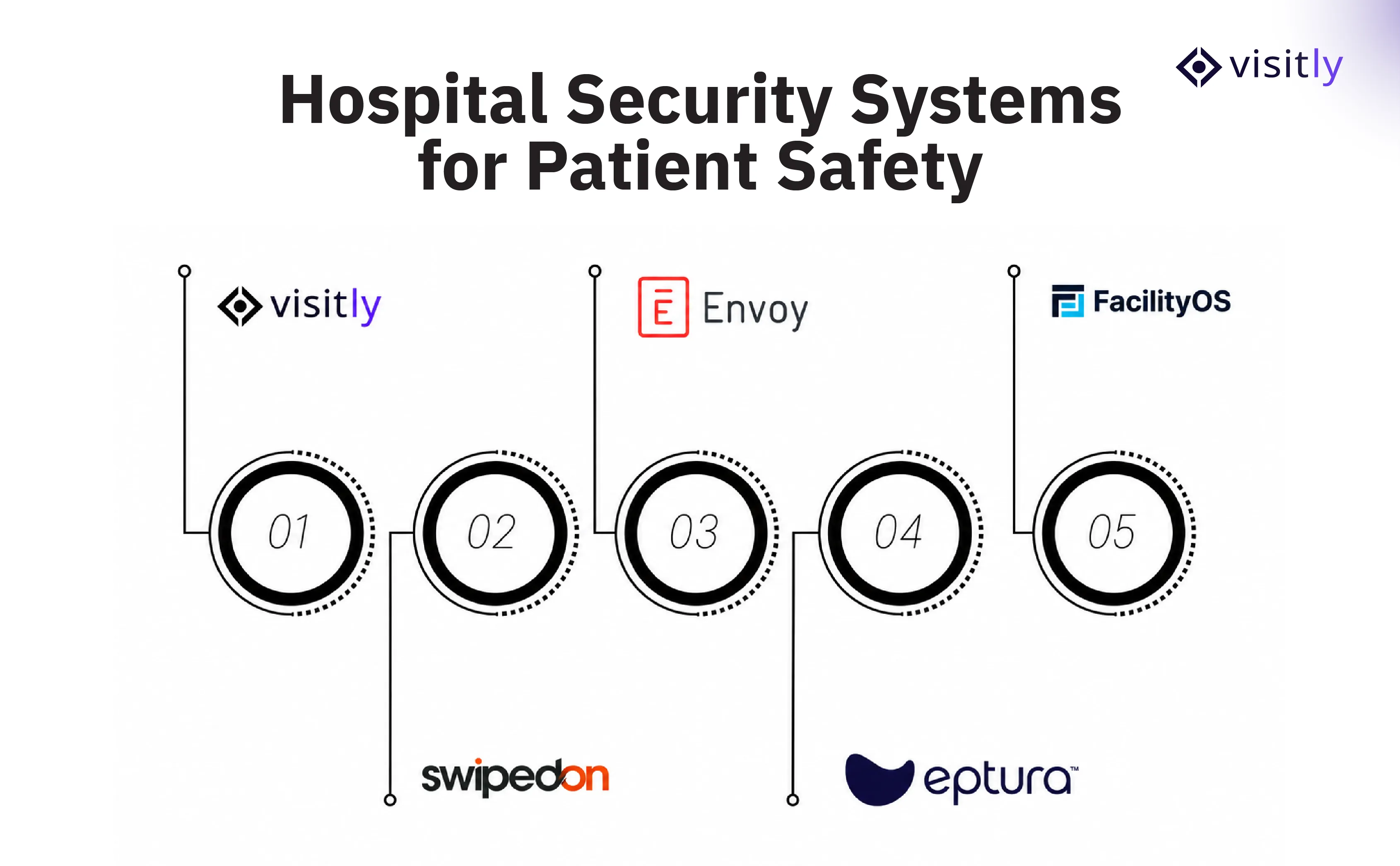
The top 5 hospital security systems for patient safety are:
- Visitly
- SwipedOn
- Envoy
- Eptura
- FacilityOS
Hospitals need more than CCTV to protect patients. This section covers the top 5 hospital security systems, highlighting features that ensure safety, compliance, and operational efficiency.
1. Visitly
What it is:
Visitly is a modern, iPad-based visitor management system built for secure, smart check-ins.
For healthcare, Visitly streamlines check-ins by replacing paper logs with a digital, HIPAA-compliant workflow that requires no app for visitors.
Key hospital security features to highlight:
- Health Screening Questions — Screen all visitors, contractors, and staff for symptoms or risk factors before they enter; capture data for contact tracing.
- Watchlist Alerts — Flag specific individuals or entry criteria; instant alerts are sent to security staff or hosts the moment a watchlist rule is triggered.
- Visitor Approvals — Approve or deny entry at check-in; unauthorized visitors are stopped before they access patient areas.
- ID Badge Printing — Customized badges with photo, timestamp, host name, and purpose of visit; visual identification across the facility.
- Pre-registration — Bulk visitor pre-registration of expected visitors (family groups, vendor delegations, contractor teams); reduce lobby congestion and admin workload.
- Evacuation & Emergency Management — Real-time emergency evacuation alerts displayed on all devices; live visitor list accessible to floor staff; new entries blocked during active emergencies.
- HIPAA Compliance — Visitor data handled with HIPAA-compliant data security; stored on AWS servers (USA); GDPR-compliant for global facilities.
- Integrations — Lenel Onguard, S2 Netbox, Brivo, Slack, Microsoft Entra ID, Webhooks for custom integrations with hospital IT and PACS infrastructure.
- Digital document signing — Visitors sign NDAs, infection control acknowledgments, or safety orientation agreements at check-in.
Best for: Hospitals and healthcare facilities with 100+ beds seeking a scalable, easy-to-deploy automated visitor management system with robust compliance and real-time security controls.
Ratings: 4.7 on Capterra, G2, and GetApp. SOC 2 compliant.
2. SwipedOn
What it is:
SwipedOn is a visitor and employee management system used in aged care and health facilities globally, with health screening and contact tracing as core capabilities.
Key hospital security features:
- Health screening questionnaires with configurable yes/no flows; trigger an alert to the health & safety manager on failure.
- Contact tracing with time-stamped entry/exit records
- ID badge printing for authorized visitor identification
- Evacuation management with on-site headcount support
- GDPR-compliant visitor data handling
- Customizable sign-in flows by visitor type (healthcare worker, resident, contractor)
SwipedOn vs. Visitly: SwipedOn lacks native support for watchlist rules, real-time approval/denial workflows, or bulk pre-registration, and does not focus on HIPAA compliance for US hospitals.
Best for: Aged care facilities and smaller healthcare settings needing straightforward health screening and contact tracing.
3. Envoy
What it is:
Envoy is a comprehensive workplace management platform used by hospital systems such as Howard University Hospital and Dignity Health. It combines visitor management, emergency notifications, digital signage, and space management in a unified platform.
Key hospital security features:
- Pre-registration, multi-step visitor approvals, blocklists, and time-bound access
- Multi-channel emergency notifications (SMS, email, Slack/Teams, on-site screens) with acknowledgment tracking
- Digital signage for safety instructions and emergency alerts in lobbies and waiting rooms
- Integrations with access control systems (Genetec, LenelS2, Brivo, Kisi) and identity providers (Okta, Azure Entra)
- HIPAA, HITECH, OSHA, and Joint Commission compliance support
Envoy vs. Visitly: Envoy handles complex operations for enterprise hospitals, while Visitly offers similar security features with quicker deployment and app-free check-in.
Best for: Large hospital systems and multi-site healthcare networks that need integrated emergency communications alongside visitor management.
4. Eptura
What it is:
Eptura is a facility management platform for healthcare environments, offering visitor and space management capabilities with a focus on asset tracking and workplace utilization.
Key hospital security features:
- Visitor check-in and access tracking
- Space management and occupancy visibility across hospital departments
- Asset and maintenance management for medical equipment
- Integration with workplace and building systems
Eptura vs. Visitly: Eptura’s healthcare security features are part of a broader facility management suite rather than purpose-built for visitor security and patient safety. Health screening, watchlists, and HIPAA-specific compliance are not core differentiators.
Best for: Hospital facility teams that need combined space, asset, and visitor management on a single platform.
5. FacilityOS
What it is:
FacilityOS, formerly iLobby, is a modular enterprise platform trusted by organizations such as Mayo Clinic and Baptist Health. It covers visitor management (VisitorOS), emergency management (EmergencyOS), contractor compliance (ContractorOS), and physical access control (SecurityOS) under one roof.
Key hospital security features:
- Visitor screening with health attestations, restricted unit access, and audit-ready visit histories
- Contractor compliance management: insurance verification, background checks, certification tracking, and HIPAA orientation at check-in
- Emergency digital mustering, code response drills, evacuation management, and roll calls
- PIAM (Physical Identity & Access Management) for time-bound access to clinical zones, pharmacies, and ORs
- Compliance with Joint Commission, CMS, OSHA, HIPAA, NFPA, SOC 2 Type 2
- Claim: 90% reduction in vendor/visitor check-in processing time
FacilityOS vs. Visitly: FacilityOS targets large-scale hospital systems with advanced features and higher costs. Visitly delivers core visitor security with faster deployment and a free trial, suitable for facilities of all sizes.
Best for: Large multi-site hospital systems with dedicated security and compliance teams managing complex contractor and vendor ecosystems.
Which Hospital Visitor Management Software Offers the Best ROI?
What Are the Core Components of a Hospital Security System?
Hospital security involves more than monitoring entrances or installing cameras. Healthcare facilities need multiple security layers that work together to control access, identify risks, protect sensitive areas, and help staff respond quickly when an incident occurs.
A complete hospital security system may include:
- Visitor management: Screens, approves, badges, and tracks visitors, vendors, and contractors.
- Access control system: Restricts entry to areas such as pharmacies, operating rooms, laboratories, data centers, and staff-only zones.
- Video surveillance: Helps security teams monitor entrances, hallways, parking areas, and other high-risk locations.
- Duress and panic alarms: Allow staff to quickly request assistance during threatening or violent situations.
- Emergency notifications: Send alerts and instructions during lockdowns, evacuations, security incidents, or other emergencies.
- Identity and badge management: Helps distinguish authorized staff, contractors, and visitors.
- Incident reporting: Creates records that security teams can review to identify recurring risks and improve response procedures.
OSHA specifically identifies controlled access, video surveillance, panic buttons, and other security measures as potential controls for workplace violence risks in hospitals.
The best approach is therefore not to depend on a single security tool, but to connect visitor management with access control, surveillance, emergency response, and hospital security policies.
How Does a Hospital Visitor Management System Work?
A hospital visitor management system creates a controlled process for determining who can enter the facility, where they can go, and how long they remain on-site.
A typical hospital visitor workflow includes:
- Pre-registration: Patients or hospital staff can register expected family members, vendors, contractors, or other visitors before arrival.
- Check-in: The visitor provides required identification and visit information at a kiosk, tablet, or reception desk.
- Identity verification and screening: The system can verify visitor information and check applicable watchlists or facility restrictions.
- Approval: Hospital staff or security personnel can approve or deny access based on the visitor's purpose and destination.
- Badge issuance: Approved visitors receive a time-limited badge identifying where they are permitted to go.
- Access control: Integrated systems can restrict visitors to approved areas instead of giving them unrestricted movement throughout the hospital.
- Real-time tracking: Security teams maintain a current record of visitors signed into the facility.
- Check-out: The system records when the visitor leaves and preserves the visit history for security reviews or audits.
What Should You Look for in a Hospital Visitor Management System?
Not every visitor management software is built for the demands of a healthcare environment. Before you invest, make sure the system you choose checks every one of these boxes:
- HIPAA compliance: documented and certified, not just a vague "data security" claim
- Customizable health screening questions: tailored to your infection control and ward-specific security standards and safety protocols
- Watchlist alerts: instant, automated flagging, not a passive log you check after the fact
- No app download for visitors: zero friction for patients' families, guests, and vendors
- Real-time host notifications via Teams, Slack, or SMS tools your staff already use
- Pre-registration and bulk upload: essential for high-volume visiting hours and vendor delegations
- Emergency evacuation support: live headcount, blocked new entries, real-time alerts on all devices
- Access control and HR integrations: Microsoft Entra ID, Okta, SSO, and existing hospital IT systems
- Audit-ready data exports: formatted for Joint Commission, CMS, and NABH accreditation requirements
- Multi-location scalability: manage multiple wards, buildings, or campuses from one dashboard
Closing Thoughts
Hospital security systems are no longer optional; they are a direct requirement for patient safety, regulatory compliance, and operational continuity. The right choice depends on your facility’s size, compliance needs, existing IT stack, and budget.
For large enterprise hospital networks with complex multi-site contractor ecosystems, FacilityOS or Envoy is worth evaluating. For aged care and smaller clinics, SwipedOn offers a clean, affordable starting point.
But for hospitals that need purpose-built visitor security, HIPAA compliance documentation, fast deployment, and proven reliability, Visitly is the clear choice.
It is the only platform in this comparison that combines healthcare-grade security, SOC 2 Type 2 certification, real-time watchlist alerts, and emergency evacuation support, all deployable on an iPad in minutes, with no app download required for visitors.
Ready to secure your facility?
Start your free 14-day Visitly trial today; no credit card required.
Frequently Asked Questions
1. What are hospital security systems?
Digital solutions combining visitor management systems, access control, and monitoring to safeguard patients, staff, and sensitive areas.
2. Why is a hospital visitor management system important?
It tracks and controls visitors, reduces unauthorized access, and ensures compliance with HIPAA, SOC 2, and other regulations.
3. How does Visitly compare to other hospital security systems?
Visitly offers enterprise-grade scalability, PACS integration, real-time analytics, and full compliance, delivering measurable ROI over Swipedon, Envoy, and FacilityOS.
4. Can hospital security systems handle multi-site campuses?
Yes. Visitly supports centralized management for multi-location hospitals, providing consistent visitor tracking, access control, and reporting.
5. Do these systems improve patient safety and compliance?
Absolutely. They prevent unauthorized access, maintain audit logs, and support compliance with HIPAA, SOC 2, and CMMC.