


Most enterprise security gaps don’t come from cyberattacks; they come from the front desk. According to industry audits, physical access control failures remain among the most common compliance findings across frameworks such as SOC 2 and ISO 27001.
The root issue? Disconnected systems.
Enterprises still rely on separate tools for visitor check-in, access control, and identity verification. This fragmentation creates blind spots, missed screenings, incomplete logs, and zero real-time visibility.
That’s why VMS integration is no longer optional. It integrates your entire visitor workflow: identity checks, watchlist screening, access permissions, and audit logs into a single system.
But not every platform qualifies. A true integrated visitor management system goes beyond check-in to deliver unified control and audit-ready data.
In this guide, we compare five standout integrated visitor management systems built for enterprise-scale security and compliance.
So, let us start!
What are the 5 Notable Integrated Visitor Management Systems for Enterprises?
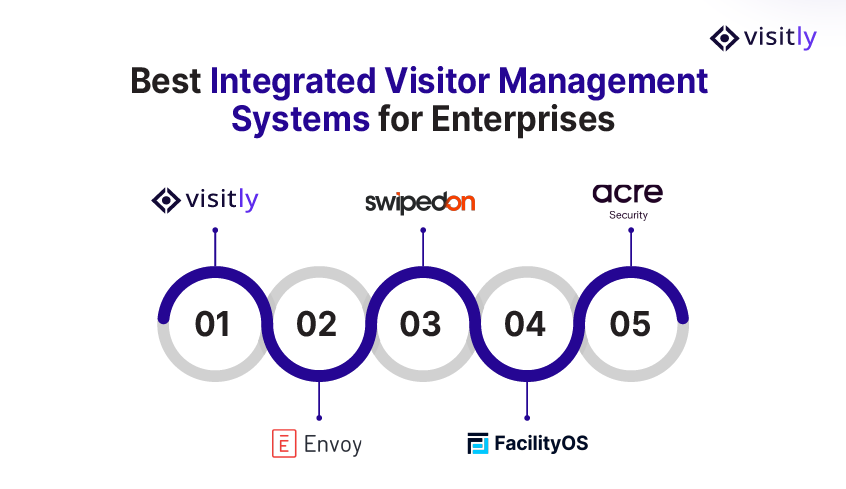
The 5 notable integrated visitor management systems for enterprises are:
1. Visitly
2. Envoy
3. SwipedOn
4. FacilityOS
5. Acre Security
1. Visitly
Overview
Visitly is an integrated visitor management system built for enterprises that need more than digital sign-in. It combines visitor check-in, contractor workflows, ID validation, badge printing, host notifications, emergency evacuation support, and compliance-focused documentation on a single platform.
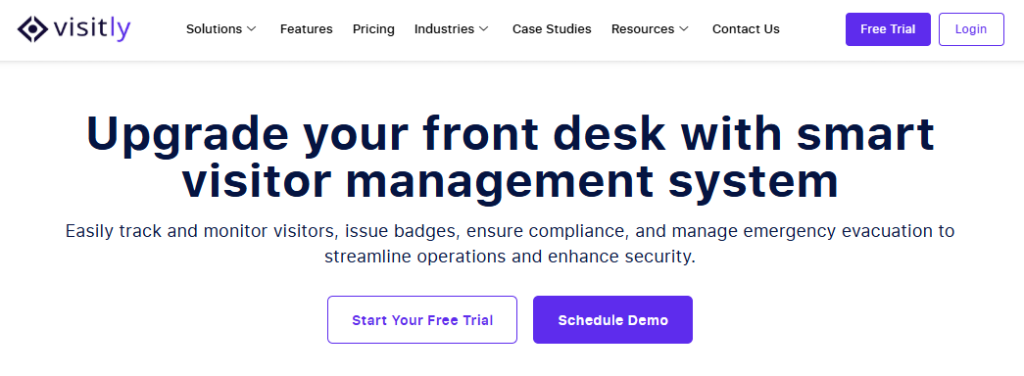
Its positioning is especially strong for organizations that manage high visitor volume, contractor access, safety acknowledgments, and multi-site operations. Visitly’s product pages also show a broader operational scope than most VMS tools in this set.
This covers visitor management, contractor management, workplace safety, and front-desk workflows through a customizable iPad-based setup.
Key Features
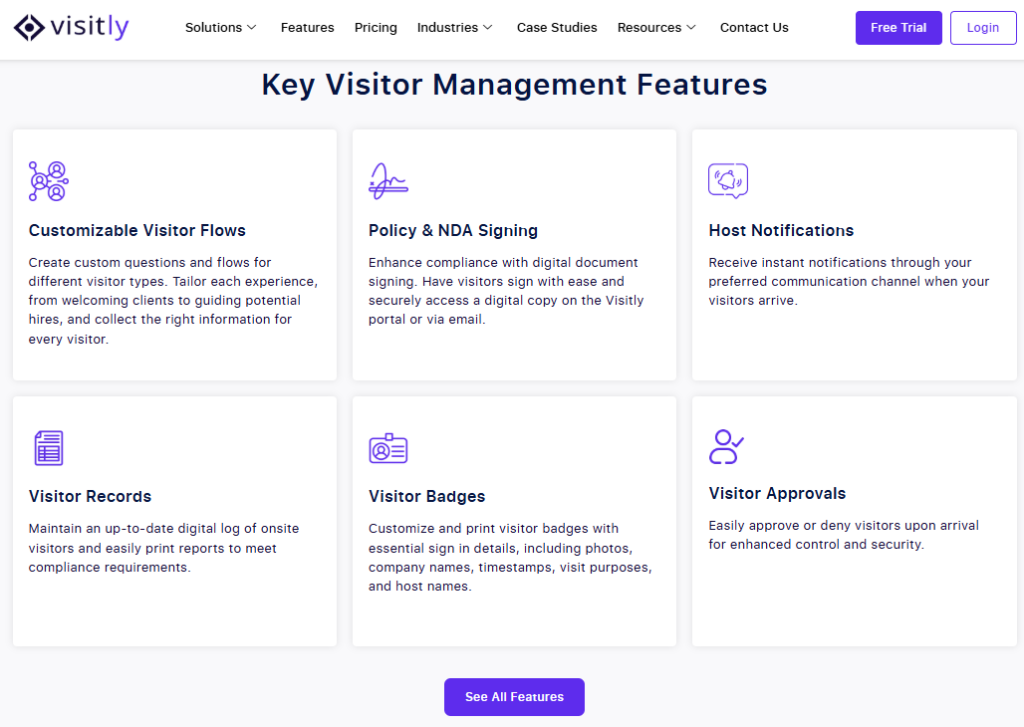
- Smart ID validation that extracts ID details and flags invalid or expired IDs at check-in.
- Offender check against the sex offender registry with real-time alerts.
- Orientation and safety videos at check-in are unusually useful for contractor-heavy or safety-sensitive sites.
- Contractor management workflows tied to workplace safety and compliance processes.
- Emergency evacuation support with real-time visitor data for fast action during incidents.
- Badge printing, real-time visitor tracking, and contactless/self-service check-in.
- Custom screening questions, bulk pre-registration, digital document signing, and real-time emergency notifications for hosts.
- Contactless, iPad-Based Visitor Management Kiosk: Fully customizable visitor management system iPad experience with QR check-in, self-service flows, and zero app dependency.
Strengths
- Stronger compliance + safety + contractor story than most VMS tools in this set.
- More specific ID validation and offender screening than the other vendors’ core product pages.
- Better fit for enterprises needing a single platform for visitor control, workplace safety, and contractor check-in. This is based on product capabilities highlighted on the official pages.
Pros
- Broad feature depth without shifting to separate point tools
- Good fit for regulated, safety-sensitive, and contractor-heavy environments
- Balances front-desk efficiency with operational control and audit readiness
Best Suited For
- Manufacturing
- Healthcare
- Education
- BFSI
- Enterprise offices
- High visitor and contractor volume environments
Why Visitly Stands Out as an Integrated Visitor Management System
- Unified platform vs point solutions (visitor + contractor + safety + delivery)
- Faster deployment using the visitor management system iPad setup
- Built-in compliance workflows (NDA, policy, audit logs)
- Real-time alerts, approvals, and visitor tracking
- No disruption to existing enterprise workflows

2. Envoy
Overview
Envoy’s Visitors product is built for companies that want visitor management tightly connected to the broader workplace stack.
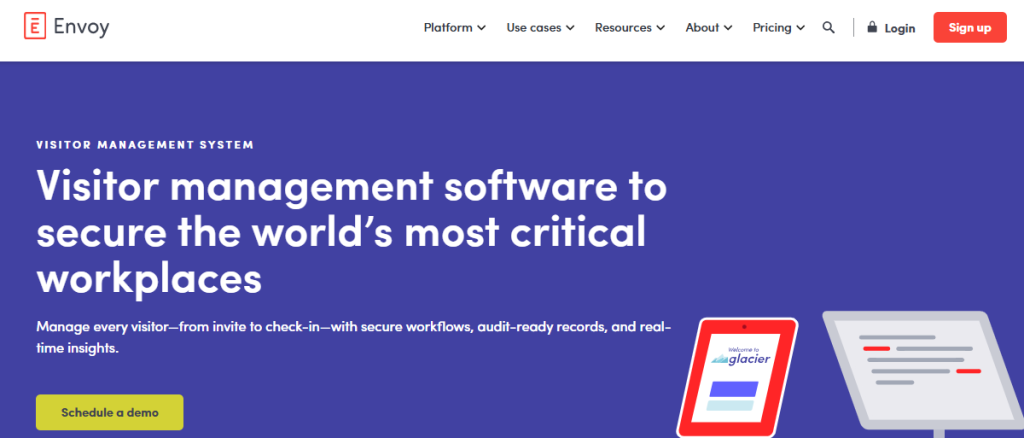
Envoy’s core value comes from customizable sign-in flows, identity verification, host notifications, badge creation, and integrations with access control and workplace tools such as Okta, Brivo, Lenel S2, email, and digital NDA workflows. Envoy excels in office environments where the visitor experience and employee workflow are crucial.
Key Features
- Customizable sign-in flows
- Host notifications
- Security integrations
- Identity verification
- Badge creation
- Access control and digital NDA integrations
Strengths
- Strong workplace ecosystem integrations
- Clean office visitor experience
- Good fit for collaboration-tool-heavy workplaces
Pros
- Mature integrations
- Familiar workplace positioning
- Strong for modern office environments
Best Suited For
- Technology companies
- Corporate offices
- Hybrid workplaces
3. SwipedOn
Overview
SwipedOn is positioned as an easy-to-implement visitor management system iPad solution for organizations that want fast setup and minimal training.
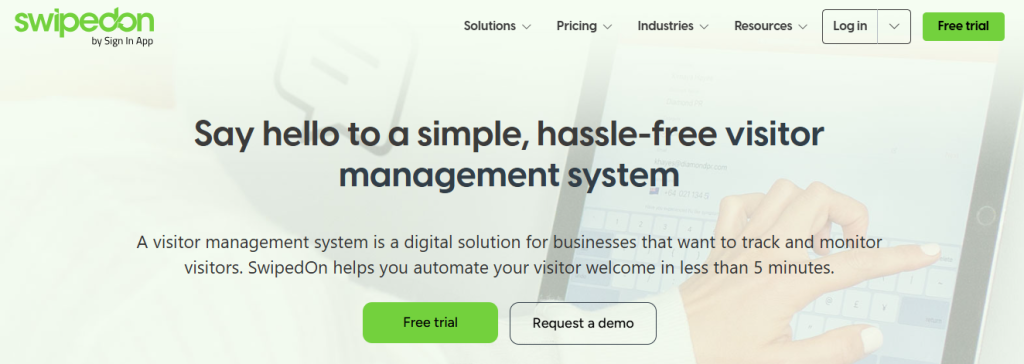
The core product covers visitor registration, badge printing, instant host notifications, real-time logs, digital agreements, evacuation management, and sign-in via phone, iPad, or tablet. Unlike solutions focused on advanced enterprise security features, its strengths are simplicity and rapid implementation.
Key Features
- Visitor registration
- iPad/tablet sign-in
- Badge printing
- Instant host notifications
- Real-time data and logs
- Digital agreements
- Evacuation management
Strengths
- Ease of setup
- Easy day-to-day use
- Clean fit for teams that want a simple rollout
Pros
- Fast onboarding
- User-friendly interface
- Lower operational complexity
Best Suited For
- SMBs
- Mid-market offices
- Enterprises with straightforward visitor workflows
4. FacilityOS
Overview
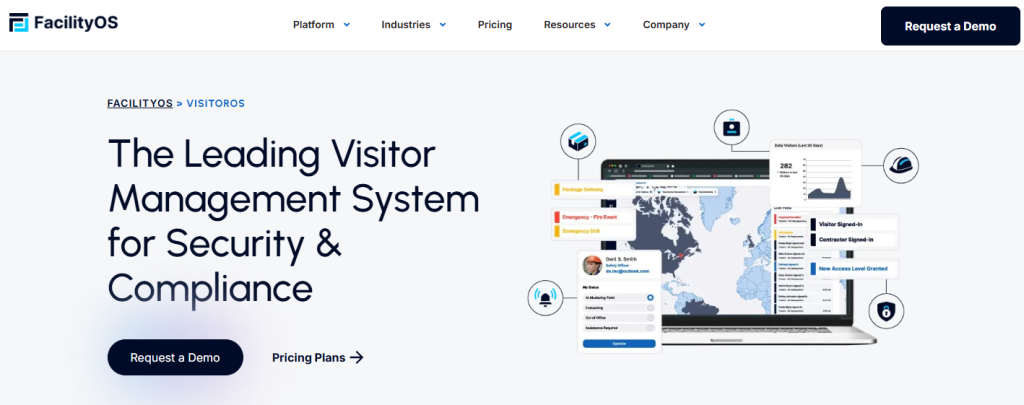
VisitorOS by FacilityOS is built for organizations that want stronger facility-level oversight and configurable visitor workflows.
FacilityOS includes visitor registration, repeat-visitor handling, photo capture, badge printing, notifications, approval controls, ID scanning, touchless sign-in, kiosks, analytics, watchlists, NDAs, legal documents, and pre-registration.
FacilityOS distinguishes itself through an operations-oriented design that emphasizes centralized oversight and compliance. It offers deeper facility management functions compared with SwipedOn and Envoy, including repeat visitor workflows, analytics, and strong process controls.
Key Features
- Visitor registration
- Repeat visitor workflows
- Analytics
- Watchlists
- NDAs and legal documents
- Advanced pre-registration
Strengths
- Strong facility visibility
- Good control over approvals and visitor workflows
- Good breadth of core VMS controls
Pros
- Solid enterprise workflow coverage
- Good for structured facility environments
- Strong visitor process controls
Best Suited For
- Large enterprises
- Multi-site facilities
- Security-conscious office and industrial environments
5. Acre Security
Overview
Acre Security is the strongest option here for organizations that want visitor management tightly integrated with physical access control and the broader security infrastructure.
Acre Security emphasizes automated check-ins, badge issuance, credential deactivation, real-time oversight across locations, and integration with access control to synchronize visitor movements and access rights.
Acre’s broader approach is unified security, with visitor management as part of a connected ecosystem that includes access control, intrusion detection, and identity workflows.
Key Features
- Automated check-ins
- Badge issuance
- Credential deactivation
- Access control integration
- Real-time visibility across locations
- Pre-registration
- Host notifications
- Digital check-in and check-out
Strengths
- Strongest physical security alignment in this set
- Best fit where visitor access must map closely to access control rules
- Built around a unified security architecture
Pros
- Strong for high-security use cases
- Good multi-site visibility
- Strong fit for integrated physical security programs
Best Suited For
- Defense
- Critical infrastructure
- Finance
- Government
- High-security enterprise facilities
Comparing the 5 Best Integrated VMS
| Platform | Key Features | Strengths | Best Suited For |
|---|---|---|---|
| Visitly | Contractor workflows · Safety and compliance sign-offs · Emergency evacuation support · Real-time alerts | Strong compliance and safety focus · Broader workflow coverage | Regulated enterprises · High visitor and contractor volume |
| Envoy | Custom sign-in flows · Workplace integrations · Badge printing · Visitor notifications | Strong workplace experience · Good integration ecosystem | Corporate offices · Hybrid workplaces |
| SwipedOn | iPad sign-in · Badge printing · Visitor logs · Evacuation management | Simple to deploy · Easy to use | SMBs · Simple multi-site setups |
| VisitorOS (FacilityOS) | Visitor approvals · Watchlists · Audit trails · Pre-registration | Strong process control · Good facility oversight | Large enterprises · Structured facility environments |
| Acre Security | Access control integration · Pre-registration · Watchlist screening · Real-time visibility | Strongest security alignment · Best for physical access control use cases | Defense · Government · High-security facilities |
What Are the Benefits of an Integrated Visitor Management System for Enterprises?
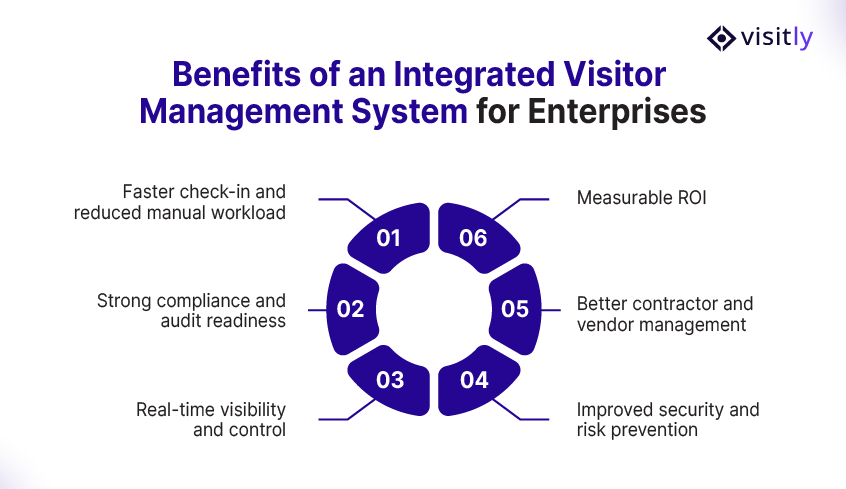
The benefits of an integrated visitor management system for enterprises are:
- Faster check-in and reduced manual workload
- Strong compliance and audit readiness
- Real-time visibility and control
- Improved security and risk prevention
- Better contractor and vendor management
- Measurable ROI
Before choosing any platform, it’s important to understand what value it actually delivers. An integrated visitor management system goes beyond basic check-ins; it connects workflows, improves visibility, and reduces risk.
Here are the key benefits enterprises see when they move from manual or disconnected systems to a fully integrated setup.
1. Faster check-in, less manual work
Automates registration, approvals, and notifications, reducing front-desk dependency and wait times.
2. Stronger compliance and audit readiness
Creates structured, timestamped logs with digital records, making audits easier to pass.
3. Real-time visibility and control
Know exactly who is on-site, at which location, and why.
4. Improved security and risk prevention
Enables screening, approvals, and alerts before access is granted.
5. Better contractor and vendor management
Tracks every visit, enforces policies per visit, and captures compliance acknowledgments.
6. Clear, measurable ROI
Saves time, reduces operational cost, and minimizes compliance risk.
How Does VMS Integration Improve Enterprise Security and Compliance?
VMS integration improves enterprise security and compliance in the following ways:
- Integration with access control systems
- Identity verification and screening
- Audit-ready logs and reporting
- Cross-location watchlist enforcement
- Compliance frameworks
This section explains how VMS integration strengthens enterprise security, improves workplace compliance, and ensures consistent, audit-ready visitor management across all locations.
1. Integration with access control systems
VMS integration connects visitor check-in directly with physical access control systems. This ensures that access is granted only after proper verification and approval. Instead of manual badge issuance, permissions can be automated based on visitor type, reducing human error and preventing unauthorized entry into restricted areas.
2. Identity verification and screening
An integrated system enables real-time identity checks using ID scanning, facial recognition, and watchlist screening. Visitors and contractors are verified before access is granted, helping organizations detect flagged individuals, prevent impersonation, and reduce security risks that manual processes often miss.
3. Audit-ready logs and reporting
Every visitor interaction is automatically recorded with timestamps, approvals, and digital signatures. These structured logs are easy to retrieve and export, making it simple to demonstrate compliance during audits. Unlike paper logs, integrated systems provide consistent, tamper-resistant records that auditors can trust.
4. Cross-location watchlist enforcement
With centralized VMS integration, watchlists and access rules are applied across all locations. If a visitor is flagged at one site, the system can automatically block or alert teams at other locations. This ensures consistent enforcement and prevents gaps that occur when sites operate independently.
5. Compliance frameworks
Integrated visitor management systems help organizations meet requirements across major compliance frameworks. They support identity verification, access control, and audit logging, key elements in standards like CMMC, SOC 2, HIPAA, and ISO 27001, making it easier to maintain visitor management compliance and reduce audit risk.
How Does Visitor Management Support ISO 27001 Compliance?
ISO 27001 treats visitor access as part of physical security. Annex A control 7.2, physical entry, expects secure areas to be protected by entry controls, and auditors check the visitor record to see that those controls ran: who came in, who let them in, and when they left.
What auditors look for in visitor records under Annex A 7.2:
- The visitor's identity, checked rather than self-declared
- Name, organization, and the time of entry and exit
- The host who approved the visit and was responsible for the visitor
- An escort in secure areas, unless the visitor is cleared to move alone
- A visible badge, so anyone can tell a visitor from staff
- A log kept securely and produced on request, for any date in the audit period
An integrated visitor management system produces that evidence as part of every check-in. Visitly checks the visitor's ID at the kiosk, notifies the named host, and prints a photo badge that shows the host, the areas the visitor may enter and an expiry time. The visit can require an escort. Every entry and exit is recorded with a timestamp in an audit log that cannot be edited, and the log can be searched and exported by date and by site when an auditor asks.
ISO 27001 also asks you to manage the security of your suppliers. Visitly holds ISO 27001 certification itself, and its Statement of Applicability is available under NDA.

How Are Visitor Management Systems Used in Hospitals and Regulated Industries?
Hospitals handle a constant flow of patients, visitors, vendors, and contractors. A visitor management system helps streamline check-ins while ensuring proper identification, badge issuance, and tracking. It reduces front-desk chaos and ensures that only authorized individuals enter specific areas like ICUs, labs, or restricted zones.
1. Handling PHI access (HIPAA)
In healthcare, protecting Protected Health Information (PHI) is critical. Visitor management systems enforce access control entry by verifying identity, restricting entry to sensitive areas, and maintaining detailed logs. This helps hospitals meet HIPAA requirements by ensuring that only authorized individuals can access patient-related environments.
2. Managing high-risk visitors and contractors
Regulated environments often deal with vendors, technicians, and third-party contractors. A visitor management system for hospitals screens, approves, and tracks these individuals during every visit. It also enforces compliance steps, such as NDA signing or safety acknowledgments, before access is granted.
3. Compliance-driven workflows
A hospital visitor management system creates structured workflows for approvals, documentation, and tracking. Every visit is recorded with timestamps, signatures, and purpose, making it easier to meet audit requirements. This ensures organizations can demonstrate compliance across frameworks like HIPAA, ISO 27001, and other industry regulations.
What Should Enterprises Look for When Choosing an Integrated Visitor Management System?
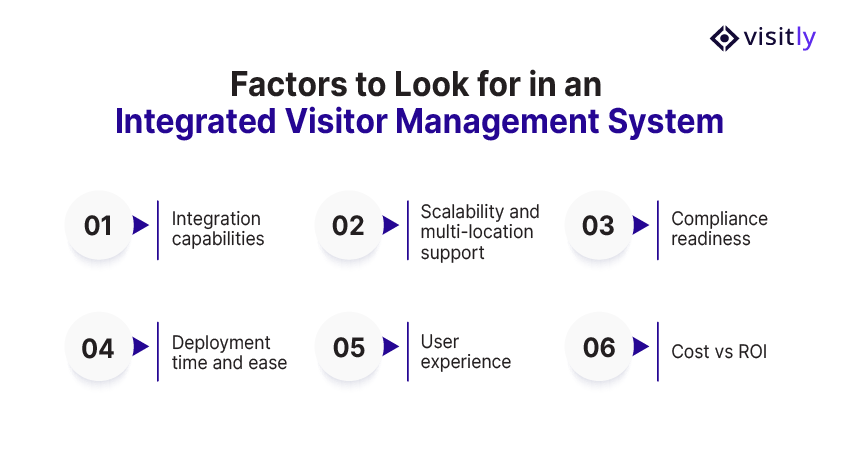
Enterprises look for these factors when choosing an integrated visitor management system:
- Integration capabilities
- Scalability and multi-location support
- Compliance readiness
- Deployment time and ease
- User experience
- Cost vs ROI
This section breaks down the key factors enterprises should evaluate to ensure their integrated visitor management system is scalable, secure, and future-ready.
1. Integration capabilities
The most critical factor is how well the system connects with your existing stack: access control, SSO, HR systems, and communication tools. A strong system should integrate seamlessly so you don’t have to change your workflows. Poor integration leads to fragmented data, manual work, and security gaps.
2. Scalability and multi-location support
Enterprise systems must operate across multiple locations while maintaining centralized control. You should be able to manage visitor policies, approvals, and logs from a single dashboard while still allowing location-level flexibility. This ensures consistency and visibility as your organization grows.
3. Compliance readiness
Look for systems that automatically generate audit-ready logs, enforce policies, and support frameworks like SOC 2, HIPAA, and ISO 27001. Compliance should not be an afterthought; it should be built into every workflow, from check-in to data retention.
4. Deployment time and ease
A successful system should be quick to deploy without heavy infrastructure changes. Cloud-based, iPad- or kiosk-driven setups are preferred as they reduce setup time and operational disruption. Complex deployments slow down adoption and increase costs.
5. User experience (visitor + admin)
The system should be simple for both visitors and internal teams. Features like self-service check-in, QR code check-in, and touchless workflows improve visitor experience. On the other hand, intuitive dashboards make it easier for admins to manage operations efficiently.
6. Cost vs ROI
Enterprises should evaluate not just pricing but the value delivered. A strong system reduces manual workload, improves security, and prevents compliance risks, leading to measurable savings in time, operational costs, and audit preparation. The right choice delivers long-term ROI, not just short-term cost savings.

Closing Thoughts
Most enterprises don’t struggle with a lack of tools—they struggle with disconnected ones. When visitor logs, access control, approvals, and compliance sit in separate systems, gaps are inevitable.
That’s where an integrated visitor management system changes the game. It brings security, compliance, and operations into a single, controlled workflow—so every entry is verified, every action is logged, and every location follows the same standard.
The real advantage isn’t just faster check-ins. It’s having complete visibility, consistent enforcement, and audit-ready proof without extra effort. That’s what reduces risk while improving efficiency at scale.
If you’re serious about closing security gaps and simplifying operations, Visitly offers the most complete integrated VMS built for modern enterprises.
See Visitly in action! Book a demo with Visitly and turn your front desk into a controlled, compliant entry point.
FAQs
What is an integrated visitor management system?
An integrated visitor management system is a visitor platform that shares data with the other systems a site depends on, such as access control, the identity provider, HR records and messaging. Check-in, screening, door access and the audit record then work as one process, and security teams do not reconcile separate logs after an incident.
Why do enterprises need visitor management system integration?
Because disconnected systems leave gaps between who was approved and who got through a door. With integration, the employee directory keeps host lists current, the access control system receives visitor approvals, and alerts reach security in the tools they already watch. Without it, staff re-enter data by hand and each site keeps its own version of the record.
How does an integrated visitor management system support ISO 27001 and SOC 2 compliance?
It keeps one time-stamped record of each visit across all sites: identity, approval, signed documents, entry and exit. Auditors ask for that record as physical access evidence under ISO 27001 and SOC 2. Visitly holds both certifications itself. The system supports your program, and your organization remains responsible for compliance.
Can visitor management systems handle contractors and vendors?
Yes. Most enterprise platforms give contractors their own check-in flow with approvals, safety or NDA documents and a record of time on site. Visitly checks contractors in through the kiosk or the MyVisitly app and shows a safety induction before entry. It does not track contractor certifications or insurance, so add a contractor compliance system if you need that.
Which systems should a visitor management system integrate with?
Prioritize four: your identity provider for single sign-on and directory sync, your access control system, your messaging platform for host alerts, and your emergency notification system. Visitly lists more than 60 integrations, including Okta, Microsoft Entra ID, Genetec, Brivo, LenelS2 Netbox, Slack, Microsoft Teams, AlertMedia and Everbridge, plus a REST API and webhooks for anything else.
Do integrations cost extra in a visitor management system?
Often, yes: many vendors place integrations in a higher plan or a separate module. FacilityOS lists access control under SecurityOS from $199 per month, separate from VisitorOS from $225 per month. Visitly includes Slack and Microsoft Teams as standard. Our team can show you how its access control and HR integrations work at your sites. Prices as of Q4 2026.