



Over 60% of enterprise security breaches originate at the front desk.
While organizations invest heavily in cybersecurity, manual sign-ins remain a major compliance risk point.
In multi-location enterprises, thousands of daily visitors: contractors, vendors, and guests, move through offices without real-time tracking, creating visitor management compliance and operational challenges.
A modern visitor management system goes beyond capturing names.
It transforms check-ins into a strategic layer of security and compliance, integrating with access control, HR, and reporting workflows. These systems provide real-time visitor tracking, enforce screening protocols, automate audit-ready logs, and enhance workplace safety, all while streamlining the visitor experience.
With tightening regulations and global operations, relying on outdated logs leaves enterprises exposed. The future of digital visitor management systems makes the front desk a controlled, intelligent, and compliant gateway, ensuring both security and efficiency for everyone entering your organization.
What is an Enterprise Visitor Management System and Why Does It Matter?
Defining the Enterprise Visitor Management System
An enterprise visitor management system is a comprehensive solution used by large organizations to manage all aspects of visitor access across offices, campuses, or facilities. Unlike traditional sign-in logs, it provides automated, centralized control over who enters the premises, when, and where.
Modern enterprise solutions automate check-ins, enforce security standards, and provide real-time visibility across locations, eliminating the need for manual logs or paper-based registers.
Key functionalities include access-control system integration, visitor-tracking software, touchless sign-ins, and role-based permissions. By replacing fragmented front-desk processes, organizations reduce bottlenecks, mitigate risks, and create a seamless experience for contractors, guests, and employee check-in.
The Role of Compliance in Visitor Management
Compliance is essential in enterprise visitor management.
An electronic visitor management system helps organizations adhere to regulatory requirements while maintaining workplace security policies. By integrating compliance into every step of the visitor workflow, enterprises can proactively manage risk and demonstrate accountability.
Key compliance benefits include:
- Regulatory Adherence: Meet standards such as SOC 2, GDPR, HIPAA, and other industry-specific requirements.
- Audit-Ready Logs: Automatically generate timestamped visitor records for inspections and audits.
- Real-Time Presence: See who is checked in, at which location and for which host. Door-level movement comes from the access control system.
- Risk Mitigation: Reduce liability by identifying and flagging unauthorized or high-risk visitors.
- Workplace Safety Enhancement: Ensure that all workplace safety checklists and access restrictions are consistently enforced.
How is the Visitor Management Process Evolving?
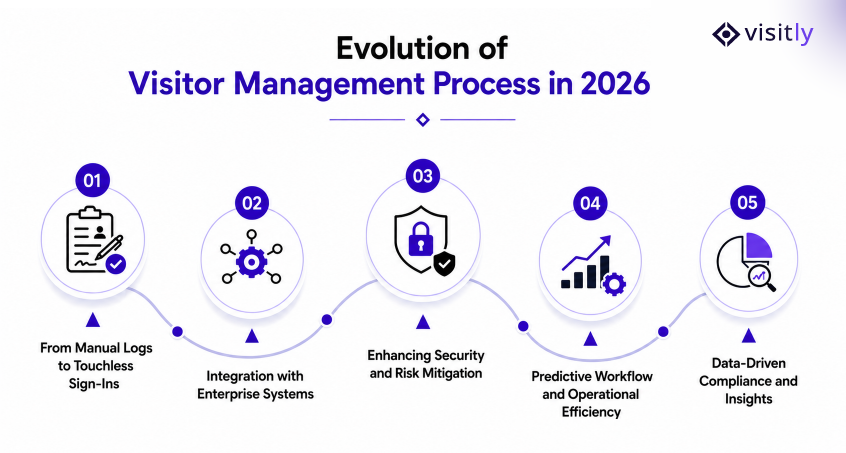
The visitor management process is evolving in 2026–2027 through the following ways:
1. From Manual Logs to Touchless Sign-Ins
2. Integration with Enterprise Systems
3. Enhancing Security and Risk Mitigation
4. Predictive Workflow and Operational Efficiency
5. Data-Driven Compliance and Insights
Enterprise visitor management is rapidly evolving to meet security, compliance, and operational demands, with organizations increasingly adopting intelligent, automated systems for improved efficiency and control across locations.
1. From Manual Logs to Touchless Sign-Ins
Modern systems replace paper-based logs with QR code check-in systems, visitor pre-registration, and facial recognition, allowing visitors to check in quickly and securely.
- Faster and more accurate check-ins
- Reduced wait times and front desk congestion
- Minimal human contact for safety and hygiene
- Automatic timestamping and record-keeping for audits
- Improved visitor experience through smooth, contactless workflows
2. Integration with Enterprise Systems
An office visitor management system now connects with HR, IT, and communication platforms such as Slack or Teams, providing centralized oversight for multi-site operations.
- Real-time emergency notifications to hosts and security teams
- Automated onboarding and offboarding workflows
- Centralized visitor database for all locations
- Simplified compliance reporting
- Reduced manual administrative tasks for front desk staff
3. Enhancing Security and Risk Mitigation
Real-time visitor screening, watchlists, and high-risk alerts reduce exposure to unauthorized or non-compliant visitors.
- Detects and blocks high-risk visitors instantly
- Strengthens workplace safety and incident response
- Supports audit and regulatory compliance
- Reduces potential liability for the organization
- Enables proactive monitoring of sensitive areas
4. Predictive Workflow and Operational Efficiency
AI-driven scheduling predicts visitor traffic and allocates resources proactively, reducing front desk bottlenecks.
- Optimizes staffing based on visitor volume
- Smooth visitor flow and reduced congestion
- Faster visitor check-in process for recurring visitors and contractors
- Improves host preparedness and response time
- Minimizes operational delays across locations
5. Data-Driven Compliance and Insights
Advanced analytics transform visitor logs into actionable intelligence for safety, compliance, and operational decision-making.
- Identifies patterns in visitor behavior
- Flags irregular activity for early intervention
- Generates audit-ready reports automatically
- Tracks compliance metrics across locations
- Supports executive-level reporting and strategic decisions

What are the Features of a Future-Ready Enterprise Visitor Management System like Visitly?
The features of a future-ready enterprise visitor management system are:
- Security & Compliance Features
- Operational Efficiency
- Data-Driven Insights
- Technology Trends
- Personalized Visitor Experiences
- Emergency & Safety Automation
- Integration & Scalability
As enterprises expand across multiple locations and face evolving regulatory requirements, the right and best visitor management system must combine real-time visibility, automated workflows, and intelligent risk management.
Understanding these enterprise visitor management features is critical for organizations looking to enhance workplace safety, reduce operational bottlenecks, and ensure audit-ready compliance.
Among the available solutions, Visitly stands out as the premier future-ready enterprise visitor management system.
It integrates security, compliance, and operational intelligence into a single platform. Hence, it enables enterprises to efficiently manage thousands of visitors while maintaining the highest standards of safety and regulatory compliance.
Below, we explore the key capabilities that make Visitly the benchmark for modern visitor management.
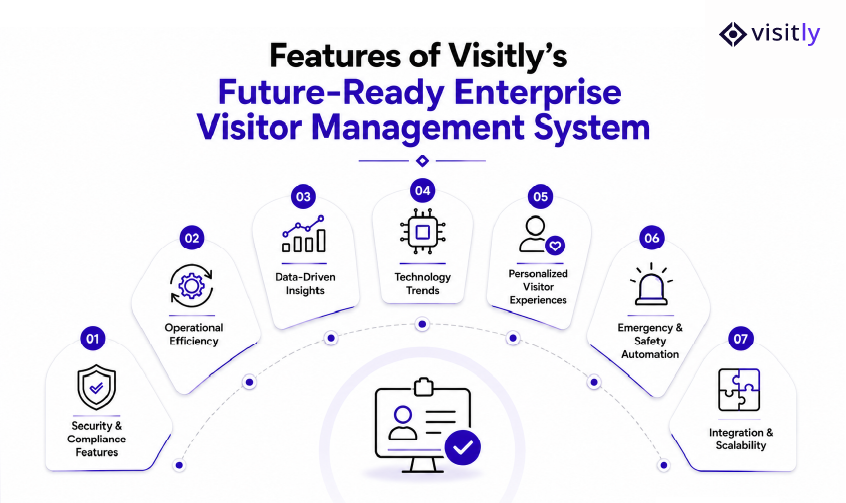
1. Security & Compliance Features
Visitly supports enterprises in meeting strict regulatory standards with audit-ready logs, real-time visitor screening, and automated compliance reports. Every interaction is tracked and timestamped, reducing risk and improving workplace safety across multiple sites.
2. Operational Efficiency
With Visitly, enterprises handle bulk pre-registration, recurring visitor scheduling, and fast check-ins seamlessly. These capabilities minimize front desk bottlenecks and save time for both visitors and staff, even in high-volume environments.
3. Data-Driven Insights
Visitly’s analytics dashboards provide real-time visibility into visitor flow, risk events, and multi-location activity. Decision-makers can monitor trends, identify compliance gaps, and optimize operations efficiently.
4. Technology Trends
AI-powered features in Visitly include AI visitor threat detection, predictive alerts, and multilingual support, enabling proactive risk management and smoother visitor experiences.
5. Personalized Visitor Experiences
Visitly tailors experiences for different visitor types: guests, contractors, vendors, and VIPs, with custom check-in flows, automated notifications, and mobile-first, touchless onboarding.
6. Emergency & Safety Automation
During emergency management situations, Visitly shows which visitors and staff are on site in real time, triggers geo-aware alerts, and stops new check-ins at the kiosk once an evacuation is started in Visitly. It does not connect to fire alarm systems automatically.
7. Integration & Scalability
Visitly integrates with HR, IT, access control entry systems, and communication platforms, offering a centralized dashboard for multi-location enterprises. Its scalable architecture supports high visitor volumes while maintaining visitor management system security, compliance, and operational efficiency.
Industry-Specific Applications
This section shows how Visitly adapts to different industries, highlighting tailored visitor management solutions for hospitals, offices, and industrial sites that ensure security, compliance, workplace safety, and operational efficiency.
1. Offices and Corporate Campuses
Visitly serves as a comprehensive visitor management system for office environments, enabling multi-site coordination by centralizing visitor data across corporate locations.
It simplifies compliance reporting with audit-ready logs, provides real-time visibility into who is on-site, and keeps security consistent alongside your physical access control system. Enterprises can streamline check-ins for employees, contractors, and guests while maintaining a smooth front-desk experience.
2. Hospitals and Healthcare Facilities
In healthcare facilities, Visitly serves as a robust touchless visitor management system, supporting your HIPAA program and integrating with the access control system for restricted areas.
It safeguards patient and vendor interactions through screening workflows, emergency protocols, and real-time alerts. Automated documentation and visitors’ log monitoring system reduces administrative overhead while enhancing workplace safety in critical healthcare settings.
3. Manufacturing and Industrial Sites
Visitly helps manufacturing plants and industrial sites manage contractor and vendor access in compliance with strict protocols.
Its emergency and evacuation tracking ensures safety during incidents, while real-time monitoring and role-based permissions maintain operational control. The visitor management system for the factory supports complex industrial workflows, enhancing both workplace safety and operational efficiency.
What are the Common Pain Points in Enterprise Visitor Management?
The common pain points in enterprise visitor management are:
- Fragmented or manual processes causing delays
- Lack of real-time visibility across sites
- Security risks and compliance gaps
- Limited integration with existing systems
- Inefficient onboarding/offboarding workflows
Enterprises face several critical challenges when relying on outdated or fragmented visitor management systems:
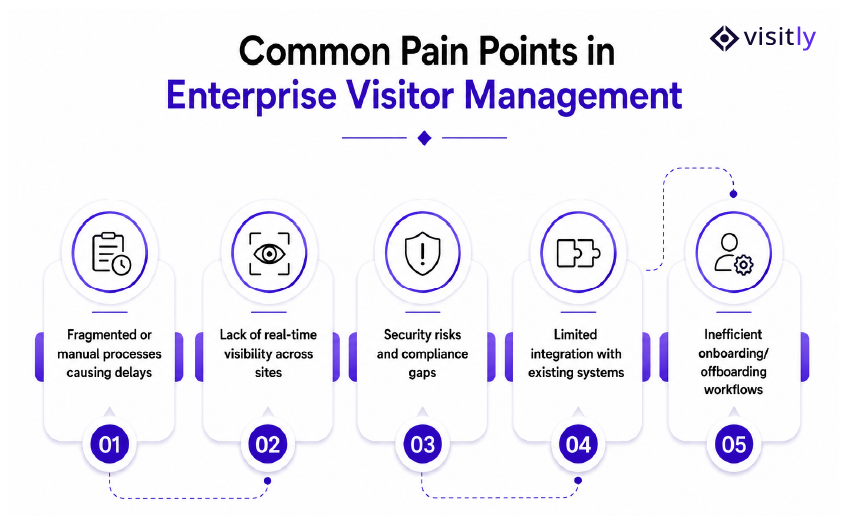
- Manual and Fragmented Processes: Paper logs and disconnected tools cause check-in delays and inconsistent tracking across sites.
- Limited Real-Time Visibility: Security teams cannot see who is on site in real time, increasing the risk of unauthorized access.
- Compliance Gaps: Lack of automated audit trails and regulatory reporting exposes organizations to fines and legal liability.
- Integration Challenges: Systems that don’t connect with HR, access control, or communication platforms create inefficiencies.
- Inefficient Onboarding/Offboarding: Contractors and vendors face redundant steps, while hosts spend unnecessary time managing approvals.
Two checks to make before you choose a system
- Audit your integrations. List the access control, identity and HR systems each site runs. Ask every vendor which of them it connects to as a standard integration and which need custom work, because custom work has to be maintained every year.
- Compare subscription and on-premises cost over the same period. A cloud subscription includes hosting, updates and maintenance. An on-premises system adds servers, upgrades and the staff time to run them at every location.
Then check which plan includes the controls your security and compliance teams must prove. Single sign-on, watchlist screening, audit log export and access control integration are often sold as upgrades.
What are the Future Trends in Enterprise Visitor Management?
The Future trends in enterprise visitor management are:
- AI-driven visitor threat detection
- Predictive analytics for high-risk scenarios
- Smart dashboards for executives and security teams
- Multi-language, globally scalable solutions
- Touchless, mobile-first visitor experiences
- Integration with IoT & smart building systems
The landscape of enterprise visitor management is evolving rapidly, driven by technological advances, compliance requirements, and the need for operational efficiency. Forward-looking organizations are adopting platforms that go beyond simple check-ins to deliver intelligence, automation, and predictive capabilities.
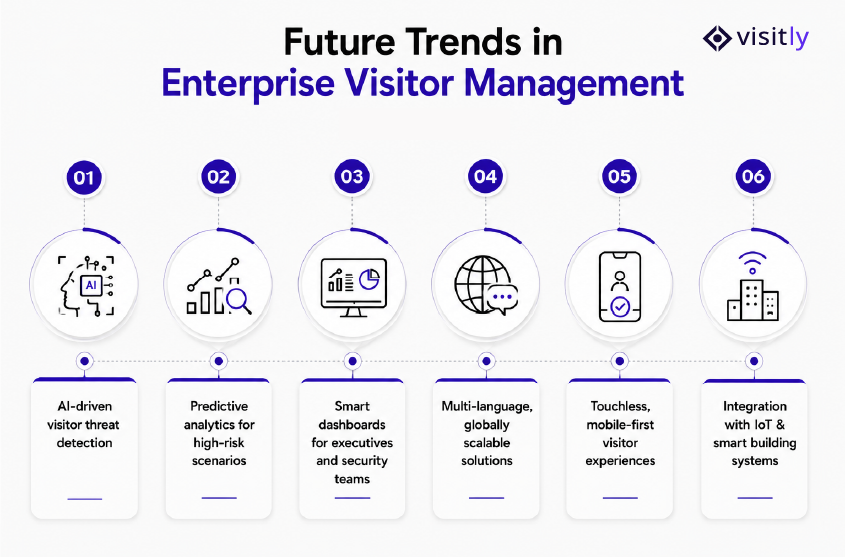
- AI-Driven Visitor Threat Detection
Advanced systems analyze visitor behavior in real time, identifying unusual patterns, repeated access attempts, or high-risk profiles. By integrating AI, enterprises can proactively prevent security incidents rather than react to breaches.
- Predictive Analytics for High-Risk Scenarios
Historical visitor data is used to forecast potential security management systems and operational risks. Enterprises can anticipate peak visitor traffic, high-risk visits, or compliance bottlenecks. It thereby enables data-driven decision-making for staffing, resource allocation, and emergency planning.
- Smart Dashboards for Executives and Security Teams
Centralized dashboards deliver actionable insights by consolidating multi-site visitor data, risk alerts, and compliance metrics. This visibility allows executives and security teams to monitor performance, optimize workflows, and respond quickly to incidents.
- Multi-Language, Globally Scalable Solutions
As enterprises expand globally, an integrated visitor management system must support diverse languages, time zones, and local regulations. Platforms like Visitly enable consistent policies and seamless experiences across international offices. Visitly check-in supports more than 150 languages.
- Touchless, Mobile-First Visitor Experiences
Contactless check-ins, QR codes, and a mobile visitor sign-in app and onboarding enhance both visitor convenience and workplace safety. This reduces bottlenecks at entry points while minimizing physical contact.
- Integration with IoT & Smart Building Systems
Modern visitor management software uses the best integration policies with building automation, access control, and environmental sensors. This enables automated alerts, energy efficiency, and enhanced security, creating a holistic, intelligent infrastructure for enterprise operations.

Where AI needs care: accuracy, consent and a human decision
Several of these trends depend on AI, and some vendor claims run ahead of the evidence. Settle three points before you rely on it.
- Accuracy across people: independent testing has found some facial recognition systems less accurate for some demographic groups. Ask the vendor for test results and measure the match rate in your own lobby.
- Consent and an alternative: a face image used to identify a person is biometric data. Give visitors notice, get consent where the law requires it, and keep a check-in path for those who decline.
- A human decision: a match or an alert should go to a person who can check it and clear a false one. Treat claims about predicting threats from visitor behavior with care, and ask the vendor to show the feature working.
Rules for biometric data differ by state and country, so have counsel confirm what applies at each location.
Closing Thoughts
Enterprise visitor management has evolved from simple front-desk check-ins to a compliance-centric, intelligence-driven system. Modern platforms provide real-time visibility, automated screening, and audit-ready logs, addressing security risks, operational bottlenecks, and regulatory requirements across multi-location enterprises.
Advanced features like AI-driven threat detection, predictive analytics, touchless onboarding, and integration with HR, access control, and smart building systems empower organizations to manage visitors efficiently while ensuring workplace safety and compliance.
Industry-specific applications, whether in offices, hospitals, or manufacturing sites, underscore the need for tailored solutions that seamlessly handle complex workflows, contractor management, and emergency protocols.
For enterprises seeking a future-ready, scalable, and intelligent visitor management system, Visitly stands out as the leading solution. Visitly combines security, compliance, and operational efficiency into a single platform.
Explore Visitly today to transform your front desk into a strategic hub for security and compliance. Book a demo with Visitly today and gain insights into enterprise VMS.
FAQs
What trends are shaping enterprise visitor management?
The main trends are touchless check-in, tighter links to access control and identity systems, automated screening at the door, and visit records built for audit. Together they move visitor management from a front desk task to a security and compliance control. For multi-location companies the practical change is one policy and one record set across every site.
What is an enterprise visitor management system?
An enterprise visitor management system is a platform that registers, screens and records every visitor across all of a company's locations from one account. It replaces paper logs with pre-registration, kiosk or QR check-in, host notification and badge printing. What makes it enterprise is central policy control, single sign-on, integrations and an audit trail.
Can visitor management systems integrate with access control?
Yes, enterprise visitor management systems connect to access control so a visitor's credential follows the approval given at check-in. In most deployments that means temporary access limited to approved areas, which ends with the visit. Visitly integrates with Genetec Security Center, Brivo, LenelS2 Netbox, Kisi and C CURE 9000. Tell our team which of these you run and we'll put the pricing together with you.
How do visitor management systems support compliance and audits?
They support compliance by producing a timestamped record of each visit: who came, who hosted them, what they signed and when they left. Auditors for SOC 2, ISO 27001 or HIPAA reviews ask for that evidence. The system supplies the records, and your compliance lead still owns the program and decides what each framework requires.
How is AI used in visitor management?
AI in visitor management is used today mostly for identity checks, such as recognizing a returning visitor's face or testing a government ID for forgery and expiry. Visitly offers facial recognition that recognizes returning visitors and matches faces against your watchlist, plus Smart ID validation with liveness and forgery detection. Treat claims about predicting threats from visitor behavior with care, and ask the vendor to show the feature working.
How should a multi-location company choose a visitor management system?
Start from the controls your security and compliance teams must prove, then check which plan includes them. Single sign-on, watchlist screening, audit log export and access control integration are often sold as upgrades. Envoy lists SAML single sign-on on Premium at $362 per location per month billed annually. Visitly includes single sign-on as standard, from $1,000 per location per year. Prices as of Q4 2026.